Mergers, equity stakes, financially pressured airlines and private investors are changing the structure of European aviation. Long fragmented, the market is moving towards a model in which a smaller number of groups could control a large share of capacity, hubs and long-haul flows. But can Europe really follow the consolidation seen in the United States?
The shift is no longer theoretical. Lufthansa Group is consolidating its control of ITA Airways. Air France-KLM wants a majority stake in SAS. Lufthansa and Air France-KLM are competing for TAP Air Portugal. easyJet has accepted a recommended offer backed by Apollo. Meanwhile, carriers such as airBaltic and Norse Atlantic remain financially vulnerable.
Why European consolidation is accelerating now
European aviation developed around national airlines, many historically state-owned. Liberalisation in the 1990s removed barriers but did not immediately create a handful of continental groups. Instead it also enabled Ryanair, easyJet and later Wizz Air to build huge point-to-point networks, forcing legacy airlines to cut costs while preventing them from controlling the market alone.
Europe therefore remains more fragmented than the United States, where major mergers between 2008 and 2013 concentrated much of the market among a few large carriers.
Delta absorbed Northwest, United merged with Continental and American with US Airways, while Southwest had already built a powerful low-cost position. Ryanair chief Michael O’Leary has long predicted a similar direction for Europe, although governments and competition authorities have slowed the process.
Lufthansa, Air France-KLM and IAG represent three consolidation models
Lufthansa Group already resembles a federation of national airlines: Lufthansa, SWISS, Austrian, Brussels Airlines and Eurowings, joined by ITA Airways in Italy.
The group acquired 41% of ITA in 2025 and exercised an option in June 2026 to increase its stake to 90%, subject to regulatory approvals. Rome-Fiumicino would then sit alongside Frankfurt, Munich, Zurich, Vienna and Brussels in a formidable multi-hub architecture.
Paris-CDG and Amsterdam-Schiphol remain its historic pillars, but Air France-KLM acquired 19.9% of SAS and announced plans to increase that holding to 60.5%, subject to approvals. Control of SAS would add a strong Scandinavian pillar centred on Copenhagen.
The group is also pursuing TAP, with a binding offer for a stake of up to 49.9%. Lisbon is strategically important for Brazil, Latin America and Africa. If both projects succeeded, Air France-KLM would become far more than a Franco-Dutch system.
TAP, easyJet, airBaltic and Norse are the next sensitive dossiers
Portugal asked Lufthansa and Air France-KLM in early September to improve their offers for TAP. The carrier controls assets that are difficult to recreate: Lisbon slots, a strong Brazilian network, links to Portuguese-speaking Africa and favourable geography for Europe-Americas traffic.
International Airlines Group already combines British Airways, Iberia, Aer Lingus, Vueling and LEVEL. Heathrow and Madrid provide powerful positions on the North Atlantic and towards Latin America. IAG’s abandoned Air Europa transaction also illustrates the regulatory limits to further consolidation when competition authorities see excessive overlap.
In August 2026, easyJet’s board recommended a cash offer from Eagle Bidco, backed by Apollo. The transaction still required shareholder approval and the UK court process, with completion envisaged by the end of the first quarter of 2027.
This would not place easyJet inside Lufthansa, IAG or Air France-KLM. It instead shows that consolidation can also come through investment funds seeking control of carriers with valuable brands, fleets and airport slots.
Ryanair is different. It has expanded without a global alliance or traditional hub network, using fleet scale, low unit costs and rapid base openings. Any future European structure therefore has to account for a large independent low-cost group, as well as easyJet and potentially Wizz Air.
Large groups benefit from broader financing access, loyalty programmes, protected hubs and fleets that can be redeployed. Smaller independents have fewer buffers. In September 2026, airBaltic was seeking creditor support for a structure allowing up to €257 million in new senior debt amid engine problems, geopolitical disruption and fuel costs. Norse Atlantic illustrates the difficulty of competing in long-haul markets against groups with joint ventures, connecting networks and large loyalty programmes.
Scale, hubs and slots are becoming decisive
Fleet renewal and environmental transition require major investment. Airport capacity constraints make slots more valuable. IT, cybersecurity and distribution costs are rising, while geopolitical shocks demand operational flexibility. Scale spreads those costs and strengthens negotiating power with manufacturers, engine makers, airports and suppliers.
When a group acquires an airline, it is also securing positions that can be almost impossible to recreate: Heathrow for IAG; Frankfurt and Munich for Lufthansa; Paris-CDG and Amsterdam for Air France-KLM; Lisbon for TAP; Rome for ITA; Copenhagen for SAS. Network value can therefore matter as much as short-term profitability.
Regulation, competition and fares: how far will Brussels allow consolidation?
The EU faces a trade-off. Competition policy seeks to prevent excessive market power and protect consumers, while European airlines argue that greater scale is needed to compete with US, Gulf and Asian groups. Slot divestitures, route remedies and limits on agreements are among the tools used to balance those goals.
The US comparison fuels concern that fewer competitors can weaken price pressure. Europe differs because low-cost carriers are exceptionally strong and rail or road alternatives exist on some routes. Consolidation therefore does not automatically imply a general increase in fares, but it could reduce competition on particular hub-to-hub markets.
The likeliest outcome: a handful of major European groups
Europe is unlikely to copy the US exactly. National brands remain politically important and international traffic rights can depend on ownership structures. A more plausible outcome is a handful of groups retaining multiple airline identities: Lufthansa Group across central Europe and Italy; Air France-KLM extending north and perhaps towards Portugal; IAG around London and Madrid; Ryanair as a pan-European low-cost giant; an autonomous easyJet under financial ownership; and potentially Wizz Air as another independent pole.
Lufthansa moving towards 90% of ITA, Air France-KLM seeking control of SAS, both groups competing for TAP, and easyJet under an Apollo-backed offer make 2026 unusually significant. Europe has not become the US market, but the strategic question is increasingly shifting from which airlines survive to which groups and hubs become the continent’s centres of gravity.
Main sources
Reuters Breakingviews, September 8, 2026; Reuters on TAP privatisation, September 4, 2026; Lufthansa Group shareholder information on ITA and TAP; Air France-KLM announcements on TAP and SAS; easyJet documentation on the Apollo offer; Reuters on airBaltic financing, September 10, 2026.
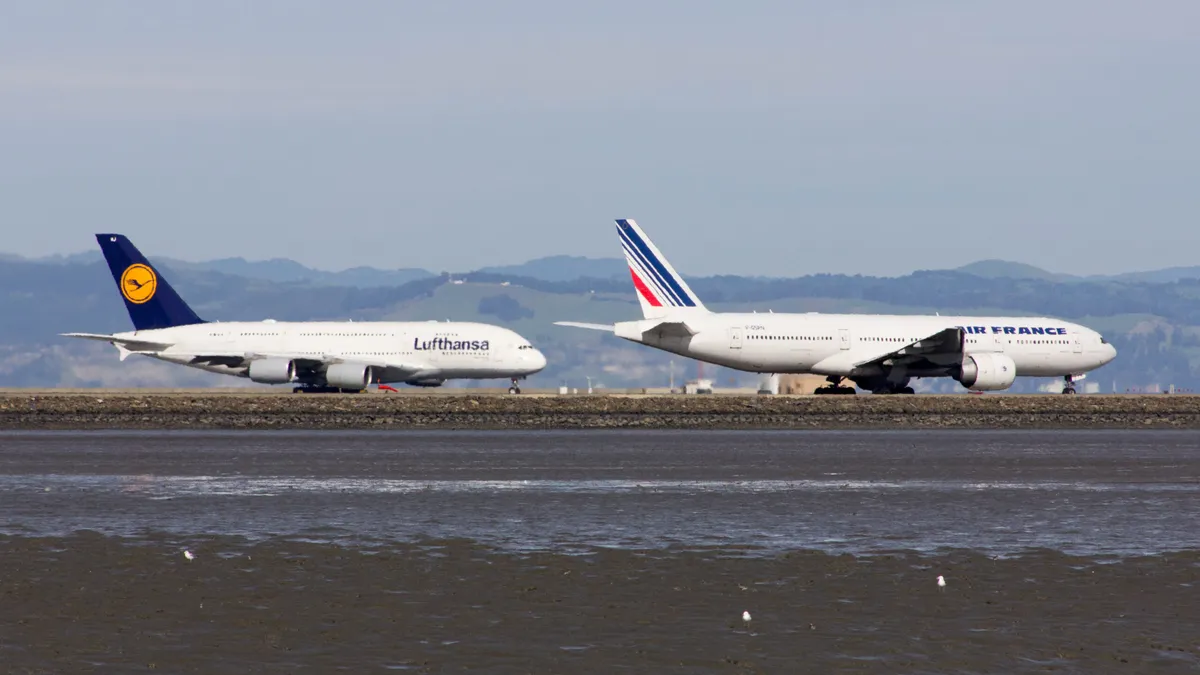
Illustration: Air France Boeing 777 and Lufthansa Airbus A380. Photo: Kohei Kanno / Wikimedia Commons, CC BY 2.0.
Related: easyJet, SAS, ITA and TAP: Europe’s airline consolidation, for the transactions already reshaping the market.
Leave a Reply