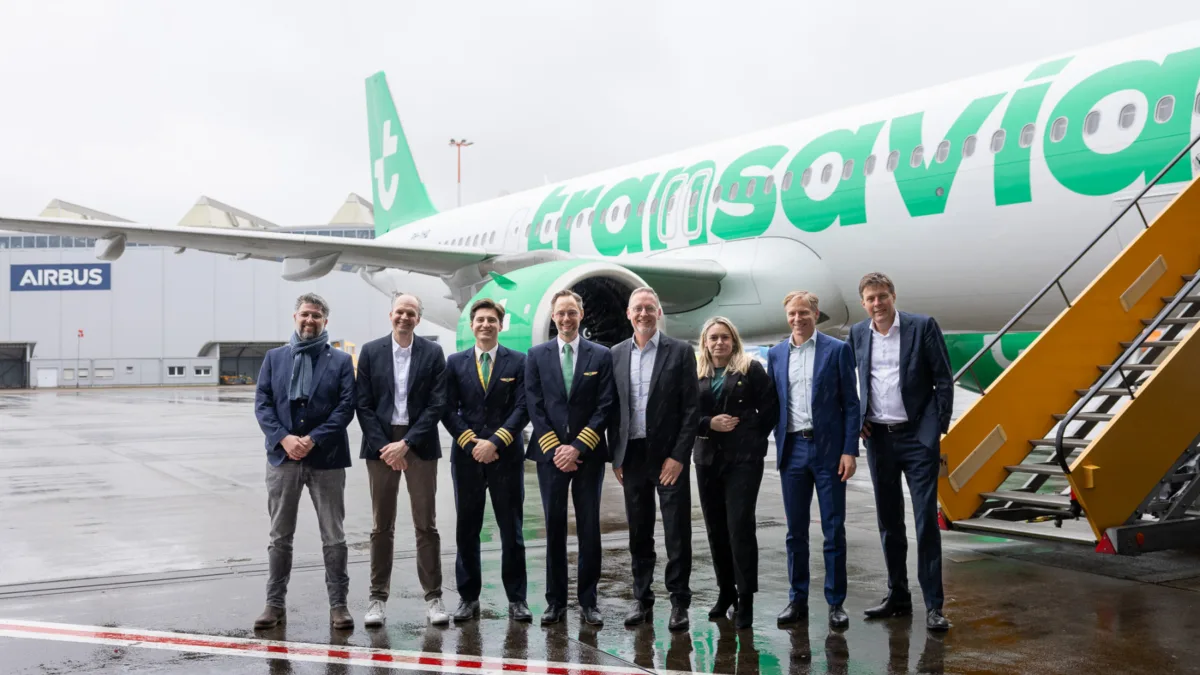
Transavia France will add the Airbus A321neo to its fleet from the end of the first quarter of 2027, with five aircraft expected for the summer peak. The significance goes well beyond a new aircraft type. At 232 seats, the A321neo gives Air France-KLM’s French low-cost arm a way to grow capacity where adding more flights is difficult because of slots, traffic rights or airport constraints.
That makes the aircraft particularly relevant at Paris-Orly, where Transavia has become the group’s reference operator. The A321neo also arrives in the middle of a much larger fleet transition from Boeing 737-800s to the Airbus A320neo family.
Five A321neos for summer 2027
Transavia France says the first A321neo will arrive from March 2027 and that five will be available for the summer peak. The airline says the type offers almost 25% more seats than its A320neo and around a 10% lower unit cost.
That is the core of the business case. A larger aircraft allows Transavia to add seats without adding a movement. On a constrained airport such as Orly, the value of each slot makes that particularly important.
Transavia also points to the environmental performance of the A320neo family, including roughly 15% lower fuel burn and CO₂ emissions compared with the older-generation aircraft being replaced and a noise footprint reduced by as much as 50%.
In September 2026, Transavia France reported a fleet of 98 aircraft: 31 A320neos and 67 Boeing 737-800s. The airline therefore remains majority-Boeing for now, even as Airbus aircraft are arriving at a rapid pace.
The A321neo adds a second capacity tier. The A320neo can remain better suited to markets where frequency and flexibility matter, while the A321neo gives Transavia a denser option where demand supports more seats on the same slot.
That distinction can already be seen on the domestic network. From December 2026, Paris-Orly–Nice and Paris-Orly–Toulouse are due to be operated entirely with A320neos, with Toulouse rising to nine weekday flights. A bigger aircraft is not automatically the right answer on every route.
Orly is the obvious proving ground
Transavia explicitly says the A321neo will help it grow in markets where airports are constrained by slots and/or traffic rights. That wording matters because it points directly to the value of capacity per movement.
Paris-Orly is the clearest example. Transavia now occupies a central place in Air France-KLM’s Paris strategy, and a 232-seat aircraft can increase capacity without requiring an additional slot.
The airline has not yet published a route-by-route list for its French A321neos. Any suggestion that Marrakech, Tunis, Djerba or another destination has already been assigned the type would therefore be premature.
Morocco is one of Transavia France’s largest markets. The airline says it carried more than 1.7 million passengers between France and Morocco in 2026, up 21%, and describes Morocco as its second-largest market by passenger numbers. Paris-Orly–Marrakech reached a 97% load factor during the summer peak, while Orly–Agadir and Orly–Oujda were also among its strongest-selling routes. Winter 2026-27 capacity exceeds 610,000 seats, with as many as 160 weekly flights across 25 routes and additional capacity from Orly to Casablanca and Rabat.
Tunisia has a similar profile. Transavia reports more than 1.2 million passengers between France and Tunisia in 2026, while Orly–Tunis, Orly–Djerba and Orly–Monastir are among its highest-volume markets. Winter 2026-27 capacity is set to exceed 410,000 seats and 117 weekly flights.
Dense leisure and visiting-friends-and-relatives demand, strong seasonal peaks and, on some non-EU markets, bilateral traffic-right constraints all make North Africa a natural area to watch. That is an operational inference, not a confirmed route plan.
Transavia France has already opened part of its summer 2027 programme, covering around one hundred destinations from Paris-Orly, Nantes, Lyon, Marseille, Montpellier, Nice and Toulouse. The full programme and new routes are due to be announced separately. Southern Europe and the Mediterranean, Spain, Portugal, Italy, Greece and the Balkans, can also generate the kind of peak-season demand that supports 232 seats.
But aircraft assignment will still depend on load factors, yields, frequency needs, airport performance and the limited availability of the first five jets.
The Dutch sister airline is already providing the playbook
Transavia Netherlands has operated the A321neo commercially since January 2024. Its first passenger day included Pisa, Ljubljana and Bari, giving the group direct experience of the aircraft on classic European leisure markets.
The Dutch fleet now includes 18 A321neos and 34 Boeing 737-800s. The A321neo carries 232 passengers versus 189 on the 737-800 it replaces, adding 43 seats per flight. Deployment has expanded beyond Schiphol to Rotterdam, with Eindhoven due to follow in summer 2027. The Dutch carrier plans to complete its Airbus transition by 2031.
For Transavia France, that experience reduces the novelty of the change. The brand already has operational knowledge of the cabin, LEAP-1A engines, training, procedures and the economics of a 232-seat layout.
The A321neo programme is part of a wider Air France-KLM fleet strategy. In December 2021, the group ordered 100 A320neo-family aircraft and secured purchase rights for 60 more, covering KLM, Transavia Netherlands and Transavia France. In 2022, it followed with an agreement for 200 CFM LEAP-1A engines. Air France-KLM is aiming for new-generation aircraft to make up a very large majority of its fleet by 2030.
The group has also set a long-term goal of shifting the majority of its fleet toward new-generation aircraft. The five French A321neos planned for 2027 are therefore the first visible step in a much larger programme rather than a stand-alone purchase.
Probably, but the pace will depend on deliveries. With 67 737-800s still reported in September 2026, Transavia France remains heavily dependent on Boeing. The A321neo strengthens the logic of an Airbus-centred future, but the French fleet is larger and its replacement calendar need not mirror the Dutch one.
The strategic question is no longer whether the 737-800 will eventually be replaced. It is how quickly A320neo and A321neo deliveries can do so without constraining growth.
More seats do not automatically mean more profit
The 232-seat A321neo is attractive when demand can fill it, but a lower cost per seat does not mean every flight becomes cheaper in absolute terms. Oversizing an aircraft in the shoulder season can weaken yields and increase risk.
That is why the A320neo/A321neo combination matters. The airline gains a choice between frequency and density instead of applying one aircraft size to every market.
The A321neo will also change the passenger experience. Transavia highlights the newer cabin environment already associated with the A320neo family, including modernised seats, USB power and larger overhead bins.
But the 232-seat configuration is still designed around low-cost economics. The product should feel newer, not necessarily more spacious. The key distinction is between fleet modernisation and a traditional move upmarket: for Transavia, the A321neo is primarily about carrying more passengers efficiently while keeping the cost per seat low.
2027 will reveal the real strategy
Five aircraft will not transform a fleet of almost one hundred overnight. Yet they can materially change capacity on a small number of dense routes. The first summer will therefore show whether Transavia uses the A321neo primarily as an Orly slot-maximiser, a North Africa capacity tool, a Mediterranean peak-season aircraft, or a mix of all three.
The full summer 2027 schedule will provide the next important clue. For now, the direction is already clear: Transavia France is not simply replacing Boeing aircraft. It is building the ability to grow seats faster than flight movements.
Related: Transavia France: the low-cost airline taking over at Orly.
Sources
Transavia France, A321neo introduction
Transavia Netherlands, fleet
Transavia Netherlands, first A321neo commercial flight
Air France-KLM, A320neo-family order
Leave a Reply