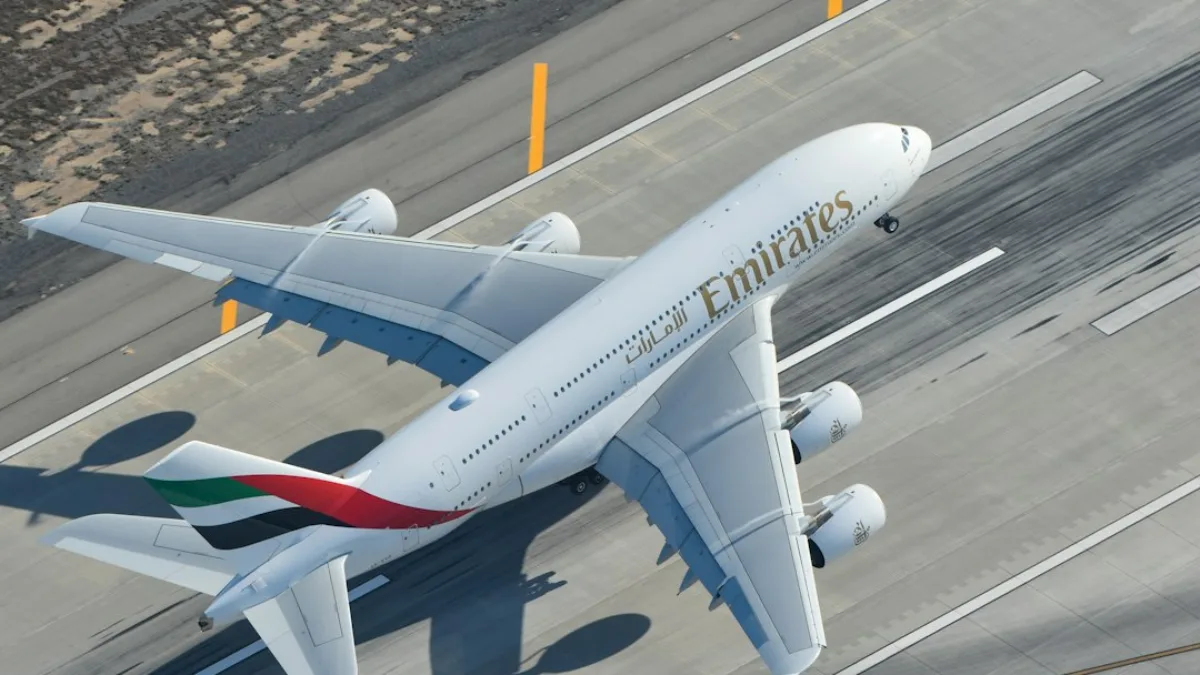
Germany has granted Emirates additional traffic rights allowing the airline to serve Berlin Brandenburg Airport with up to one daily flight from Dubai — a breakthrough the carrier had sought for more than two decades. Berlin authorities confirmed the change on September 10, 2026. Until now, Emirates’ German network was limited to Frankfurt, Munich, Düsseldorf and Hamburg.
A request dating back to 2004
Emirates has pushed for access to Berlin and Stuttgart since 2004, arguing that two of Germany’s major city regions were under-served by long-haul Gulf connectivity.
In June 2026, the airline said it was ready to launch daily services to both cities once approvals were granted and estimated annual operating expenditure of more than €100 million per route, including fuel, airport charges, salaries and other costs.
The decision sits inside wider Germany–UAE rapprochement
The new rights were granted as Germany and the United Arab Emirates announced a broader package of economic cooperation and investment around the state visit of UAE President Mohammed bin Zayed Al Nahyan to Berlin.
That context matters because the traffic-rights decision is not only about one airline. It reflects a wider political and economic relationship between Berlin and Abu Dhabi.
Why Berlin matters to Emirates
BER is still heavily focused on European traffic and has spent years trying to deepen its long-haul network. A direct Emirates service would give the German capital one-stop access through Dubai to a broad range of destinations in Asia, Africa, the Indian Ocean and Australia.
For Emirates, Berlin adds another large European catchment area to a network built around feeding Dubai from major regional markets.
Competition will be intense from the start
Emirates will not enter an empty Berlin–Dubai market. Condor is scheduled to launch Berlin–Dubai service from October 25 for winter 2026–27, while Eurowings plans to begin flights from November 1.
Emirates’ advantage is not simply local demand between Berlin and Dubai. Its strength is the onward network to destinations such as Bangkok, Singapore, Bali, India, Australia, East Africa and the Maldives.
That network effect also helps explain Lufthansa’s long-standing opposition to broader Gulf-carrier traffic rights in Germany: additional Emirates access creates competitive pressure not only on Berlin–Dubai, but also on connecting traffic that might otherwise flow through Frankfurt or Munich.
Which aircraft will Emirates use?
At publication, Emirates had not confirmed a launch date, timetable, flight number or aircraft type for Berlin.
The airline previously said it wanted a daily widebody service. Its long-haul fleet includes Boeing 777s, Airbus A380s and a growing Airbus A350 fleet.
The A380 often used in publicity around Berlin is not a confirmed route assignment. Emirates did display a four-class A380 at ILA Berlin in June 2026, where German Chancellor Friedrich Merz visited the aircraft, but that event should not be confused with a scheduled A380 operation.
Berlin becomes a symbol of Emirates’ European ambitions
Emirates has served Germany since 1987 and considers the country one of its historic European markets.
Berlin would become a fifth German destination once the commercial service is launched, giving the capital direct access to one of the world’s largest connecting hubs.
For BER, the move is equally symbolic: a capital airport often criticised for limited intercontinental connectivity gains the right to host one of the world’s largest long-haul network carriers.
What still needs to be announced
The essential details remain outstanding: first-flight date, flight numbers, schedule, terminal, aircraft type and the opening of reservations.
Traffic rights make the service legally possible; they do not mean the route is already operating or bookable.
Main sources
Berlin government; Berlin Senate; Emirates Media Centre; Berlin Brandenburg Airport.
Leave a Reply