
Qatar Airways pushes Starlink deeper into its long-haul fleet
Qatar Airways has passed 150 Starlink-equipped widebodies and is extending the system across its Boeing 787 fleet, turning inflight connectivity into a core part of its long-haul product.
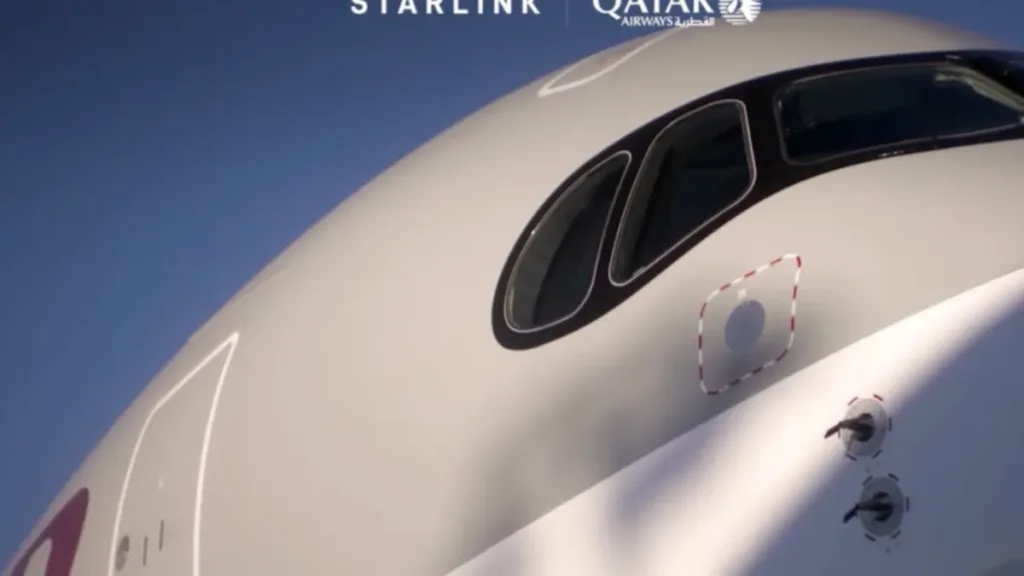
Qatar Airways is making onboard internet connectivity a core part of its long-haul service rather than an optional extra. By August 2026, the airline said more than 150 of its widebody aircraft were equipped, after completing the Boeing 777 and Airbus A350 programmes and expanding the rollout across the Boeing 787 fleet. Connectivity is no longer being treated as an optional extra. It is becoming part of the airline’s core premium proposition.
A fleet-wide connectivity programme changes more than the onboard entertainment offering. It creates expectations about consistent service across aircraft types and routes, while also requiring installation time, certification and reliable performance under real passenger demand. The number of equipped aircraft is therefore a milestone, not a complete measure of service quality.
The rollout has moved beyond the 777 and A350
Qatar Airways completed Starlink installation across its Boeing 777 fleet and then across the Airbus A350 programme before moving onto the Dreamliner. In 2026 it also became the first airline to operate a Starlink-equipped Boeing 787-9.
The airline says more than 23 million passengers have used Starlink since the service launched in October 2024. The remaining Boeing 787 programme is due to continue through the end of 2026.
For passengers, fleet-wide deployment matters because connectivity is only a dependable product when it is offered consistently across the aircraft they actually book. Hardware availability, service coverage and technical reliability can differ from headline speeds. Qatar Airways’ competitive advantage therefore depends not just on installation counts but on making the experience repeatable from one long-haul flight to the next.
Why scale matters more than a headline installation
That is why the 777, A350 and 787 rollout matters strategically. Qatar Airways is trying to make high-speed connectivity predictable across a broad share of its intercontinental operation rather than a feature passengers encounter by chance.
Starlink changes what passengers can realistically do in flight
Low-orbit satellite connectivity reduces latency and can support much heavier data use than older inflight systems. Qatar Airways advertises speeds of up to 500 Mbps on equipped aircraft, making streaming, cloud work, video calls and large file transfers more realistic at cruise altitude.
For business travellers, that can turn a long sector into productive time. For leisure passengers, it narrows the gap between normal digital habits on the ground and the experience onboard.
The decisive measure of onboard Wi-Fi is not a headline peak speed but the experience throughout a flight: ease of access, service continuity and a predictable standard across aircraft. Qatar Airways’ broad rollout can strengthen its premium proposition only if travellers encounter that reliability on the routes they actually fly.
The network effect is becoming visible
Qatar Airways says Starlink is available across an expanding number of Boeing 777, Airbus A350 and Boeing 787 services to more than 130 destinations. In September 2026, the carrier said as many as 340 Starlink-enabled flights a day were operating across its network.
Access conditions can vary by flight and passenger status. The airline’s current connectivity page promotes free access and additional full-flight benefits for Privilege Club members, so travellers should check the specific terms shown for their service.
A new benchmark for Gulf competition
Gulf carriers have traditionally competed on lounges, seat design, catering and network connectivity. High-speed Wi-Fi adds a digital layer to that contest. Once passengers become accustomed to reliable fast access, slow paid internet becomes much harder to defend as a premium product.
That puts pressure not only on Emirates and Etihad but on every long-haul carrier competing for premium traffic between Europe, Asia, the Gulf, Australia and North America.
Installing hardware is only the first stage of a network-wide connectivity promise. Aircraft substitutions, maintenance requirements and the pace of retrofits can create different passenger experiences on the same route. That makes accurate pre-flight information and consistent service delivery as important to the airline’s proposition as headline speeds or the number of equipped jets.
Completing an installation programme does not automatically guarantee a consistent passenger experience. Actual service availability, equipment maintenance and connectivity performance across different aircraft types will determine whether the investment delivers on its promise. For a hub airline, inconsistency between two legs of the same journey can quickly undermine the product advantage.
The difficult part is execution
Fleet-wide connectivity still requires certification, installation time and careful planning around aircraft utilisation. The commercial value therefore depends on maintaining rollout speed without creating operational disruption.
AeroSillage view: Qatar Airways is not simply adding another onboard feature. It is trying to make the digital cabin part of the airline’s brand in the same way the Qsuite helped define its physical premium product.
Main sources
Qatar Airways, 150 Starlink-equipped widebodies, August 2026
Qatar Airways, winter 2026-2027 network update
Qatar Airways onboard connectivity information
Related on AeroSillage: Qsuite Next Gen and Qatar Airways’ premium strategy.
Read next
JOIN THE CONVERSATION
Let’s discuss this story.
A question, a clarification or a different perspective? Share it with us.