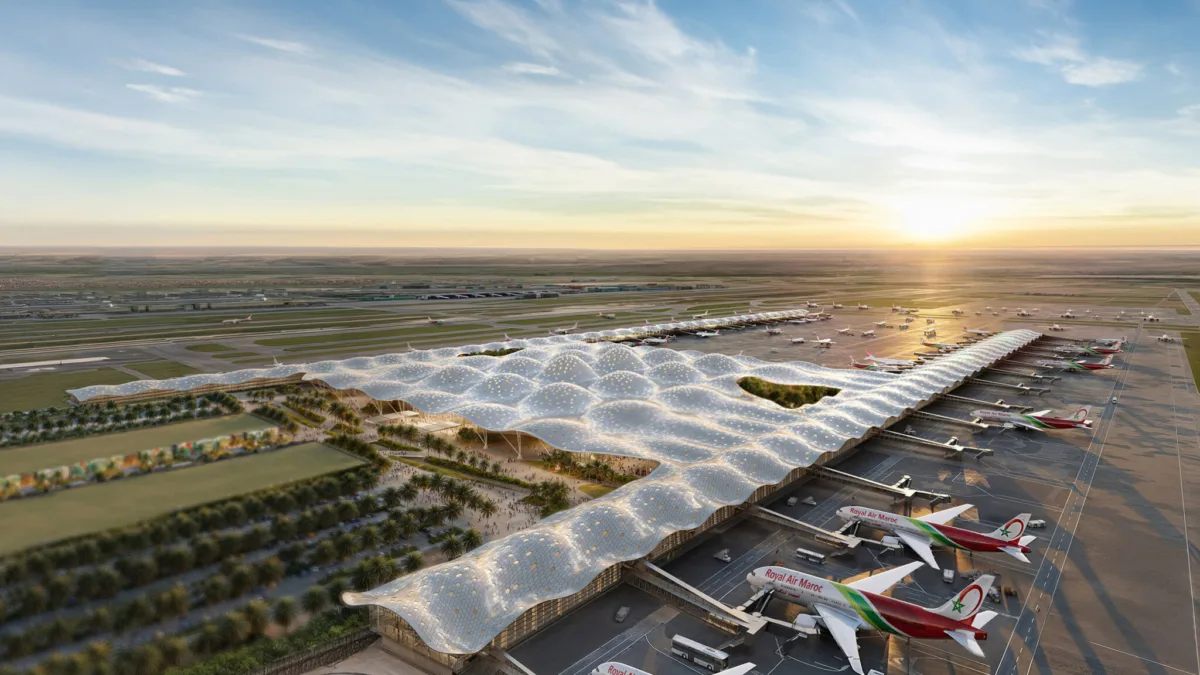
The project intended to turn Casablanca Mohammed V into a much larger African intercontinental hub has moved into the construction phase. Morocco’s airport operator ONDA has launched preparatory works for a new terminal that is one of the flagship projects of the “Airports 2030” strategy.
Capacity, layout and airside infrastructure are being redesigned together
The new terminal is designed to add roughly 20 million passengers of annual capacity, taking Casablanca Mohammed V to around 35 million passengers per year.
The announced investment is around MAD15 billion, with entry into service targeted for 2029.
ONDA presents the project as a transfer-oriented hub terminal from the outset. Its H-shaped layout is intended to shorten walking distances, bring arrival and departure flows closer together, improve baggage transfers and reduce connection times.
For a hub airline, those operational details matter more than raw floor area.
The terminal programme is accompanied by a new 3,700-metre runway and a new control tower of around 42 metres.
The project also includes commercial areas, a hotel and landscaped spaces, showing that ONDA is building a complete airport complex rather than simply more gates.
ONDA says the architectural concept is inspired by the movement of the Atlantic. Beyond the visual language, the operational objective is clear: shorter, more legible passenger flows and a better transfer experience.
Rail access and Royal Air Maroc are central to the hub strategy
A planned high-speed rail connection is intended to integrate the airport more closely with Morocco’s major urban centres.
That matters because hub competitiveness is not only about airside connections. An airport also has to be easy to reach from Casablanca and the wider national network.
The new infrastructure directly supports Royal Air Maroc’s fleet and network expansion across Africa, Europe and North America.
Without more terminal, baggage and aircraft-handling capacity, the airline’s growth would eventually be constrained by the airport itself.
2029 is the deadline, but connection quality is the real test
Commissioning in 2029 would leave Morocco some margin before the 2030 World Cup, which the country will co-host.
But the project goes well beyond the tournament. The strategic objective is to make Casablanca a stronger transfer competitor among African and Mediterranean hubs.
A bigger terminal is only useful if it makes the hub easier to use. The project will ultimately be judged on shorter connections, reliable baggage transfers, clear passenger flows and the ability to absorb Royal Air Maroc’s growth without congestion.
Main sources
ONDA presentation of the new Casablanca terminal and preparatory earthworks.

Leave a Reply