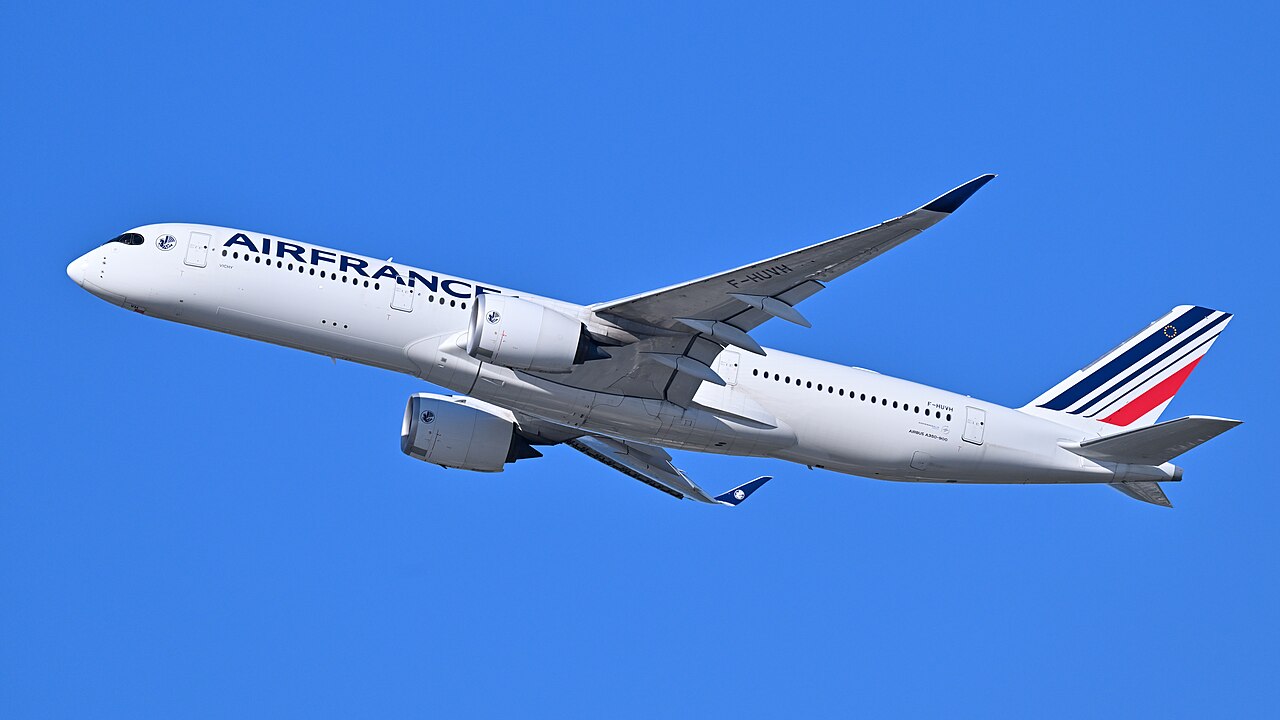
In twenty years, Air France has faced almost every shock a major airline can encounter: a global financial crisis, the AF447 tragedy, repeated restructuring plans, major labour conflicts, the failure of Joon, the Covid shutdown, massive state support and then a rapid rebuild around Paris-CDG, Transavia, the Airbus A220 and A350, and a much more premium positioning.
By 2025, Air France-KLM had posted the strongest operating result in its history and in 2026 was again trying to expand through European consolidation. But several weaknesses remain: high costs, exposure to fuel and geopolitics, French taxation, a structurally weaker domestic market and the huge cost of decarbonisation.
Air France and Air France-KLM: the right perimeter for reading two decades of change
Since the Air France-KLM group was created in 2004, most financial data: revenue, operating profit, net result and debt: are published at group level. Unless otherwise stated, the financial figures below therefore refer to Air France-KLM, not Air France alone.
2006–2012: from initial success to structural crisis
In 2006–07, Air France-KLM generated €23.073 billion in revenue, €1.240 billion in recurring operating profit and €891 million in net profit. Paris-CDG was already the centre of Air France’s connection model, while SkyTeam and Flying Blue reinforced the commercial network.
But the group was already highly sensitive to fuel prices and the economic cycle, while Air France’s cost position was becoming a recurring concern.
The reversal was brutal. Revenue remained around €23.97 billion, but the group moved to a €129 million operating loss from a €1.414 billion operating profit a year earlier. Net loss reached €814 million.
Business travel and cargo weakened sharply, while fuel hedges that had protected the airline during the oil-price surge became painful when crude prices fell.
On June 1, 2009, flight AF447 Rio de Janeiro–Paris, operated by an Airbus A330-203, crashed into the Atlantic. All 228 people on board died.
The BEA investigation identified a sequence beginning with Pitot-probe icing and unreliable airspeed indications, followed by loss of control and a prolonged stall. The wreckage and recorders were only recovered in 2011 after an exceptionally difficult deep-sea search.
In May 2026, the Paris Court of Appeal found Air France and Airbus guilty of involuntary manslaughter and imposed the maximum corporate fine. The ruling was not final, as a cassation appeal was announced. Technical safety findings and criminal liability must therefore remain clearly distinguished.
Gulf airlines expanded on long-haul markets, low-cost carriers grew across Europe and high-speed rail eroded part of the domestic network. By September 2011, Air France-KLM debt had risen from roughly €2.7 billion in 2008 to €6.5 billion.
2012–2019: restructuring, labour conflict and simplification
Transform 2015 aimed to improve competitiveness by around 20%, cut unit costs, restructure short- and medium-haul activity and reduce debt.
In June 2012, Air France announced a first plan affecting 5,122 jobs by the end of 2013, with the stated aim of avoiding compulsory redundancies. Later parliamentary work referred to roughly 10,000 departures through 2015.
Air France headcount fell from 56,851 in 2008 to 47,920 in 2014: a decline of about 16%.
The September 2014 pilots’ strike lasted fourteen days. Management wanted to expand Transavia as a lower-cost tool for leisure and European markets; pilots feared activity would progressively move outside Air France conditions.
Air France-KLM estimated the strike cost at around €425 million in operating result and close to €500 million in lost revenue.
Twelve years later, Transavia had become the group’s reference operator at Orly for several major domestic and leisure routes: validating much of the strategic logic that had caused the dispute.
After failed productivity negotiations, management presented a “Plan B” including roughly 2,900 job cuts and the removal of fourteen long-haul aircraft by 2017. The October 5 works-council meeting was invaded, and images of executives with torn shirts became international symbols of Air France’s social crisis.
Air France tried to move beyond permanent cost-cutting through the Trust Together plan and the creation of Joon, designed as a lower-cost, younger and more digital brand. Its positioning proved difficult to understand.
In 2018, repeated strike days cost an estimated €300 million. CEO Jean-Marc Janaillac put a pay proposal to an employee vote; 55.44% rejected it, and he resigned.
Benjamin Smith became Air France-KLM CEO in August 2018, while Anne Rigail took over Air France in December.
Joon was reintegrated into Air France in 2019. The group ordered 60 Airbus A220-300s to replace A318s and A319s, while long-haul strategy shifted toward the Boeing 787 and especially the Airbus A350. The A380 exit was planned as the group moved toward smaller, more flexible aircraft.
2020–2023: survival, recapitalisation and rebuilding
In 2020, Air France-KLM revenue collapsed to €11.1 billion, down 59%. Operating loss reached €4.5 billion, net loss €7.1 billion and net debt about €11 billion.
France put in place €7 billion of liquidity support for Air France through state-guaranteed bank loans and a shareholder loan.
The crisis accelerated structural decisions. Air France retired the A380 two years early, taking a €500 million impairment, and announced a reduction of 6,560 jobs by end-2022 from roughly 41,000 positions; HOP! was to cut more than 1,000.
In August 2020, a majority agreement with the SNPL allowed Transavia France to expand on domestic routes. In the union referendum, 90.37% voted in favour.
The shift reflected a basic economic reality: on many French domestic routes, Air France faced TGV competition, low-cost carriers and a cost base too high for low-yield point-to-point flying.
French state support was partly converted into equity-like instruments in 2021, followed by a major capital increase in 2022 in which CMA CGM became a reference shareholder.
In March 2023, Air France-KLM repaid the remaining €2.5 billion of the original €4 billion French state-guaranteed loan.
The French state’s long-term influence nevertheless increased: its holding rose from 18.6% in March 2006 to 28% at June 30, 2026.
Fleet renewal, premium strategy and the shift to CDG
Air France now invests more than €1 billion a year in new-generation aircraft. By 2025 it had 54 A220s and 41 A350s. New-generation aircraft represented around 45% of the Air France fleet excluding HOP!, versus only 7% in 2021, with a target of 70% by 2030.
Air France estimates that new-generation aircraft cut CO₂ emissions by about 20–25% compared with the aircraft they replace.
The recovery was not based on cost cuts alone. Air France invested in lounges, new Business seats, La Première, onboard connectivity and a more consistent premium proposition.
In 2025, Air France-KLM exceeded €33 billion in revenue, posted an operating result above €2 billion: the best in its history: and carried more than 100 million passengers. Air France alone said it carried more than 42 million travellers.
In Q2 2026, the group reported an adjusted operating result of about €484 million, while trimming capacity expectations because of geopolitical disruption.
By summer 2026, Air France had concentrated most Paris operations at Charles de Gaulle, apart from Corsica public-service routes.
Transavia became the group’s reference operator at Orly and took over routes including Toulouse, Nice and Marseille, while Air France reinforced those cities from CDG to feed international connections.
The strategic division is now much clearer: Air France for hub connectivity, long-haul and premium traffic; Transavia for more price-sensitive point-to-point markets.
In 2025, Air France said nearly 40 million customers used CDG, with 53% connecting. The airline accounted for more than half of airport activity by its own figures.
Summer 2026 included nearly 170 destinations in 73 countries and up to 630 daily short- and medium-haul flights.
The hub is a major competitive advantage: and a vulnerability. Weather, ATC, baggage, security or labour disruption at CDG can propagate across the entire network.
Competitiveness, decarbonisation and the weight of the past
A 2026 French parliamentary report estimated that Air France-KLM paid around €750 million in French ticket taxes in 2024 and €990 million in air-transport charges, around €1.74 billion across the network.
The report estimated the 2025 increase in the solidarity tax would represent roughly €150 million a year for the Air France group, Air France and Transavia.
Not all of those charges are a pure competitive handicap: some finance essential aviation functions: but they remain central to the debate over whether French policy shifts connecting traffic toward foreign hubs.
Air France aims for average fuel consumption below 3 litres per passenger per 100 km by 2030, versus roughly 3.3 today. Fleet renewal, sustainable aviation fuel, eco-piloting and optimised trajectories are the main levers.
But SAF remains much more expensive than fossil kerosene and global supply is limited. Decarbonisation is therefore an industrial, financial and political challenge as much as an environmental one.
Alongside the AF447 appeal ruling, the EU Court of Justice in February 2026 rejected appeals in the air-cargo cartel case involving practices from 1999 to 2006. Air France had received a €182.9 million fine in that case.
From rescue recipient to European consolidator
In July 2026, Air France-KLM submitted a binding offer for roughly 44.9–49.9% of TAP Air Portugal. In September, Portugal asked both Air France-KLM and Lufthansa to improve their proposals.
Only six years earlier, the group depended on extraordinary state support to survive the pandemic. The strategic balance has clearly changed.
So is Air France really saved?
Yes, compared with its most critical periods. The fleet is newer, the network is clearer, Transavia has a defined role, CDG is fully embraced as the centre of the model and premium investment is producing results.
No, if “saved” means protected from future crises. Fuel, wars, taxes, epidemics and environmental transition can still damage margins rapidly.
The biggest difference from 2012 or 2020 is that Air France now appears to have a more coherent model: Air France for hub traffic, premium and long-haul; Transavia for price-sensitive point-to-point; newer aircraft for cost and emissions; Air France-KLM as the platform for European scale.
Main sources
Air France-KLM annual reports and results 2005–2026; Air France corporate fleet and network data; BEA AF447 investigation; French parliamentary and Senate reports; European Commission; Reuters reporting on results, AF447 and European consolidation.
Leave a Reply