After 1945, French commercial aviation entered a completely different era. The country rebuilt its infrastructure, Air France became a national carrier, new private airlines emerged and the market gradually divided between domestic services and intercontinental networks. For nearly half a century, several major French brands coexisted, competed and complemented one another before eventually converging.
This second part of AeroSillage’s historical series covers the post-war period through 1997 and focuses on five major names: Air France, TAI, UAT, UTA and Air Inter. Together they explain how France moved from a multi-airline national system to a much more concentrated model.
1945: Air France is nationalised and rebuilt
After the Liberation, Air France emerged from the war deeply transformed. In 1945, the airline was nationalised and had to rebuild its network, modernise a mixed fleet and recover its place in a global market where US manufacturers and airlines had gained a major lead.
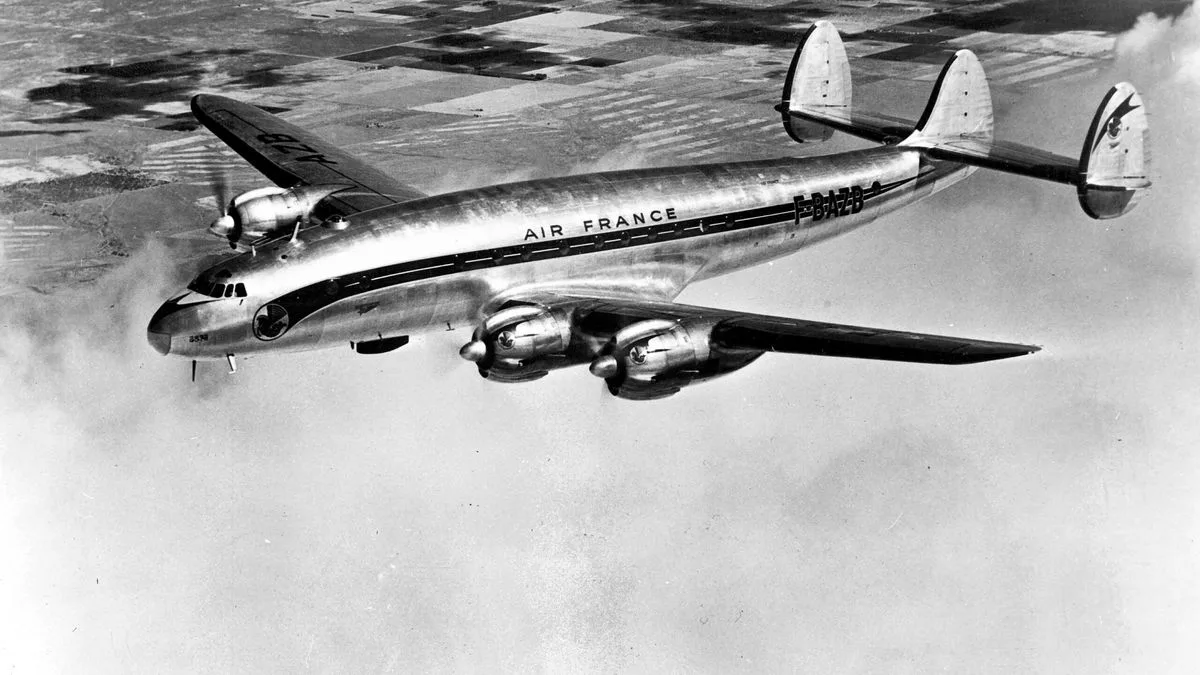
In 1946, Air France opened Paris–New York with the Douglas DC-4. The crossing still took almost a full day with stops. Lockheed Constellations and later Super Constellations then changed the long-haul experience through greater speed, range and comfort.
The 1950s and 1960s moved Air France into the jet age. The Caravelle entered service at the end of the 1950s, while the Boeing 707 dramatically reduced North Atlantic journey times. Boeing 747s and Concorde later reinforced Air France’s global profile.
Legacy: Air France remained the backbone of French air transport and would progressively absorb the country’s other major carriers during the 1990s.
1946–1963: TAI: a private intercontinental airline
Transports Aériens Intercontinentaux (TAI) was created in 1946 as a private airline with a clear ambition: build routes beyond Europe in markets where demand for air transport was expanding rapidly.
TAI served North Africa, sub-Saharan Africa, Madagascar, Indochina and Southeast Asia, with routes touching Tunis, Damascus, Karachi, Bangkok, Saigon and Hanoi. Other services ran via Algiers, Fort-Lamy, Douala, Brazzaville and Tananarive.
The Pacific gradually became another strategic axis, with routes extending towards Nouméa, Auckland and Tahiti. Douglas DC-6s and DC-7s became emblematic of an era when long-haul travel still meant multiple stops and when operational reliability itself was a major commercial advantage.
Legacy: TAI did not collapse. It moved closer to UAT and the two companies merged to form UTA in 1963.
1949–1963: UAT: Africa and an early move into jet travel
Union Aéromaritime de Transport (UAT) emerged around the late 1940s with a strong African orientation linked to French commercial and maritime networks.
UAT became notable for operating the De Havilland Comet, the world’s first commercial jet airliner. That early adoption reflected the ambition of a private French airline trying to compete through fleet modernity rather than scale alone.
Its network expanded across West and Equatorial Africa, but decolonisation transformed the political and commercial framework of those routes. New national airlines and changing traffic rights forced French operators to rethink how they served the continent.
Legacy: UAT and TAI began cooperating commercially before merging in 1963.
1963–1992: UTA: Air France’s major French rival
The merger of TAI and UAT created Union de Transports Aériens (UTA) in 1963. It inherited complementary networks and became France’s major private long-haul airline.
Africa remained central, but UTA also expanded to the Indian Ocean, Asia and the Pacific. DC-8s, DC-10s and later Boeing 747s became familiar at Paris-CDG, while UTA also developed significant industrial activity through UTA Industries.
French route policy limited direct competition with Air France. UTA could not freely open every route it wanted and was long excluded from markets such as Paris–New York and many European services already associated with Air France. The system reduced direct competition between two French flag carriers while giving UTA room to grow elsewhere.
The oil shocks, weaker traffic on some African markets and changes in the Pacific complicated expansion. By the end of the 1980s, however, UTA remained a substantial airline with profitable positions on several routes just as European liberalisation began changing the competitive environment.
In 1990, Air France acquired UTA. The brand continued briefly before full legal integration at the end of 1992.
Legacy: UTA disappeared into Air France, contributing its network, fleet, crews, industrial know-how and holdings: including its stake in Air Inter.
1954–1997: Air Inter: making domestic France accessible by air
Created in 1954, Air Inter answered a different need: connecting major French cities quickly. Regular operations only really accelerated from 1960, but growth then became spectacular, exceeding 20% a year during parts of the 1960s and 1970s.
Paris was connected to Lyon, Marseille, Nice, Toulouse, Bordeaux, Strasbourg and many other cities. Before the motorway network and TGV reached today’s scale, air travel became crucial for business, administrative and professional mobility.
Air Inter operated Viscounts, Caravelles, Fokker F27s, Dassault Mercures, Airbus A300s, A320s and A330s. The Dassault Mercure occupies a special place in its history: designed for dense short-haul flying, it found its main commercial home with Air Inter.
The airline also developed a highly specific domestic operating model: fast turnarounds, high aircraft utilisation, simplified procedures and pricing designed for the French internal market.
European liberalisation eventually undermined the protected domestic structure. Because UTA was already a major Air Inter shareholder, Air France’s takeover of UTA gradually brought all three carriers into the same group.
In 1996, Air Inter became Air France Europe, and on April 1, 1997 it was fully merged into Air France.
1990–1997: The end of a multi-carrier French system
As European deregulation accelerated, the state favoured consolidation. Air France took control of UTA in 1990, legal integration followed in 1992 and UTA’s stake in Air Inter helped bring all three companies under the same umbrella.
The Groupe Air France emerged in 1993, with Air Inter fully integrated in 1997. In only a few years, France therefore moved from several major national airlines to one dominant group: a process that later culminated in Air France-KLM in 2004.
What came next?
Consolidation did not end independent French aviation. Deregulation instead encouraged a new generation including Minerve, AOM, Air Liberté, Air Littoral, Euralair and Corsair. They would try to build alternatives to Air France in charter, regional, leisure and scheduled flying.
Their rise: and the failures that followed: are the subject of part three of this series.
Main sources
Air France historical archives; French Ministry of Transport / civil aviation archives; French National Archives; Légifrance; Wikimedia Commons historical material.
Continue the series: French airlines (3/4): Minerve, AOM and Air Liberté.
Leave a Reply