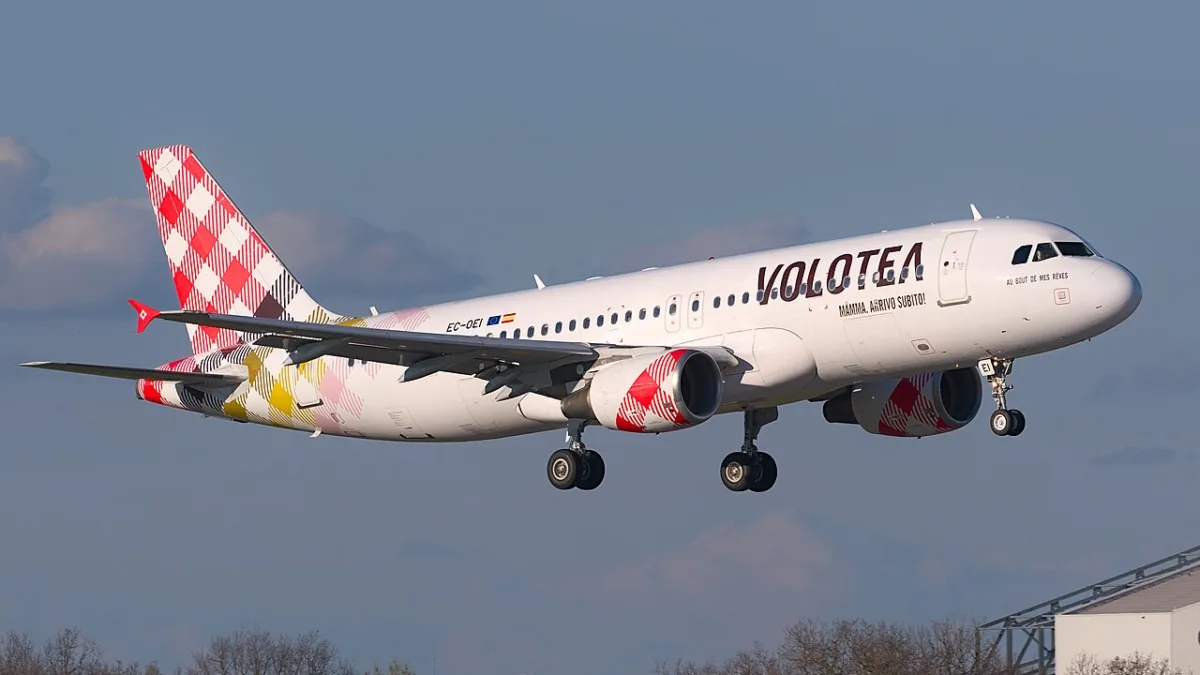
Volotea has become one of the most distinctive airlines in the French market. Built around direct links between small and medium-sized European cities, the Spanish carrier has made France its largest market, representing around 60% of activity. In 2026 it is still opening bases and routes, but its financial picture is more nuanced than the growth story alone suggests: operating performance is improving, net losses persist, 2025 targets were missed and the balance sheet was strengthened with a €71 million capital increase.
Volotea has become a major regional player in France
Volotea carried 11.3 million passengers in 2025 and reached 85 million passengers since launch by May 2026.
The network covers around 110 airports and about 430 routes, with more than half described as exclusive.
The airline has 21 operational bases in Europe, a fleet of roughly 43–45 Airbus A319/A320 aircraft and more than 2,250 employees.
France represents around 60% of activity.
Volotea planned more than 9 million seats in France in 2026, up 12.5% year on year.
It operates more than 280 French routes, including 74 domestic services, and claims 12 French bases: Bordeaux, Brest, Lille, Limoges, Lourdes, Lyon, Marseille, Montpellier, Nantes, Rodez, Strasbourg and Toulouse.
The number of aircraft based in France rose from 23 in 2025 to around 30 in 2026.
Volotea avoids competing head-on with Ryanair, easyJet and Air France on every major trunk route.
Instead it focuses on direct regional links, many seasonal and many with little or no competition.
The airline says more than half of its routes have no direct competitor. That creates local pricing power and lets the carrier build small regional monopolies, but it also ties the model closely to airport partnerships and local demand.
Volotea opened a base at Limoges in February 2026 with an Airbus A319. The first major route was Limoges–Paris-Orly under a public-service delegation, followed by seven additional services and more than 230,000 seats planned from Limoges in 2026.
Montpellier is due to become another base from November 2026 with a locally based A320 and four new routes.
At Lille, Volotea added a third based aircraft and opened new 2026 routes including Seville, Valencia, Madrid, Bari and Burgas. It now offers around 40 destinations from Lille and more than 845,000 seats for the year.
At Toulouse, a second based aircraft is intended to support winter 2026–27 routes including Pisa, Fuerteventura and Gran Canaria.
Across the network, the first part of spring-summer 2027 was already on sale with 10.5 million seats and more than 60,000 flights planned between March and October.
Operating performance is improving, but profitability is still incomplete
Revenue reached €818 million in 2025, compared with €811 million in 2024 and €694 million in 2023.
EBITDA margin rose from 14% in 2023 to around 20% in 2025, while EBIT increased by 41% to €47.4 million.
That shows a real improvement in the economics of the core operation.
The company ended 2025 with an IFRS net loss of €64 million.
Volotea attributes a substantial part of that result to exceptional accounting items, including tax-asset reassessments and currency-conversion reserve adjustments.
It would therefore be misleading to describe the airline as operationally collapsing. But it would also be wrong to ignore the fact that bottom-line profitability remains negative.
In October 2025, Volotea was still guiding toward about €840 million in revenue, EBITDA above €190 million and EBIT of €70–80 million.
The final result came in at €818 million of revenue and €47.4 million of EBIT.
The trend improved year on year, but the gap shows that profitability remains sensitive to operating conditions.
Capital and Aegean provide strategic support without an announced takeover
In March 2026 Volotea completed a €71 million capital increase launched in 2024.
Participants included Aegean Airlines, US fund PAR Capital and Alaeo, the vehicle grouping management around founder Carlos Muñoz.
The original target could have reached €100 million. Volotea said improved operating performance reduced the amount ultimately required.
The transaction does not mean the airline was close to bankruptcy, but it does show that balance-sheet strengthening remains part of its growth strategy.
Aegean is now more than a commercial partner. The Greek airline has invested through convertible instruments and participates in Volotea’s capital structure.
There is no officially announced takeover plan, but the relationship is strategically important and worth monitoring.
A flexible but ageing fleet, with more cautious growth
Volotea operates only Airbus A319 and A320ceo aircraft. That simplifies training, maintenance and operations.
But fleet databases put average age at roughly 19 years in 2026, with many A319s older than 20 years.
Age is not a safety problem in itself when aircraft are maintained correctly. Economically, however, older aircraft generally burn more fuel and can require more maintenance than new-generation narrowbodies.
AeroSillage did not identify a major direct A320neo family order for Volotea in Airbus’s published 2026 customer list.
A 2026 fleet RFP showed the airline looking instead for 2 to 6 additional A320ceos, potentially more if economics were attractive, preferably aircraft 10–18 years old on two- to six-year leases.
That fits the airline’s model: low initial capital commitment and flexible capacity. It also postpones the question of a major fleet renewal.
Earlier communications discussed close to 14 million seats and a fleet of 44–46 aircraft for 2026.
By July, when 2025 results were published, Volotea was talking about around 13 million seats, up 7%, and a fleet near 43 aircraft.
The airline is still growing, but more cautiously than initially planned.
The key risk is executing growth without weakening labour or operational stability
Because France is now Volotea’s biggest market, labour disputes there matter much more than they once did.
French unions SNPL, UNAC and SPL called pilots based in France to strike from September 4 to 6, 2026, citing pay and working-condition concerns.
Those are union claims and should be presented as such. Volotea limited cancellations and contacted affected passengers directly; around ten flights were initially reported cancelled.
Volotea reported an OTP15 punctuality rate of 79% in 2025 and a completion factor of 99.7%.
The airline says Cirium ranked it among Europe’s more reliable low-cost carriers for a second consecutive year.
Volotea has also grown through public-service routes such as Limoges–Paris-Orly and Rodez–Orly.
These contracts provide visibility and local relevance, but they also tie part of the network to public tenders and political decisions that can change.
Strengths, vulnerabilities and the next battle
- Clear focus on direct regional connectivity.
- A high share of routes with little or no direct competition.
- France as a dense and strategically important home market.
- Improving operating profitability.
- Flexible leased-fleet strategy.
- Persistent net losses: €64 million in 2025.
- Missed financial guidance: EBIT materially below prior target.
- An ageing fleet: cheaper to acquire or lease, but less fuel-efficient.
- Heavy exposure to France: around 60% of activity concentrates regulatory and labour risk.
- Labour tension: important for an airline opening more bases.
- Fuel sensitivity: especially with an all-ceo fleet.
The airline is not in a situation comparable with a carrier on the edge of insolvency. Revenue is strong, EBIT is improving, investors have injected capital and the network continues to expand.
But Volotea has not yet fully proved that rapid expansion can produce recurring net profit.
It has probably won the battle for regional presence in France. The next battle is sustainable profitability.
Main sources
Volotea 2025 results; Volotea capital-increase and network announcements; SNPL; Airbus order data; Volotea fleet RFP; fleet databases.

Leave a Reply