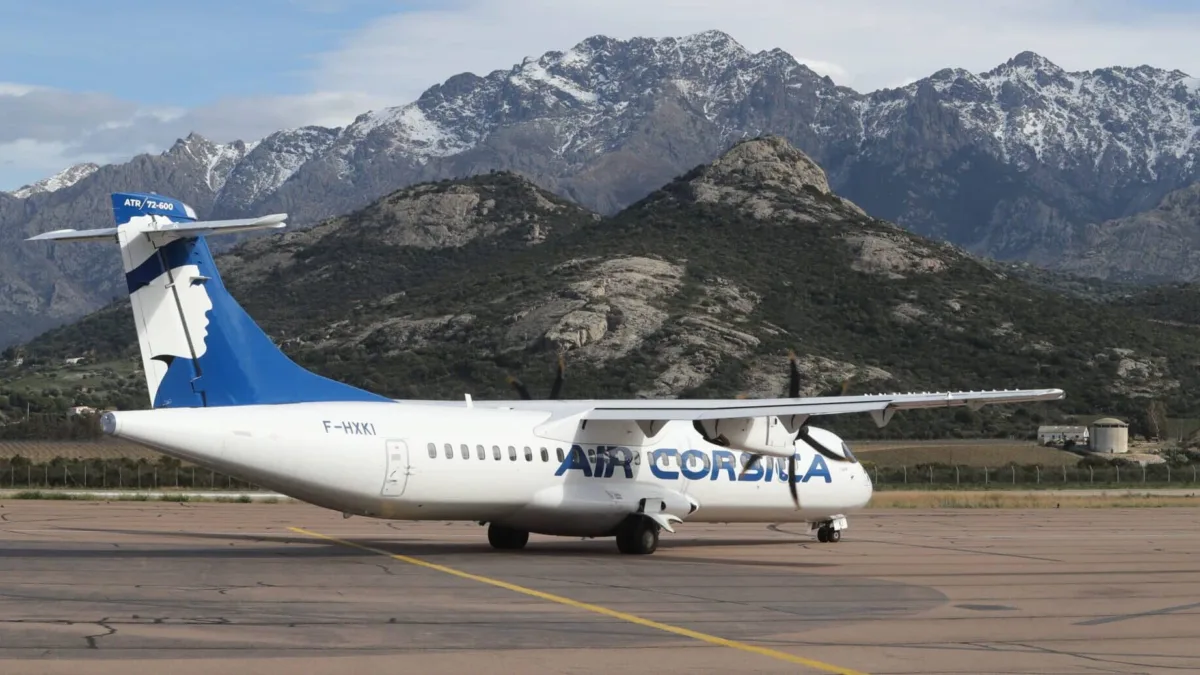
Updated 4 October 2026: Five of Air Corsica’s seven ATR 72-600s remain grounded as a precaution after repeated reports of unusual odours, mainly in the cockpit. More than 70% of the airline’s turboprop subfleet is therefore unavailable. Investigators are focusing on the aircraft’s air-supply and conditioning chain, but no generic defect affecting the ATR 72-600 or the PW127XT engine has been established.
Five aircraft grounded, with only two left in the subfleet
Air Corsica operates seven ATR 72-600s. Several aircraft were removed from service in early September, four were reported grounded by 18 September, and a fifth subsequently joined them. On 23 September, the airline formally confirmed that five of the seven aircraft were being kept out of service as a precaution.
The airline has not published an official list of the five registrations. Flight-tracking records can show whether an individual airframe has recently flown, but they cannot prove why it is inactive. AeroSillage therefore does not identify a specific registration as technically grounded unless that status is confirmed by the airline or an identifiable technical source.
What investigators are looking for and why the probe takes time
The investigation started with recurring unusual odours reported in the cockpit. Some accounts have also referred to intermittent smoke-like events, smells reminiscent of heated oil and headaches among crew members. Those are reported symptoms, not a confirmed diagnosis of the technical cause.
The main area under examination is the equipment that supplies the air-conditioning system. That does not automatically mean the engine itself is at fault. Cabin and cockpit air depends on a chain of components and controls including air supply, valves, regulation, heat-exchange equipment and associated software. Investigators therefore have to reproduce the event and trace how any contaminant or abnormal odour could reach the airflow.
Air Corsica is working with ATR, engine maker Pratt & Whitney Canada and equipment supplier Liebherr. The carrier’s ATR 72-600s use PW127XT engines, and Air Corsica was the launch operator of that powerplant generation when it entered airline service in late 2022.
Testing and analysis are being carried out, including work in Toulouse. Reporting by Le Monde on 3 October said the airline, airframer and engine manufacturer were reviewing progress on a daily basis. Possible avenues include a mechanical origin, equipment or valve behaviour, control logic and software, maintenance or handling factors, and oil characteristics. None of those possibilities should be treated as the cause until testing confirms it.
Finding an odour is not enough. Engineers need to reproduce the event, determine the conditions under which it appears, identify its path into the ventilation system and then demonstrate that a corrective action prevents it from returning. An intermittent event can require repeated ground or flight tests, component inspections and comparisons between affected and unaffected aircraft.
That is why Air Corsica is keeping the aircraft grounded as a precaution. Their return to service depends on the required checks and technical clearance. No firm date has been announced for the return of the five aircraft.
No evidence of a fleet-wide ATR defect
The concentration of cases at Air Corsica does not, by itself, establish a fleet-wide airworthiness problem affecting all ATR 72-600s or all PW127XT engines. ATR has said there is currently no evidence supporting such a conclusion. A key question is whether investigators can identify one common factor across the five Air Corsica aircraft or a more local combination of operating and technical conditions.
How Air Corsica is replacing lost ATR capacity
With five ATRs temporarily unavailable, Air Corsica introduced an exceptional replacement programme. On 9 September, the airline detailed three principal wet leases: an Amelia Airbus A319 from 9 to 27 September, an Air Caraïbes Airbus A350 on 12 and 13 September, and a Chalair ATR 72 from 14 to 30 September.
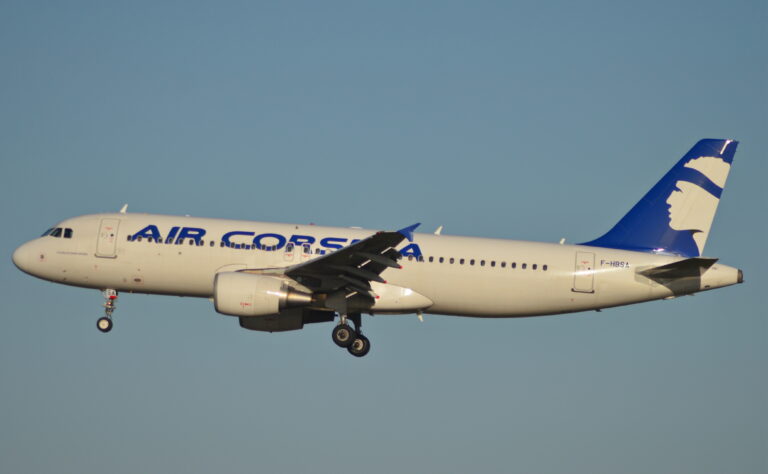
The A350 was not intended as a like-for-like replacement for an ATR on thin regional sectors. Its role was to carry a larger number of passengers on selected services and, in turn, free some of Air Corsica’s own Airbus A320 capacity for rotations that would normally be operated by ATRs.
By 4 October, the officially announced lease periods for the Amelia A319 and Chalair ATR had expired, while the Air Caraïbes A350 had only been planned for two days. AeroSillage has not found a newer Air Corsica statement confirming that those same aircraft remain on lease in October, so they should not be presented as current replacement aircraft without fresh confirmation.
At its 23 September briefing, Air Corsica said it was looking in particular for aircraft in the 70-to-100-seat range, closer to the capacity of the ATR 72-600 and better suited to short public-service routes between Corsica and mainland France. At the same time, the airline has been using its own Airbus fleet intensively to compensate for the shortage of turboprops.
The replacement programme announced in early September represented more than one hundred substitute flights through the end of October. That figure refers to the number of replacement rotations planned, not to a guarantee that any one wet-leased aircraft would remain assigned for the whole period. The mix can change depending on aircraft availability, operational needs and any ATR returning to service.
For passengers, the next meaningful milestones are the first confirmed return to service of a grounded ATR and evidence that the airline can stabilise its schedule without extraordinary replacement capacity.
What still needs to happen before normal operations return
AeroSillage will track any identified common component or operating scenario, technical guidance from ATR or Pratt & Whitney Canada, action by aviation safety authorities, and the first verified return to service among the five grounded aircraft.
Related: Air Corsica: public service, modern fleet and a push into Europe.
Sources
Air Corsica statements dated 7, 9 and 23 September 2026; ATR; Pratt & Whitney Canada; Liebherr; Corse Net Infos, 23 September 2026; Le Monde, 3 October 2026.
Leave a Reply