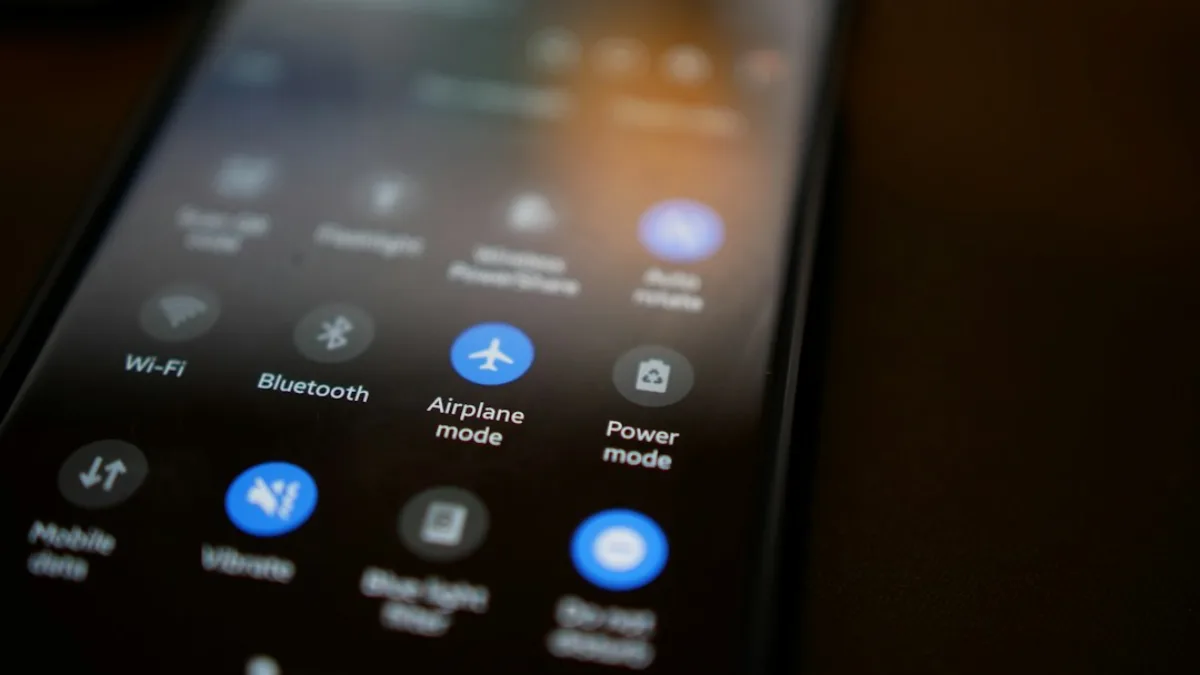
Every flight repeats the same instruction: switch your phone to airplane mode. Most passengers comply automatically, but the real reason is more nuanced than the myth that one forgotten smartphone could make an aircraft fall out of the sky.
Airplane mode mainly disables cellular transmission
The key function is the phone’s connection to terrestrial mobile networks. A normal smartphone constantly searches for available cells and tries to move between them. At altitude, an aircraft can pass over many ground antennas at very high speed.
The FAA still requires phones and similar devices to be used in airplane mode or with cellular service disabled. Wi‑Fi can then be turned back on where the aircraft is equipped for it and the airline permits it. The same increasingly applies to Bluetooth.
Can a phone actually interfere with an aircraft?
Modern airliners are designed and certified to tolerate many forms of electromagnetic interference. The FAA has long concluded that most commercial aircraft can safely accommodate the use of many portable electronic devices.
That does not mean cellular transmissions are completely irrelevant. European rules require operators to ensure that portable electronic devices do not adversely affect navigation, communications or other onboard systems.
The practical risk on a modern aircraft is low, but aviation still removes unnecessary radio emissions where possible because critical systems must remain extremely reliable.
Ground mobile networks are part of the reason
The issue is not only the aircraft. A phone operating normally several kilometres above the ground can “see” many terrestrial cell towers and try to hand over rapidly between them while travelling at close to 900 km/h.
Conventional mobile networks were not designed for that operating pattern. Historically, that was another reason for restricting normal cellular use in flight.
Aircraft that do provide mobile service use dedicated onboard equipment, such as a small picocell, so phones communicate with the aircraft system rather than directly with multiple ground towers.
Why Wi‑Fi and Bluetooth can still be allowed
Airplane mode no longer necessarily means being completely offline. On many devices, Wi‑Fi and Bluetooth can be re-enabled after airplane mode is activated.
Onboard Wi‑Fi uses an aircraft-certified system, generally through satellite or an air-to-ground network. Bluetooth operates at low power and is widely accepted for headphones, watches and keyboards, subject to airline rules.
That is why it is perfectly normal to see a passenger in airplane mode streaming over the aircraft Wi‑Fi while using Bluetooth headphones.
What if you forget?
Usually, nothing dramatic happens. A phone left in normal mode is not going to stop the engines or make the pilots lose control of the aircraft.
It may, however, keep searching for service, use more battery and transmit unnecessarily. It also means the passenger is not following the airline’s procedures and crew instructions.
So forgetting once is not a catastrophe, but that is not a reason to ignore the rule deliberately.
Why larger devices may have to be stowed for take-off and landing
Sometimes the issue is physical rather than electronic. A laptop or large tablet can become a dangerous projectile during sudden braking, turbulence or an evacuation.
That is why airlines may require larger devices to be stowed during critical phases of flight even when smaller phones remain permitted.
Lithium batteries are the more tangible onboard risk
For modern phones and personal electronics, the most concrete hazard is often the battery rather than the radio signal.
The FAA recommends keeping devices with lithium-ion batteries in the cabin where a problem can be detected quickly. If a phone becomes unusually hot, swells, smokes or catches fire, passengers should alert the crew immediately.
Spare batteries and power banks must remain in the cabin and must not be placed in checked baggage.
Airplane mode still has a practical purpose
The rule can feel outdated in an era of inflight Wi‑Fi and occasional mobile connectivity. In reality, it remains a simple and universal way to ensure that conventional cellular transmitters are switched off.
Airplane mode is not protection against an imminent disaster. It is a technical, regulatory and operational precaution that simplifies the safe management of millions of personal devices carried every day.
Main sources
Federal Aviation Administration guidance on portable electronic devices and PackSafe lithium-battery rules; European Union Aviation Safety Agency requirements for portable electronic devices.


Leave a Reply