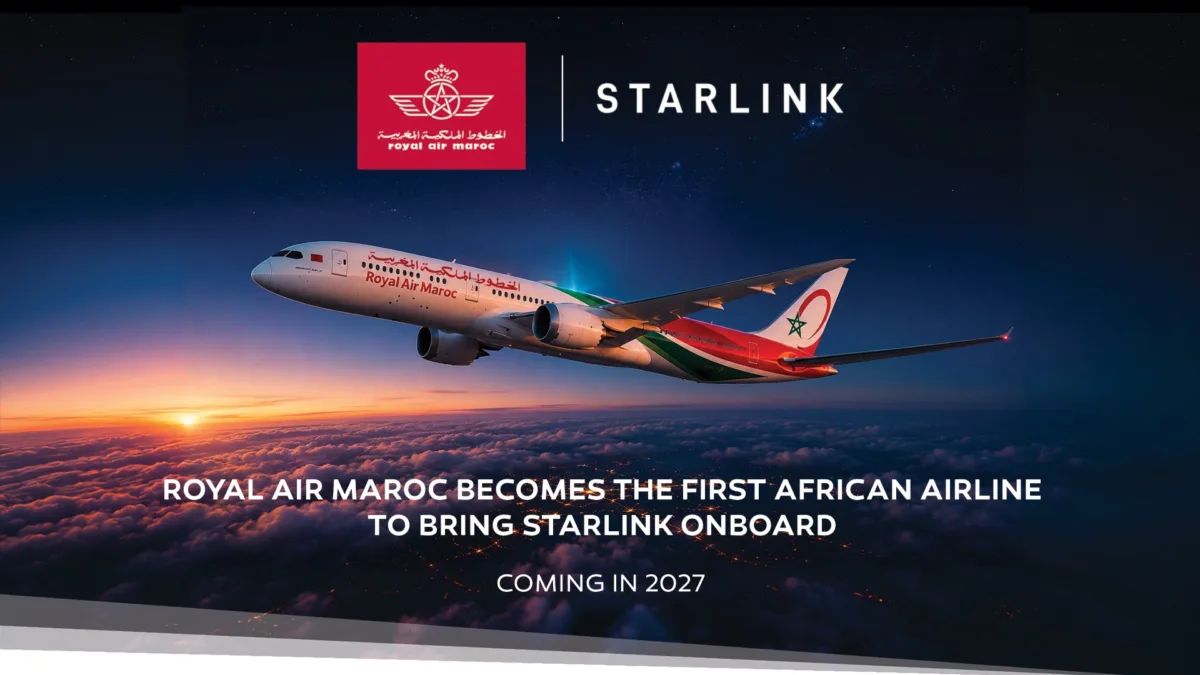
Royal Air Maroc is making a deliberate move to put connectivity at the centre of its next phase of growth. The Moroccan flag carrier has selected Starlink for a progressive rollout across 41 aircraft from early 2027, positioning itself as the first African airline to introduce the satellite service on board. For an airline building Casablanca into a larger intercontinental hub, the decision is as much about competitive positioning as it is about faster Wi-Fi.
The agreement was announced on 7 October 2026. Installation is due to begin in the first quarter of 2027 and then expand progressively across the selected aircraft. RAM has not yet published a tail-by-tail deployment plan or identified every fleet type involved.
Connectivity is becoming part of the airline product
Starlink uses a low-Earth-orbit satellite constellation designed to provide high bandwidth with lower latency than traditional geostationary satellite systems. In practical terms, that opens the door to streaming, video calls, cloud-based work and messaging at a quality much closer to what passengers expect on the ground.
That matters particularly on Royal Air Maroc’s longer sectors between Morocco, North America, Europe and sub-Saharan Africa. On those routes, inflight connectivity is increasingly becoming part of the competitive product rather than an optional extra.
Information released around the agreement indicates that Safar Flyer members are expected to receive access without an additional charge, giving RAM a direct way to tie the new service to its loyalty strategy.
A first for Africa — but the real test is scale
Royal Air Maroc is billing the deal as the first Starlink deployment by an African airline. Several African carriers already offer inflight internet using other satellite technologies, so the distinction is specifically about Starlink.
The more significant number may be 41. This is not a one-aircraft trial or a showcase installation. If the programme is delivered as announced, RAM will be deploying the service across a meaningful share of its operating fleet.
That scale could make the airline a reference point for other African operators considering their next generation of connectivity systems.
Why Casablanca makes the technology strategically relevant
Royal Air Maroc’s network model increasingly depends on connecting flows through Casablanca. The hub links Europe with West and Central Africa, while also supporting services to North America and the Middle East.
Passengers making those connections may spend many hours within the RAM ecosystem. Reliable inflight internet can therefore improve the value of the entire journey, especially for business travellers and passengers who need to remain connected across multiple sectors.
It also helps RAM narrow a product gap with global airlines that have invested heavily in cabin technology and digital services.
Which aircraft will get Starlink first?
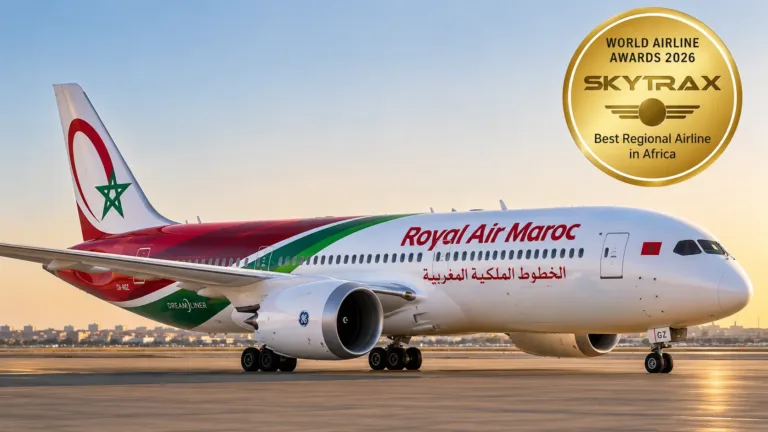
The airline has not yet provided a detailed installation sequence. Its Boeing 787 fleet would appear commercially important because of the duration and profile of long-haul services, but RAM has not officially said that Dreamliners will necessarily be first.
The 41-aircraft figure also points to a programme broader than long-haul alone. Depending on certification and installation schedules, parts of the narrowbody fleet could also become relevant as the rollout progresses.
Until RAM releases the implementation plan, any aircraft-by-aircraft assumptions should remain exactly that: assumptions.
Part of a wider fleet and customer-experience transformation
Royal Air Maroc is preparing for significant fleet growth over the coming years. The Starlink decision sits alongside that expansion rather than apart from it.
Chief executive Hamid Addou has framed the partnership as part of a broader overhaul covering fleet renewal, cabin improvements and the passenger experience both on the ground and in the air.
That timing matters. Installing a modern connectivity platform while the fleet is being renewed can help the airline establish a more consistent product standard across new and existing aircraft.
Starlink is becoming harder for airlines to ignore
SpaceX has rapidly expanded Starlink’s aviation footprint. Airlines are attracted by the prospect of high throughput, lower latency and an experience that can support the same digital behaviour passengers use at home or in the office.
But the technology still has to be integrated aircraft by aircraft. Antennas, certification, maintenance planning and downtime all affect rollout speed. Royal Air Maroc’s phased 2027 schedule reflects those operational realities.
The first-mover advantage will depend on execution
The announcement gives RAM a clear communications advantage today. Maintaining that lead will depend on how quickly the 41 aircraft are equipped, how consistently the system performs across the network and how simple the passenger access model proves to be.
If Royal Air Maroc delivers at scale, however, the significance will go beyond faster internet. An African airline will have moved early on a cabin technology that some much larger international competitors are only beginning to adopt — and that could strengthen Casablanca’s ambitions as a global connecting hub.
Sources: Royal Air Maroc, 7 October 2026; Starlink; RAM statements reported by Le Desk, Le360 and TelQuel. Visual: Royal Air Maroc / Starlink.

Leave a Reply