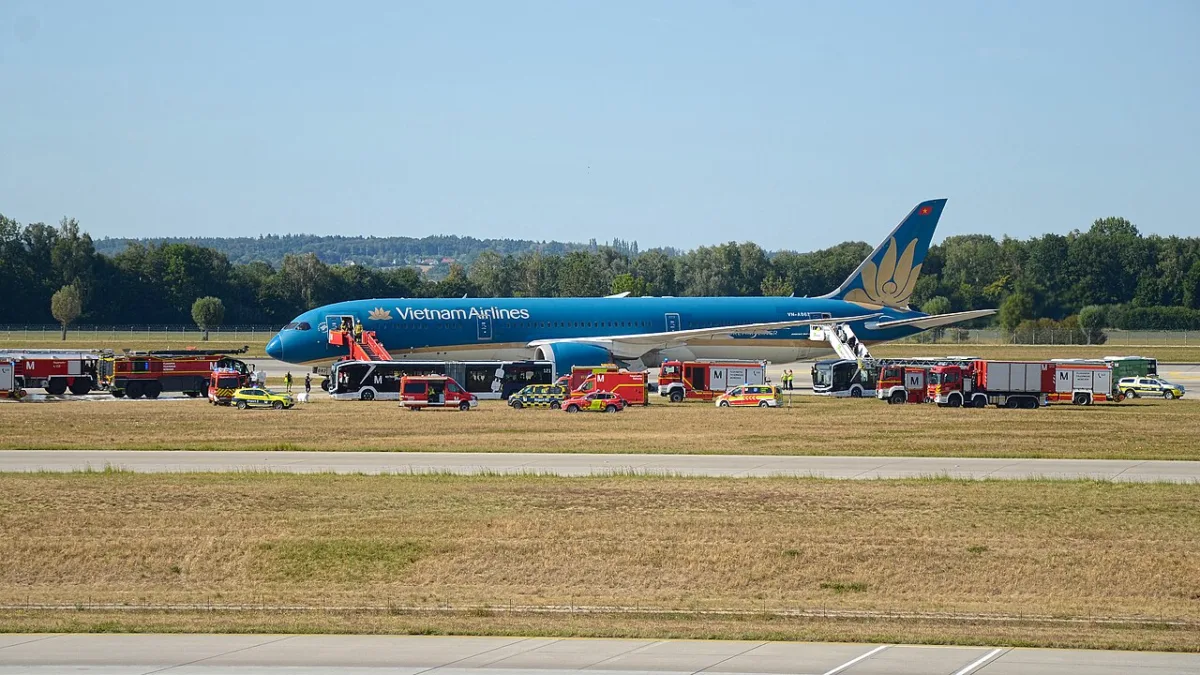
Germany’s BFU interim report has given the Vietnam Airlines VN34 investigation a much firmer factual basis: flight-recorder data show braking inputs during the Boeing 787-9’s takeoff roll at Munich. The report documents what the aircraft did, but it does not yet establish why the braking occurred or assign responsibility.
What happened on runway 26L
On August 15, 2026, Vietnam Airlines Boeing 787-9 VN-A867 was departing Munich for Hanoi with 271 passengers and 16 crew members. The aircraft used almost the full length of runway 26L, travelled beyond the paved end before becoming fully airborne and suffered a tail strike.
The crew later returned to Munich after dumping fuel. None of the 287 people on board was injured, although the aircraft sustained significant damage to the main landing gear and rear fuselage area.
Recorder data show two braking sequences
According to the BFU, the flight data recorder captured a first input on both brake pedals at the left pilot seat only seconds after takeoff mode had been activated. A second braking sequence was recorded later in the ground roll.
Those inputs reduced acceleration while the takeoff continued. The new evidence helps explain why the aircraft’s acceleration was abnormal, but it does not explain the origin of the inputs.
Why the cause remains open
The interim report does not establish whether the braking was deliberate, inadvertent, related to crew action, a technical issue or another factor. Investigators still have to determine how the crew perceived the aircraft’s performance, how the braking events fit into the cockpit sequence and why the takeoff continued rather than being rejected.
A 4,000-metre runway did not remove the risk
Munich’s runway provided roughly 4,000 metres of available distance, but a heavy long-haul aircraft can consume that margin rapidly when acceleration is lower than expected. The extremely late rotation meant the 787 passed beyond the paved surface before fully lifting off.
That is why the investigation is focused not only on the braking inputs themselves, but on the relationship between acceleration, decision-making and the remaining runway margin.
What investigators still need to establish
The BFU is continuing work on the recorders, aircraft systems, operational procedures and human factors. Until the final report is published, attributing the event to pilot error, a technical malfunction or any other single cause would be premature.
AeroSillage takeaway: the recorder data narrow the investigation, but they do not close it. The critical question is now why braking occurred during the takeoff roll and why the aircraft continued once its expected performance had degraded.
Source
Bundesstelle für Flugunfalluntersuchung (BFU), interim report on Vietnam Airlines flight VN34; operational flight data and specialist aviation reporting.

Leave a Reply