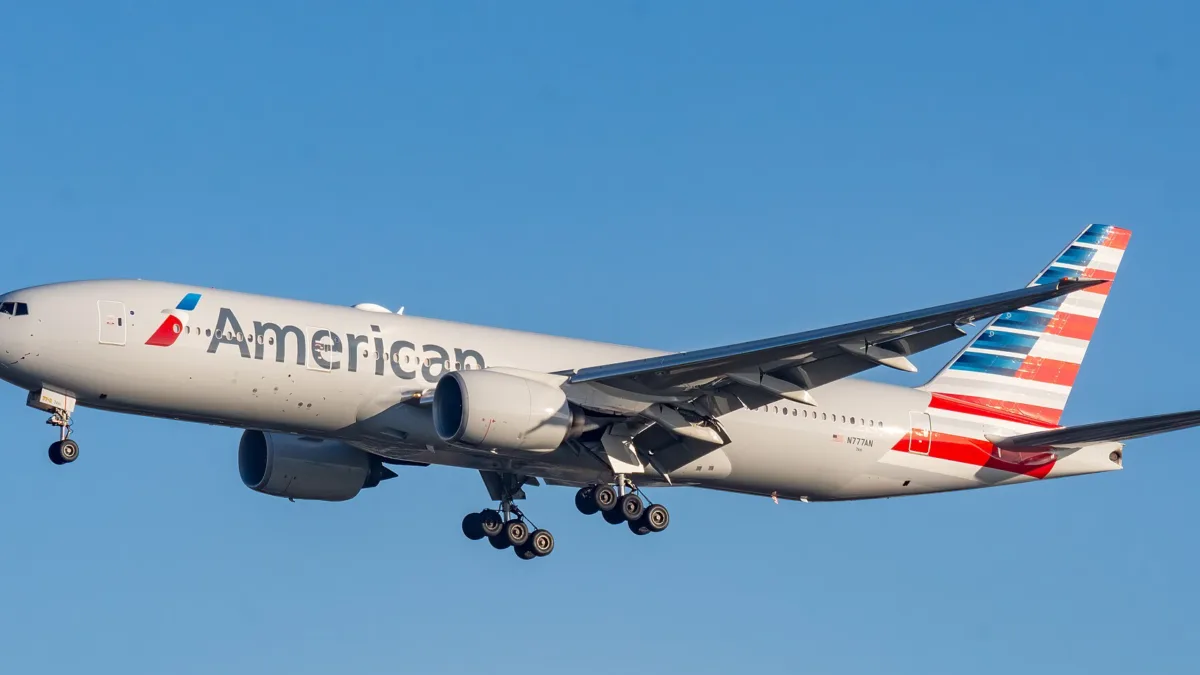
Six of eight lavatories stopped working aboard an American Airlines Boeing 777-200ER crossing the Atlantic on October 6, 2026. Flight AA37, originally bound from Madrid to Dallas-Fort Worth, diverted to New York JFK instead. The unusual disruption highlights a side of airline operations that rarely makes headlines: passenger-service systems can become serious operational constraints even when an aircraft remains capable of flying.
There were 287 people aboard the aircraft, identified as N772AN, leaving just two usable lavatories for everyone on the flight. Reports describe a PAN PAN urgency call before a safe landing at JFK. The aircraft later continued to Dallas after an extended stop.
American Airlines confirmed that the flight carried 275 passengers and 12 crew members. The carrier said the Boeing landed normally at JFK, underwent a maintenance inspection and then departed for Dallas. It apologized to customers for the disruption.
How the transatlantic itinerary changed
The aircraft departed Madrid-Barajas on its scheduled route to Dallas-Fort Worth. Once the lavatory problem became significant, the crew opted for the major East Coast gateway rather than continuing across the United States. Flightradar24’s flight history shows AA37 operating from Madrid to JFK on October 6 and then onward from JFK to Dallas using the same registration.
A PAN PAN call signals urgency and requests the attention of air traffic control. It is not synonymous with a MAYDAY distress call, and it should not be taken on its own as proof that an aircraft faced imminent danger. Public accounts confirm the diversion and the widespread lavatory failures, but they do not provide a complete technical reconstruction of how the problem developed.
Why a lavatory problem can change a flight plan
Passengers may reasonably wonder why pilots would divert a flyable jet because of toilets. The answer lies in what must be maintained throughout a long passenger flight, not simply whether the aircraft can continue through the air. With 75% of its lavatories unavailable, queues, hygiene and the needs of passengers requiring frequent access can rapidly become difficult to manage.
There is no universal rule requiring an immediate diversion whenever a set number of onboard toilets fail. The remaining flight time, the number of passengers, available alternatives and conditions inside the cabin all influence a crew’s judgment. Procedures governing dispatch with an inoperative component also differ from decisions taken when equipment fails after departure.
JFK offered a substantial airport infrastructure for handling the Boeing 777 and its passengers. Choosing it turned a cabin systems problem into an unscheduled stop, but avoided extending the situation for the remainder of the trip to Texas.
Operational judgment, not evidence of a fleet-wide defect
AA37 illustrates the distinction between airworthiness and the practical conditions of passenger carriage. Engines and flight controls may be functioning normally while cabin conditions no longer support the planned itinerary. Airlines and crews must weigh the implications for travelers as well as aircraft operations.
Publicly available reporting does not establish the precise cause of the lavatory failures. The event therefore does not, by itself, show a recurring design problem with the Boeing 777 or a broader maintenance failure at American Airlines.
The jet eventually reached Dallas, but the stop in New York demonstrates that what seems like a minor inconvenience on the ground can reshape a transatlantic journey. For wider fleet context, see AeroSillage’s reporting on American Airlines’ long-haul fleet plans.
Sources: FOX 4 Dallas, American Airlines statement, October 7, 2026; CNN, FAA statement, October 6, 2026; Flightradar24 AA37 history; AeroCorner, October 7, 2026; Airwork, October 7, 2026. Illustrative photo: American Airlines 777-200ER N777AN, not incident aircraft N772AN. © Mitchell R. Hope / Wikimedia Commons, CC BY-SA 2.0 (cropped and WebP optimized).

.jpg)
Leave a Reply