
Varig Flight 967, six men and a Boeing 707 lost over the Pacific
A Varig Boeing 707 vanishes after leaving Tokyo, taking six crew and valuable paintings with it. A documented investigation of the evidence and the myths.
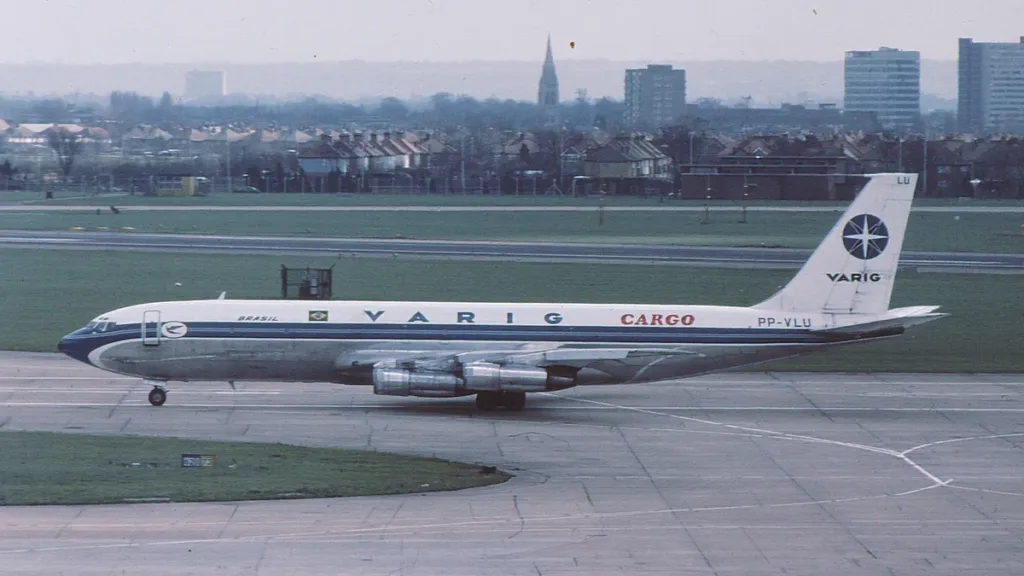
On 30 January 1979, a Varig Boeing 707 freighter departed Tokyo for Los Angeles. Six men were aboard, along with commercial cargo and paintings by a celebrated artist. The aircraft never reached its first stop. Nearly half a century later, the loss of Flight 967 remains one of commercial aviation’s most haunting unresolved disappearances.
A photograph taken at London Heathrow on 26 March 1978 shows the aircraft itself: a Boeing 707-323C wearing Varig colours and the registration PP-VLU. Delivered to American Airlines in 1966 as N7562A, airframe 19235 had entered service with the Brazilian airline in 1974. By January 1979, its work was to carry cargo between continents, not passengers.
The Tokyo shipment was substantial. Contemporary Brazilian reporting, revisited decades later by UOL, describes around 20 tonnes of freight, including electrical and electronic equipment, ship parts, computer components, sewing machines and paintings. The artwork belonged to Manabu Mabe, the Japanese-born Brazilian abstract painter, and was returning from an exhibition in Japan. Los Angeles was the next stop, with Lima and Rio de Janeiro listed on the onward route in specialist accounts.
The captain, Gilberto Araújo da Silva, had accumulated approximately 23,000 flight hours, according to accident histories. But his name carried another memory. On 11 July 1973, he had commanded Varig Flight 820, a Boeing 707 approaching Paris-Orly when an inflight fire filled the cabin with smoke. He brought the aircraft down in a field short of the airport. 123 people died; he survived. That terrible event had left physical evidence investigators could examine. Six years later, another 707 under his command would disappear without that possibility.
30 January 1979, Narita
Araújo da Silva’s five colleagues were first officer Erni Peixoto Mylius, fellow pilots Antonio Brasileiro da Silva Neto and Evan Braga Saunders, and flight engineers José Severino Gusmão de Araújo and Nicola Exposito. A replacement crew was reportedly scheduled to take over in Los Angeles.
The departure may already have been running late. In a 2014 retrospective, UOL journalist Wellington Ramalhoso revisited contemporary Folha de S.Paulo reporting of a delay of nearly two hours associated with maintenance. The surviving account does not identify the maintenance work. At 8:23 p.m. Japan time, the Boeing took off from Narita and headed out over the Pacific.
From here the chronology contracts into a few reported radio times. The Bureau of Aircraft Accidents Archives and several aviation summaries place a contact at 8:45 p.m., twenty-two minutes after takeoff. Brazilian journalist Ricardo Gallo, writing for Folha de S.Paulo in 2014, gives 8:55 p.m. instead. Accounts also differ on the aircraft’s location: some refer to an area roughly 200 kilometres east-northeast of Tokyo, while others speak of approximately 500 kilometres from the Japanese coast. Without an original radio log available for comparison, neither version can be turned into a precise final position.
A further report was expected at about 9:23 p.m.. It did not come. There was no authenticated distress transmission describing a fire, a mechanical emergency or a struggle to control the aeroplane. Flight 967 simply failed to answer, then failed to arrive.
Japanese and American search efforts followed. Aircraft and ships searched the Pacific, but the days passed without a confirmed piece of wreckage. The six crew members were not recovered. With no aircraft to examine and no dependable crash position, investigators could not establish whether its end involved a structural failure, a fire, a pressure-system problem or some other event.
The paintings and the stories they inspired
Mabe had moved from Japan to Brazil as a child, worked on his family’s coffee plantation and become a leading figure in abstract painting. His shipment gave the loss an unusual second storyline. The specialist accident archive lists 53 paintings, worth an estimated US$1.24 million in 1979. Other reports give the number as 153. An original cargo manifest was not available for this investigation, so the discrepancy remains part of the historical record. Brazilian reporting also described insurance of $10,000 per painting, below what the artist believed the works were worth.
The valuable shipment encouraged speculation about a planned theft or a hijacking. Yet a theory built around the paintings must also account for a missing four-engine aircraft, six crew members and many tonnes of unrelated freight. The reviewed sources provide no authenticated evidence of a diversion or the sale of the missing artwork. Other rumours, including a Soviet interception and secret military cargo, belong to the Cold War mythology surrounding the case rather than to its established record.
A less cinematic possibility is rapid depressurisation. At cruising altitude, a serious loss of cabin pressure can deprive crew members of oxygen. If they become incapacitated, an aircraft may, under certain conditions, continue on autopilot until its fuel runs out. Gallo’s Folha investigation includes recollections from Maria Letícia Chavarria, the captain’s daughter, who said Varig had mentioned depressurisation as a possible explanation. It remains a scenario, not a finding: no recovered aircraft or confirmed flight data supports it in this case. Nor can a fire or another sudden emergency be established.
The comparison with Flight 820 is revealing for a reason beyond the captain’s remarkable history. In 1973 investigators had a damaged aircraft, evidence of fire and survivors to question. In 1979 they were left with conflicting radio accounts, an open stretch of ocean and no identified wreck. That difference determines how much can responsibly be said about each event.
The years after the search
On 31 January 1979, the Brazilian press led with the disappearance of the “hero pilot of Orly”. The search became news, then the lack of results became news. But for the families, the story did not end when the search operations did.
A Folha report dated 29 February 1980, revisited by UOL, said Varig still had no explanation more than a year later. The same account reported that the six men’s families had received compensation. When Brazilian journalists returned to the case in 2014, relatives and a former Varig pilot were still confronting unanswered questions.
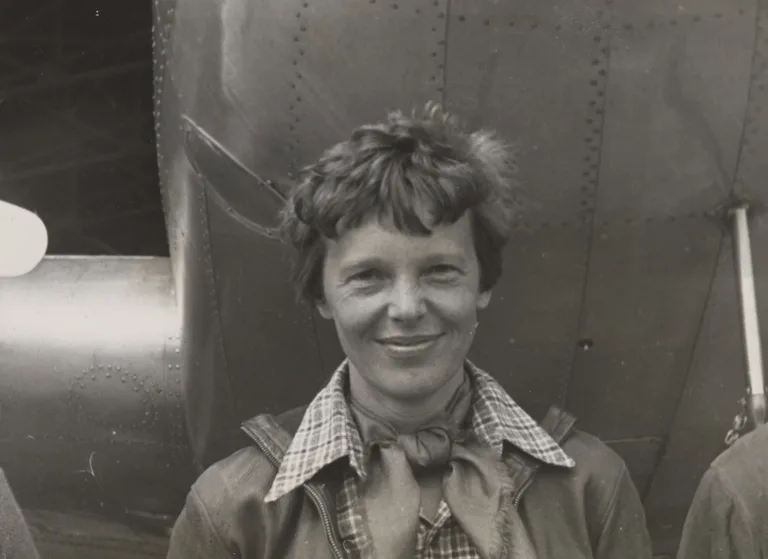
Other missing aircraft have shown how much an investigation depends on physical traces. Our investigation into Amelia Earhart’s disappearance follows another search in which an intriguing lead had to be tested against the material evidence. Flight 967 has not yet offered even that opportunity. Its confirmed story stops in the air between Tokyo and Los Angeles, with six men aboard and an aircraft that has never been conclusively located.
Sources: Ricardo Gallo, Folha de S.Paulo, 2014; Wellington Ramalhoso, UOL, 2014; Bureau of Aircraft Accidents Archives; Fear of Landing; Aerial Visuals, PP-VLU airframe history.
JOIN THE CONVERSATION
Let’s discuss this story.
A question, a clarification or a different perspective? Share it with us.