
Etihad Boeing 787 Enters Active Runway at Boston Logan, Forcing Regional Jet to Go Around
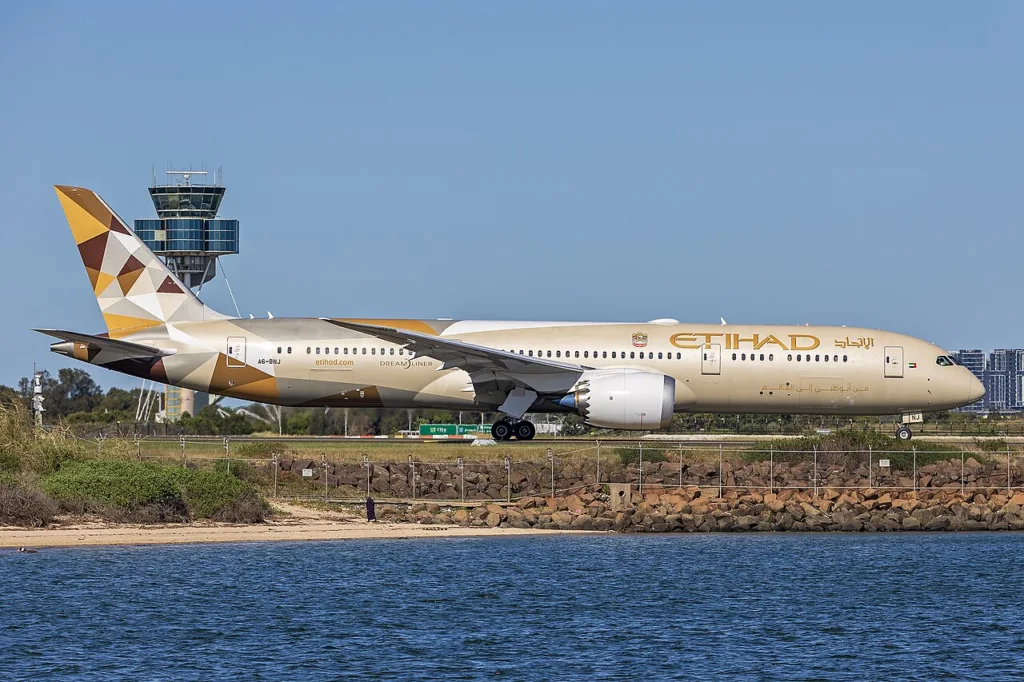
Etihad Boeing 787-9 A6-BNJ in Sydney, 2025. © Robert Myers / Wikimedia Commons, CC BY-SA 3.0 AU.
An Etihad Airways Boeing 787-9 entered Runway 4L at Boston Logan International Airport without clearance on 15 October 2026, prompting a regional jet on approach to go around. The Dreamliner’s pilots had correctly read back an instruction to hold short of the runway but continued taxiing beyond the holding point.
The aircraft, registered A6-BNJ, had just arrived from Abu Dhabi as flight EY7. On its way to the terminal, the crew was instructed to follow taxiways R and N and stop before Runway 4L, known as 22R when used in the opposite direction. The pilots acknowledged the clearance correctly over the radio.
The Boeing nevertheless crossed the runway holding position and entered the protected area. Republic Airways flight 5739, an Embraer 175 operating for Delta Connection, was approaching the same runway to land. According to a reconstruction based on air traffic control recordings and flight tracks, the controller told the Etihad crew to stop and then instructed the Republic aircraft to go around.
The Embraer abandoned its approach, climbed away and subsequently returned to land. A go-around is an established safety procedure when an intended landing cannot safely continue; the manoeuvre does not, by itself, show that a collision was imminent.
With the Etihad aircraft already on the runway, the tower subsequently cleared it to complete the crossing on taxiway N and hold short of Runway 15L. The Dreamliner then received the necessary clearances for the remaining runway crossings on its way to the terminal.
As the aircraft approached its parking position, ground control advised the crew of a possible pilot deviation and provided a telephone number to call. In US aviation, such a notification alerts pilots to a potential departure from air traffic control instructions. It is not itself a penalty or a final finding of responsibility.
Publicly available information does not establish why the crew crossed the holding point after correctly acknowledging the instruction. No official severity classification has been reported for the incursion. The Boston sequence highlights a basic distinction in runway safety: reading back a hold-short instruction confirms receipt, but keeping the runway clear depends on following it.


JOIN THE CONVERSATION
Let’s discuss this story.
A question, a clarification or a different perspective? Share it with us.