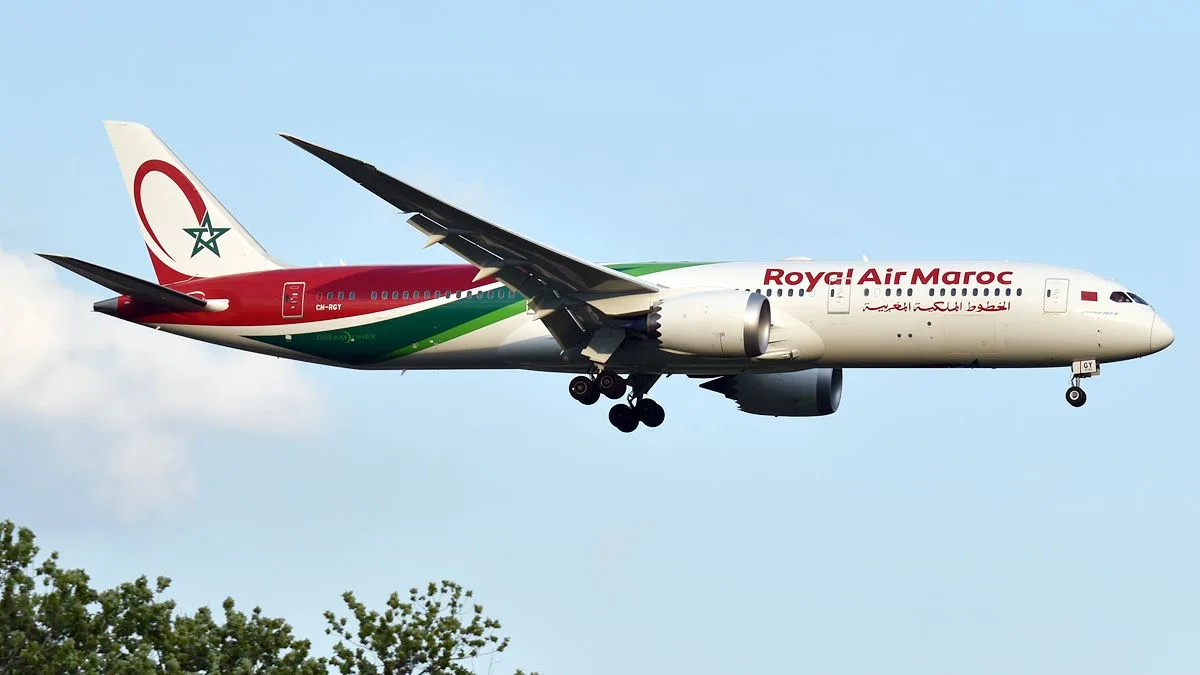
Royal Air Maroc has entered a new phase of its history. After returning to profitability, joining oneworld, strengthening long-haul flying and accelerating fleet renewal, Morocco’s flag carrier is now pursuing a major change of scale. The ambition is clear: turn Casablanca into a major intercontinental hub and progressively grow the fleet towards 200 aircraft.
But the trajectory also carries real vulnerabilities: thin margins, dependence on public support, pressure on the Casablanca hub, uneven disruption handling, baggage issues, refunds and customer service. AeroSillage’s reading of the public data is therefore positive but cautious: RAM has clearly crossed a strategic threshold, but the next test is execution.
Profitability restored, growth accelerating and public support
According to the Moroccan public-enterprise report accompanying the 2026 finance bill, Royal Air Maroc generated MAD19.944 billion in revenue in 2024. Operating profit reached MAD605 million and net profit MAD473 million, up 7% year on year.
The document presents that net result as the best of the decade. But a net margin of about 2.4% remains narrow for an airline and can be eroded quickly by fuel, currency movements, disruption or aggressive competition.
Royal Air Maroc is still overwhelmingly state-backed. At the end of 2025, share capital stood at about MAD42.122 billion. The Moroccan state held 55.15%, Fonds Hassan II 44.52%, and private shareholders only 0.33%.
That structure means RAM is not just a commercial airline. It is also a national-connectivity tool, a tourism instrument, an African diplomatic asset and part of Morocco’s wider transport strategy.
The central challenge is therefore to convert public support into profitable growth rather than simply more capacity.
RAM says it carried 8 million passengers in 2025, served more than 100 destinations and operated an average of 1,471 flights per week.
Summer 2026 marked another record, with nearly 8.2 million seats scheduled: around 23% more than summer 2025: across 86 international destinations.
The strategy is increasingly about more than Morocco–Europe traffic. RAM wants Casablanca to connect sub-Saharan Africa with Europe, the Middle East and the Americas. Casablanca–Los Angeles is one example of that intercontinental ambition.
Joining oneworld in 2020 was one of the most important moves in RAM’s recent history. It became the alliance’s first full African member.
For a medium-sized airline, the alliance multiplies network reach. RAM can sell connections beyond its own map while feeding Casablanca with passengers from partners.
But the flip side is higher expectations: passengers naturally compare RAM’s reliability, digital integration and service with other oneworld members.
Fleet, Casablanca hub and the 200-aircraft bet
Royal Air Maroc communicates a fleet of about 69 aircraft with an average age close to 12 years.
Its published fleet includes roughly 17 Boeing 737 MAX 8s, 27 Boeing 737-800s, 7 Boeing 787-8s, 6 Boeing 787-9s, 4 Embraer 190s, 6 ATR 72-600s and a Boeing 767 freighter, though totals can vary slightly depending on the update date.
The 787 is now central to long-haul flying, while the 737 MAX gradually modernises the narrowbody fleet. The transition must balance lower fuel burn against financing costs and the need to maintain high aircraft availability.
The 2023–2037 state-airline programme targets a fleet of up to 200 aircraft, with an intermediate level of roughly 130 around 2030.
That ambition fits Morocco’s tourism growth, airport investment and the 2030 World Cup. But moving from around 70 aircraft to well over 100 in only a few years is an industrial challenge.
Aircraft deliveries alone are not enough. The airline also needs pilots, cabin crew, engineers, ground staff, planners, slots, profitable routes and airports able to absorb the traffic.
Casablanca-Mohammed V is the heart of the strategy. Its geography is naturally favourable for connecting Europe, Africa and the Americas.
But a hub multiplies the impact of irregular operations. A late arrival can trigger missed connections, baggage misconnects and downstream delays across the network.
Morocco’s investment in a new Casablanca terminal is therefore as important to RAM as new aircraft. A 130- or 200-aircraft airline cannot operate efficiently through an undersized hub.
Punctuality, disruption handling and customer experience
RAM reported an 82% punctuality rate in 2025. That is positive, but the airline does not publicly detail every methodological element behind the figure, including the delay threshold and precise flight perimeter.
The deeper question is disruption recovery. In a hub model, a two-hour delay can have much greater consequences for a connecting passenger than for a point-to-point traveller.
As of September 20, 2026, RAM’s Trustpilot profile showed 2,068 reviews, an average of 1.3/5 and 92% one-star ratings.
The recurring complaints concern delayed or lost baggage, refunds, difficulty reaching customer service and poor support after cancellations or missed connections.
These platforms are not representative surveys of all passengers: unhappy customers are more likely to post: but repeated complaint themes are still a useful qualitative signal.
Skytrax 2026 placed Royal Air Maroc fourth among African airlines. It also ranked first in Africa among regional airlines and eighth globally in that category.
That creates a striking contrast: strong institutional recognition and alliance positioning coexist with a weak reputation among a segment of disrupted passengers.
Closing that gap may be one of the airline’s most important tasks.
Competition, Morocco’s growth market and execution risks
RAM faces intensifying competition from Ryanair, easyJet, Transavia and other low-cost carriers on Morocco–Europe traffic.
That limits pricing power on direct short-haul routes. RAM’s real advantage is therefore less about matching the lowest fare than about network breadth, African connectivity, long-haul flying, baggage, loyalty and connections.
Morocco offers an unusually strong demand environment: record tourism, fast-growing airports, a large diaspora, major public infrastructure spending and the 2030 World Cup.
That creates opportunity: but also raises the cost of failure. If fleet and capacity grow faster than operational organisation, disruption can scale just as quickly as traffic.
- Growth too fast for the organisation: aircraft arriving faster than crews and infrastructure can absorb them.
- Thin margins: a 2.4% net margin leaves limited room for cost shocks.
- Hub saturation: Casablanca must expand with the network.
- Disruption handling: baggage, refunds and communication can damage the brand quickly.
- Competition: low-cost carriers in Europe and major global airlines on long-haul limit pricing power.
The real test: scaling up without degrading operations
Royal Air Maroc has clearly crossed a threshold: it is profitable again, belongs to a major global alliance, is renewing its fleet and benefits from one of Africa’s strongest aviation-growth markets.
But the difficult phase is the next one: turning a roughly 70-aircraft carrier into a much larger airline without losing punctuality, cost discipline or service quality.
RAM has many of the ingredients of a future major African intercontinental carrier. Its success will depend on whether operational quality can grow as fast as the fleet plan.
Main sources
Royal Air Maroc key figures and fleet information; Moroccan public-enterprise budget report; oneworld; Skytrax; public traffic and infrastructure data.

Leave a Reply