
Royal Air Maroc expands its fleet as claims of soaring profits remain unverified
Royal Air Maroc is adding aircraft and planning more services from Casablanca to Toronto, São Paulo and Beijing. Claims of a 150% profit increase lack comparable published accounts.
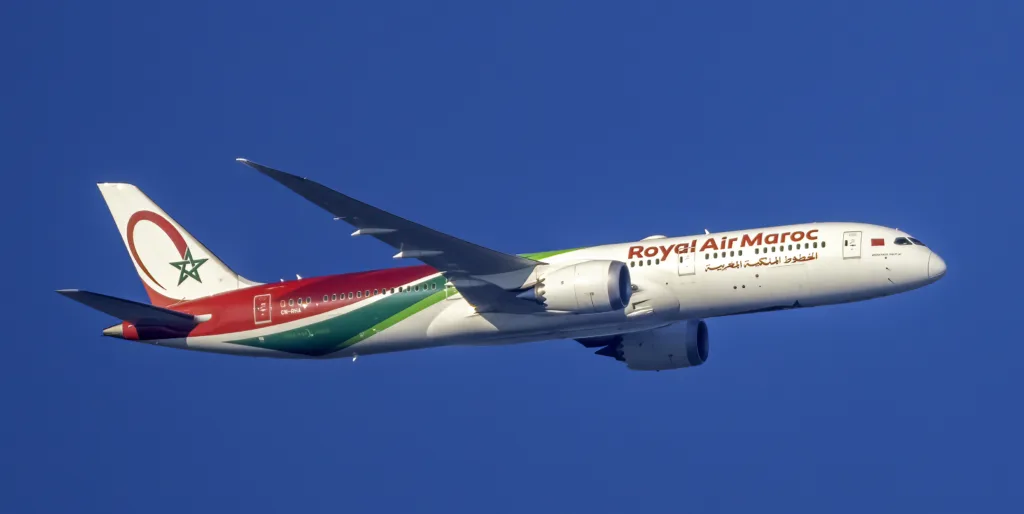
Royal Air Maroc’s next stage of growth can be seen in its flight schedules and aircraft arrivals. Its reported profit surge is far less certain. From 26 October 2026, the Casablanca-based carrier plans additional flights to Toronto, São Paulo and Beijing. An Embraer E190 joined the fleet on 21 October, but claims of a 150% increase in profit have circulated without an identifiable set of accounts confirming the figure.
The expansion is part of Morocco’s effort to build Casablanca into a larger connecting hub. Its financial returns will become clearer only when comparable company accounts are available.
New frequencies across three continents
Schedule changes tracked by Aeroroutes and reported by Bladi show Casablanca–Toronto increasing from three to four weekly services from 26 October. São Paulo is due to rise from four to five on 28 October and Beijing Daxing from three to four on 29 October, with Boeing 787-9 aircraft planned for the Beijing route. The increases had previously been associated with summer 2027 but were brought forward to the winter 2026–27 schedule.
None of these is an entirely new destination. The changes give travellers more possible departure days and potentially more connecting options through Casablanca, but they remain scheduled increases until the flights actually operate. More capacity also brings higher fuel, maintenance, staffing and airport costs, so the commercial benefit depends on demand and fares, not simply on the number of seats offered.
Royal Air Maroc’s agreement with the Moroccan state for 2023–2037 envisages a fleet of 200 aircraft and approximately 31.6 million passengers annually. The first deliveries from a major new tender are expected in 2028. The current additions represent earlier stages of that longer programme, not evidence that its financial objectives have already been met.
What has reached the fleet
The Embraer E190 registered CN-RIA arrived in Casablanca on 21 October. Delivered originally to Kenya Airways in 2011 as 5Y-KYQ, it underwent maintenance at Exeter Aerospace in Britain before joining Royal Air Maroc under an Azorra Aviation lease. It is a previously operated regional jet, not a newly manufactured aircraft. Another E190, CN-RHW, is expected but should not be counted as delivered. If both enter service, the airline is expected to have six E190s.
Two Boeing 737 MAX 8 aircraft, CN-RHS and CN-RHT, arrived in late September, taking that fleet to 20. Published fleet inventories recorded more than 70 aircraft in September and 71 in early October; those historical snapshots are not verified totals following the latest delivery. A Boeing 787-8, CN-RHV, had also arrived in August, taking the reported Dreamliner fleet to 13 at that point.
Each type plays a different role. E190s and 737s can operate shorter services feeding the Casablanca hub, while Boeing 787s cover longer intercontinental sectors. The strength of that arrangement depends on workable connections and aircraft availability as much as on fleet size.
Why the profit claims need scrutiny
On 24 October, Atlasinfo reported a 150% annual rise in profit to more than two billion Moroccan dirhams, alongside a 3.5-billion-dirham investment programme. The publisher said the numbers had not been independently checked and did not specify the financial period. They cannot be presented as official confirmed results.
A more traceable reference comes from the Moroccan public-enterprise report accompanying the draft 2026 budget. For 2024 it gives revenue of 19.944 billion dirhams. Its explanatory text reports net profit of 473 million dirhams, up 7%, operating profit of 605 million and a net margin of 2.4%. A separate IFRS presentation in the same material gives net profit of 821 million dirhams. The available information does not establish the accounting basis for the difference, and it would be misleading to collapse the two into one figure.
There is an additional, but different, perspective in Médias24’s analysis of 12 October. A consultant expected the airline’s 2025–26 financial year, due to end on 31 October, to finish near break-even, with rising jet-fuel prices adding future pressure. That is an outside forecast rather than a company result. It does not disprove the Atlasinfo claim, whose period and calculation remain unspecified.
The next scheduled change is the increase to four weekly Casablanca–Toronto flights from 26 October, followed by more São Paulo and Beijing frequencies later in the week.
Sources: Bladi, schedules; Atlasinfo, reported profit claim; Médias24, 12 October analysis.
Read next

JOIN THE CONVERSATION
Let’s discuss this story.
A question, a clarification or a different perspective? Share it with us.