Paris Charles de Gaulle is preparing for a transformation that goes far beyond changing terminal signs. On March 16, 2027, the familiar 2A, 2B, 2C, 2D, 2E, 2F and 2G labels will give way to a simpler sequence from Terminal 1 to Terminal 7. Behind the renaming sits a much larger investment programme that will reshape the airport through 2034.
After the pre-pandemic mega-Terminal 4 project was abandoned, Groupe ADP changed strategy. Capacity will now be added in stages: making better use of existing buildings, increasing border and baggage capacity, expanding constrained terminals and then adding targeted new infrastructure.
Why Paris CDG is changing strategy after fifty years of growth
Charles de Gaulle has expanded layer by layer since 1974. Terminal 1 was followed by the sprawling Terminal 2 complex, eventually split into 2A through 2G, while Terminal 3 remained separate. The layout works operationally, but it can be difficult to decode for travellers unfamiliar with the airport.
That matters at a hub where more than 30% of daily passengers are connecting. ADP says customer feedback repeatedly points to wayfinding as a weakness, especially for international travellers moving between terminals and departure halls.
March 16, 2027: how the new Terminals 1 to 7 will work
The buildings will stay where they are. What changes is the naming logic: Terminal 1 stays Terminal 1; today’s Terminal 3 becomes Terminal 2; 2A and 2C become Terminal 3; 2B and 2D become Terminal 4; 2E becomes Terminal 5; 2F becomes Terminal 6; and 2G becomes Terminal 7.
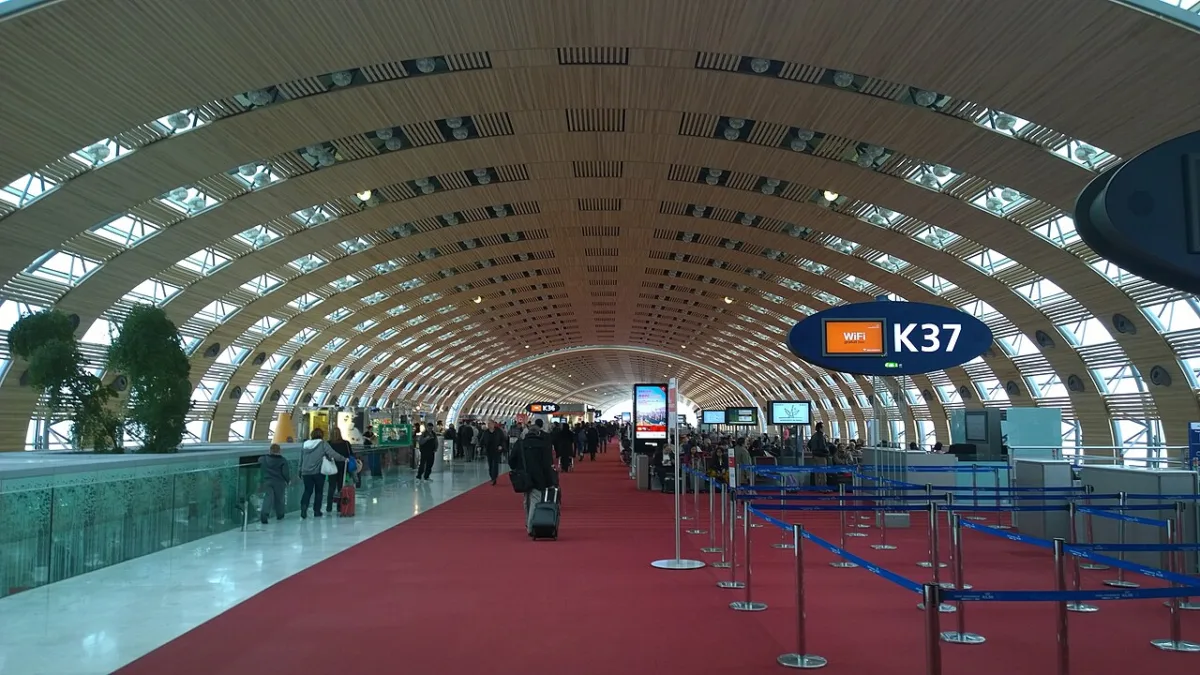
Departure areas will use letters: Terminal 1 gets S and R; Terminal 2, V; Terminal 3, F; Terminal 4, G and H; Terminal 5, B, C and D; Terminal 6, E; and Terminal 7, N.
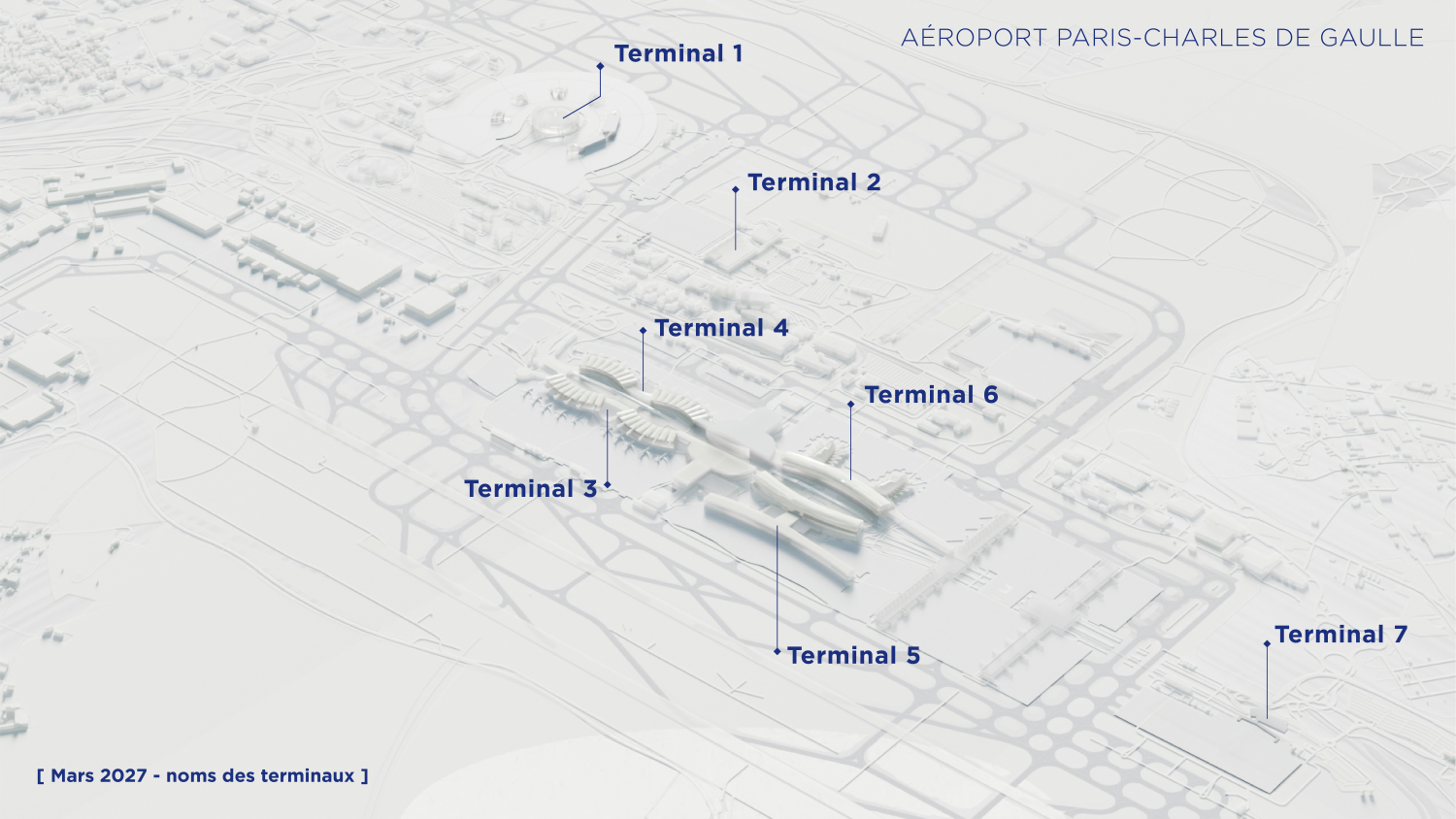
The principle is intentionally simple: numbers outside the terminal, letters inside. Parking areas will also carry the same number as the terminal they serve.
More than 3,000 signs inside terminals, around 600 parking signs and roughly 250 road-signage elements must be changed. Behind the scenes, some 10,000 CCTV camera allocations and hundreds of IT applications also need to be renamed or reconfigured.
New signage is due to be installed during 2026 and kept covered until the official switch. Airlines selling tickets far in advance must also begin using the new labels before the airport itself changes over.
Before Covid, CDG’s growth strategy centred on a huge new Terminal 4. The pandemic, revised traffic assumptions and environmental pressure changed the economics and politics of that approach. The project was dropped in its original form.
The new 2027-2034 programme is deliberately modular. ADP can add capacity where bottlenecks emerge rather than commit to one enormous building years ahead of demand.
Reworking the existing airport instead of building another mega-terminal
Terminal 1 will keep its number but not remain untouched. ADP plans new border-control infrastructure and changes to Schengen flows so that the existing building can handle passengers more efficiently.
Today’s Terminal 3, future Terminal 2, is set for one of the biggest transformations. Security, border control, baggage and boarding capacity will be expanded, and a new northern pier will bring more aircraft positions into a more efficient terminal operation.
ADP’s consultation documents attribute roughly four million additional annual passengers of capacity to the Terminal 3 programme, together with thirteen additional narrowbody stands.
Existing border areas at 2A and 2C will be expanded and reorganised. At 2E arrivals, ADP plans a new border-control building east of the terminal isthmus, while departure-side waiting and processing areas will also be enlarged.
These projects are critical because a hub cannot simply add gates. If border control, security and baggage systems do not grow at the same pace, congestion merely moves from one part of the journey to another.
The eastern satellite will reshape the heart of the hub
The most substantial new terminal structure will rise east of today’s 2E, future Terminal 5. It will be developed in stages, with the first phase planned around 2030 and a later phase toward 2034.
Unlike the former Terminal 4 project, the satellite is designed to integrate with the existing hub and add capacity progressively, including additional widebody contact stands.
The renaming contains an unusual twist. Terminal 2G will become Terminal 7 in 2027, yet ADP already plans its eventual closure and demolition to clear space for the eastern development.
That means replacement Schengen capacity has to be created elsewhere first. ADP estimates that capacity removed through existing infrastructure changes, including 2G, amounts to around 3.5 million annual passengers.
Borders, baggage and connections: the infrastructure passengers rarely see
CDG’s connection performance depends heavily on baggage transfer. The programme includes upgrades to sorting and storage systems intended to support larger connecting flows.
For Air France and its partners, which operate the hub in waves of arrivals and departures, baggage reliability can be as important as terminal square metres.
ADP plans the terminal renaming for the same date as the expected opening of the CDG Express rail link. The new numbering follows the way passengers approach the airport by road and rail, while car parks will share the number of their terminal.
Through 2034: about 14.1 million additional passengers of net capacity
The transformation is phased. Early projects include border works and existing-terminal upgrades, followed by the first eastern satellite phase and changes to the connection system around 2030. Later milestones include an extension of the LISA automated train, new internal transfer links, a new connection transport system planned around 2032, rehabilitation of runway 3 around 2033 and continued development of the eastern satellite through 2034.
The advantage of this approach is flexibility. The disadvantage is that CDG will remain a live construction site for years while continuing to process tens of millions of passengers.
ADP’s investment programme identifies about 17.6 million annual passengers of gross additional terminal capacity at CDG. After accounting for capacity removed or reconfigured, including 2G, the net gain is about 14.1 million annual passengers.
That is technical capacity, not a traffic forecast. Actual passenger volumes will still depend on airline strategy, demand, environmental constraints and European airspace capacity.
Air France is directly exposed to the work around 2E and 2F, the heart of its long-haul and connecting operation. More border capacity, more contact stands and stronger baggage systems could make the hub more resilient.
For foreign airlines, the renaming should simplify passenger information. But the transition itself will require precise coordination across ticketing systems, GDS displays, airline apps, airport screens and boarding passes.
The real test: transforming CDG without degrading the passenger journey
The success of CDG’s transformation will not be measured by architectural renderings. It will be measured by whether passengers can continue to connect reliably while parts of the airport are rebuilt around them.
On March 16, 2027 travellers will notice new numbers. In operational terms, however, that date will mark the visible beginning of a much longer redesign of France’s main international hub.
Main sources
Groupe ADP: terminal renaming
Groupe ADP: 2027-2034 investment programme
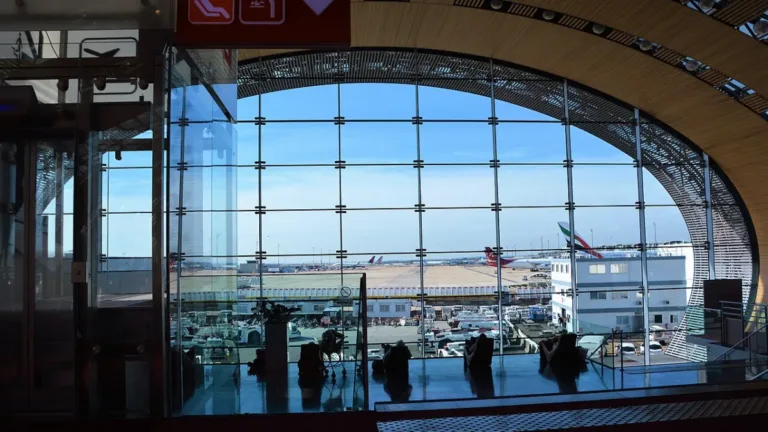
Main photo: Paris Charles de Gaulle Terminal 2E. 4net / Wikimedia Commons, CC BY 3.0.
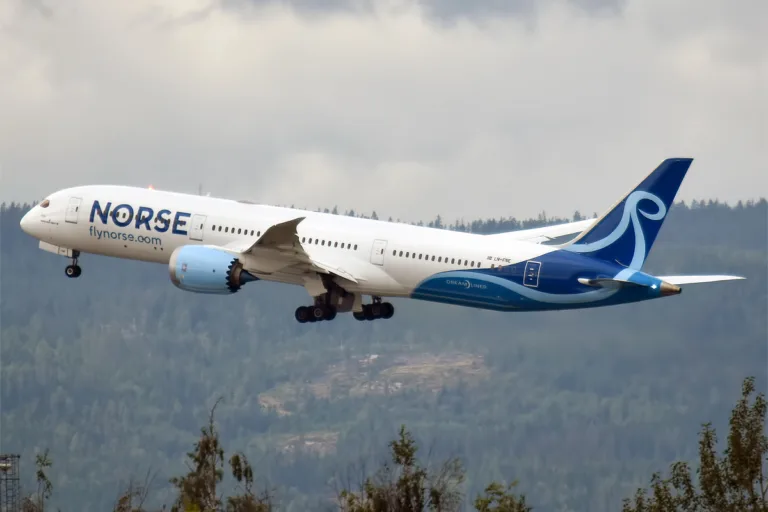
Related: Norse restructures at Paris-CDG while hiring elsewhere in Europe, another recent example of how airline strategy is evolving around the hub.