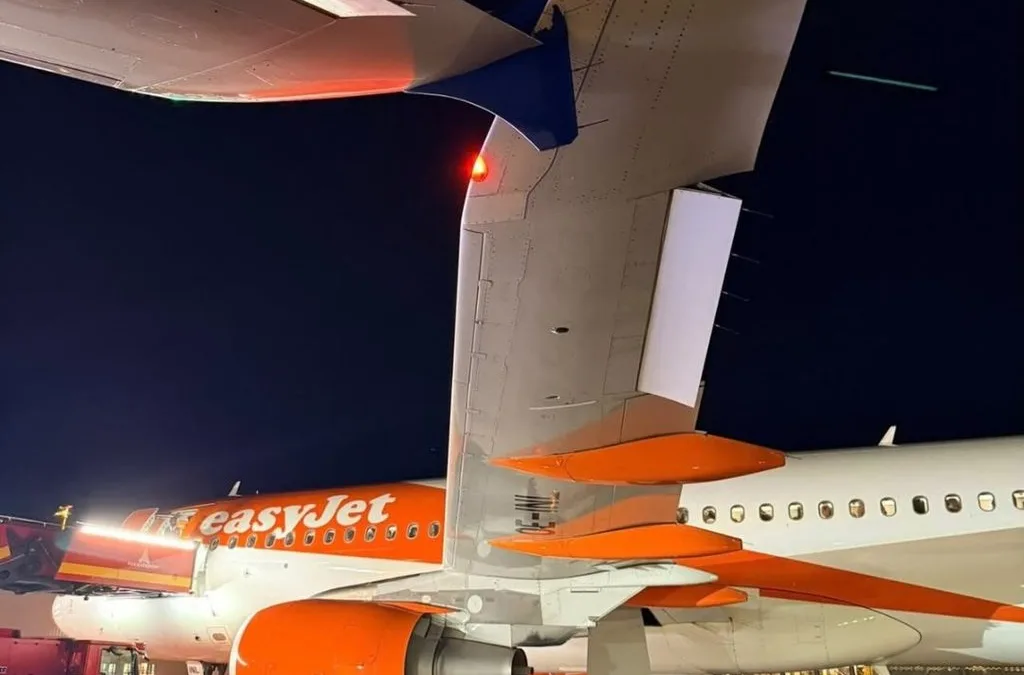
Air Serbia Airbus A320 YU-APS was back in scheduled service by 4 October, two days after its right wingtip was damaged in a ground contact with an easyJet A320 at Paris Charles de Gaulle. The incident occurred on Friday, 2 October, after the Serbian aircraft had arrived from Belgrade. Air Serbia said its jet was stationary on the manoeuvring area and waiting for further air traffic control instructions when the easyJet aircraft’s sharklet made contact. No passengers or crew were injured.
Photo credit: OpenSky.rs.
A short grounding after the Paris collision
YU-APS is an Airbus A320-232, manufacturer serial number 4716. It had operated flight JU242 from Belgrade to Paris CDG before the collision. Air Serbia said the aircraft was correctly stopped when the contact occurred and that damage was found around the right wingtip.
The airline removed the A320 from service for a detailed technical inspection and began coordinating with airport services and the other parties involved. The return flight JU243 was not operated normally by the same aircraft after the event, so the collision had an immediate operational consequence even though nobody was hurt.
That disruption proved brief. Flight-tracking information reported by Aero Telegraf and DJ’s Aviation indicates that YU-APS left Paris for Belgrade on 3 October as JU4243. On 4 October it was operating scheduled service again, including JU480 from Belgrade to Larnaca.
What the published evidence does and does not show
Air Serbia’s statement establishes several important points: its A320 was stationary, the other aircraft was an easyJet Airbus A320, the contact involved the easyJet sharklet and the right wingtip of YU-APS, and there were no injuries. Photographs circulated after the incident are consistent with localised wingtip damage.
The registration of the easyJet aircraft has not been confirmed publicly to a standard AeroSillage considers sufficient for publication. Nor does the fact that YU-APS was stationary, by itself, settle the complete chain of operational responsibility. Investigators still need to consider aircraft positions, ground clearances, instructions and the precise circumstances of the movement.
That distinction matters because a ground collision can look straightforward in photographs while the operational sequence is more complex. A parked or stopped aircraft may be only one element in a wider system involving taxi routes, stand geometry, wingtip clearance, air traffic control instructions and ground procedures.
Why a wingtip strike still matters
A sharklet is the tall wingtip device fitted to many Airbus A320-family aircraft. It improves aerodynamic efficiency in flight, but its position at the outer edge of the wing also makes wingtip clearance a critical issue during taxiing and other ground movements.
Even when visible damage appears limited, an airline cannot return the aircraft to passenger service on photographs alone. Maintenance teams must inspect the local structure, wingtip equipment and any possible secondary damage before release to service. In this case, the rapid return of YU-APS to regular operations is the important update: the aircraft was not left in a prolonged grounding after the Paris event.
The remaining open questions concern the exact easyJet aircraft involved and the final operational account of how the two wingtips came into contact. Until those points are established by sufficiently robust sources, AeroSillage is keeping them separate from the facts already confirmed.
Main sources: Air Serbia; public flight-tracking data; Aero Telegraf; DJ’s Aviation; AviationTrack; EX-YU Aviation News; OpenSky.rs.
Leave a Reply