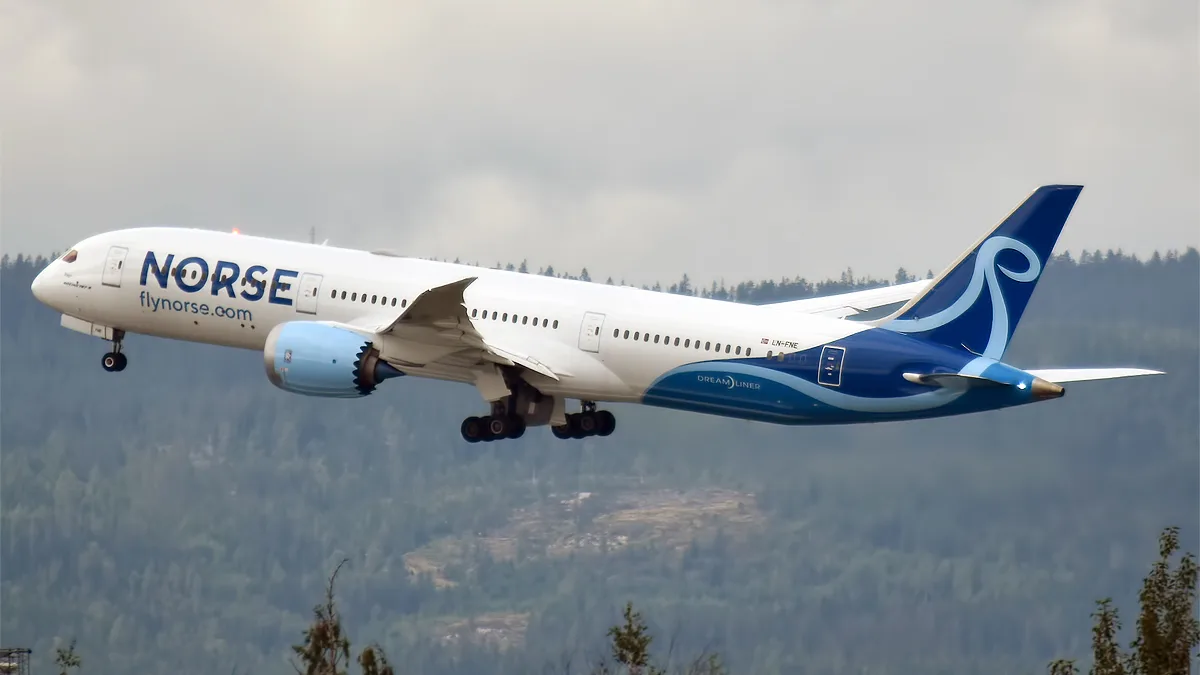
Norse Atlantic Airways is reshaping its European operating footprint in 2026, and Paris-Charles de Gaulle is among the locations facing pressure as the airline pursues a wider cost-cutting and flexibility programme. While jobs are being reduced in France, Norse is simultaneously recruiting cabin crew elsewhere in Europe, including Athens for the 2026/27 winter season.
The overlap is striking, but it requires context. It does not automatically mean that a position removed in Paris is being recreated on a one-for-one basis in Athens or London. Contracts, qualifications, seasonal needs, labour law and base economics differ. What it does show is how aggressively Norse is moving towards a more flexible model for deploying its Boeing 787 fleet and crews.
Project Falcon targets up to $50 million in annualised savings
On 7 May 2026, Norse Atlantic announced an acceleration of its Project Falcon cost programme, targeting up to $50 million in annualised savings against its 2025 cost base.
The measures include around 75 administrative job cuts across the group, equivalent to roughly 35% of administrative headcount, consolidation of functions, relocation of the corporate headquarters from Arendal to Oslo, temporary crew furloughs, temporary pay reductions for some non-flying staff and a more flexible base structure.
Those 75 positions are a group-wide administrative figure. They should not be interpreted as 75 redundancies at Paris-CDG. Norse has not published a sufficiently detailed public breakdown to establish the final number of French jobs affected.
In its second-quarter 2026 reporting, Norse still listed a Paris office alongside Oslo-Gardermoen, London Gatwick, Fort Lauderdale and its operational headquarters in Riga. At 30 June, the group reported 1,071 employees, including 803 flight crew and 268 engineering, maintenance and office staff.
That administrative presence does not mean activity or staffing at CDG is unchanged. Norse has explicitly said it wants a structure that allows aircraft and crews to be redeployed more quickly toward markets and contracts offering stronger returns.
Athens cabin crew recruitment highlights the contrast
At the same time, Norse has recruited seasonal cabin crew for an Athens base for the 2026/27 winter programme. The campaign targeted experienced European cabin crew for Boeing 787 operations.
This matters because it shows that Norse is not operating a blanket hiring freeze. Instead, it is cutting costs and resizing some parts of the business while hiring selectively where future flying requires additional staff.
For employees facing restructuring in Paris, that distinction may offer little comfort, but it is operationally important. A seasonal Greek contract is not automatically interchangeable with a French permanent contract, and mobility depends on local employment rules, staffing needs, qualifications and the terms attached to each base.
French collective agreements add another layer
Norse cabin crew based at Paris-CDG are covered by a French collective agreement running from 1 April 2025 to 31 March 2028.
In the event of workforce reductions, the agreement provides for seniority considerations, possible reassignment to another base where feasible, preservation of seniority and, where possible, rank, as well as a 24-month re-employment right.
It also states that temporary or seasonal contracts should not be used as part of a reduction in permanent employment at the French base. That clause does not automatically govern recruitment under another country’s employment law, but it makes the question of internal mobility particularly relevant.
A separate agreement covering Norse pilots in France requires specific negotiations where an activity reduction would trigger a collective redundancy process, with the aim of avoiding or limiting economic dismissals.
The agreement also places limits on the use of fixed-term pilot contracts when permanent staffing is being reduced.
Why Norse is moving toward a more flexible model
The Paris situation is part of a wider strategic shift. Norse is increasingly trying to balance its own scheduled network with ACMI activity and seasonal deployment of aircraft.
That transformation comes despite very strong load factors on parts of its network. High seat occupancy alone does not guarantee profitability if fuel, financing, staffing and aircraft utilisation costs remain too high.
What matters next for Paris-CDG
Three questions now matter most for employees in France: how many positions will ultimately be affected at Paris-CDG, what redeployment options will be offered, and how the protections contained in the French agreements will be applied in practice.
The parallel recruitment in Athens shows that Norse is not withdrawing from the European aviation labour market. It is redistributing capacity and staffing around the locations and contracts it believes best fit its future network.
AeroSillage is deliberately not publishing a specific Paris redundancy figure until it can be supported by an official company, works council or union document.
Sources
Norse Atlantic Airways: Project Falcon
Norse Atlantic: 2026 interim reporting
Paris-CDG cabin crew collective agreement
Norse France pilot collective agreement
Norse Atlantic Airways: seasonal cabin crew recruitment in Athens
Related: Paris CDG: new terminal names and expansion through 2034, for the wider context around changes at the French hub.
Leave a Reply