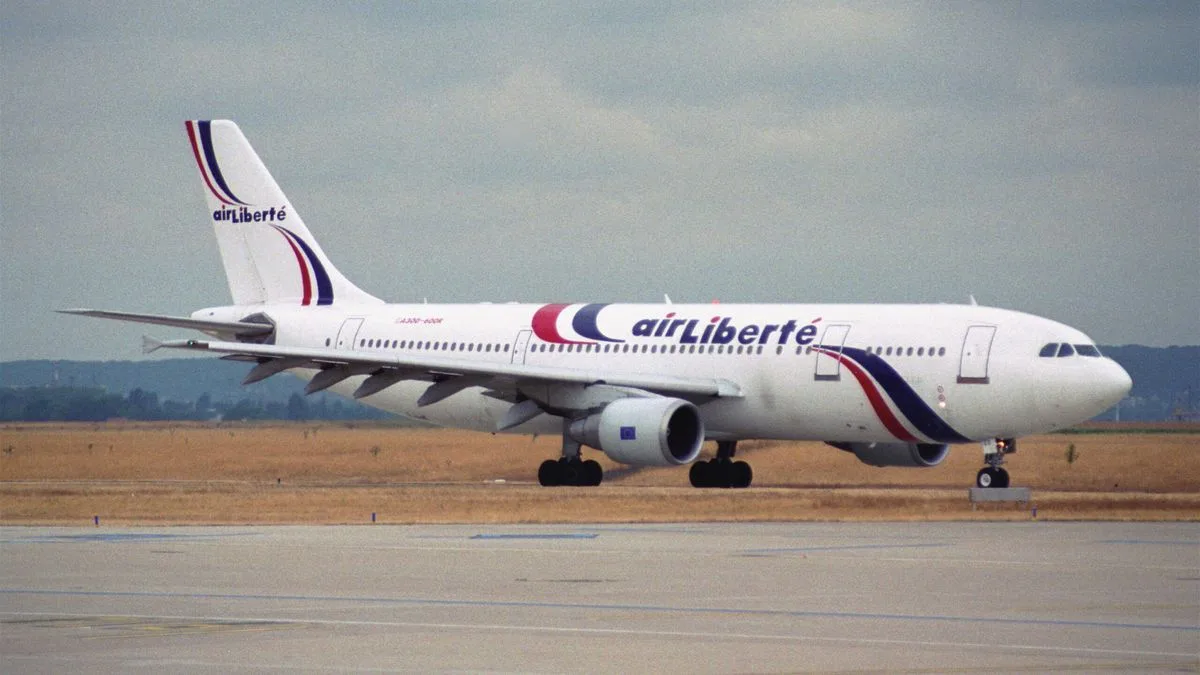
From the 1970s: and especially during the 1980s and 1990s: French aviation entered a new competitive era. Alongside Air France and Air Inter, private airlines tried to build positions in charter flying, leisure long-haul, regional services and, after European liberalisation, scheduled routes. Some became credible alternatives. Many disappeared only a few years later.
This third part of AeroSillage’s historical series is therefore not just a list of bankruptcies. It tells the story of repeated attempts to build durable French airlines outside the Air France group.
1975–1992: Minerve: the charter airline that wanted to grow up
Founded in 1975, Minerve first established itself in charter flying as package tourism expanded. It gradually built a medium- and long-haul fleet, notably around the Douglas DC-8, and by the end of the 1980s tried to move beyond pure holiday traffic toward scheduled operations.
Minerve embodied a generation of private French operators seeking to exploit the progressive opening of the market. But expansion required substantial capital, and at the beginning of the 1990s the airline moved closer to Air Outre Mer.
Outcome: that rapprochement led to the creation of AOM French Airlines. Minerve disappeared as an independent brand in 1992, but part of its fleet, staff and long-haul ambitions survived through AOM.
1991–2001: AOM: the ambition to become France’s second major airline
Born from the combination of Air Outre Mer and Minerve, AOM aimed far beyond charter flying. Based at Orly, it developed a network combining mainland France, overseas territories and international services, notably with DC-10s.
During the 1990s AOM became one of the clearest symbols of French competition to Air France. The strategy was expensive, however. Ownership changed and the airline entered the orbit of Swissair, which was simultaneously trying to build a wider European airline group and also controlled Air Liberté in France.
Outcome: AOM and Air Liberté were brought together in 2001. The new entity became Air Lib. The project unravelled rapidly as Swissair collapsed and the post-September 11 aviation crisis hit an already fragile business.
1987–2001: Air Liberté: Orly’s other major challenger
Air Liberté appeared in 1987 and expanded quickly in both leisure and scheduled markets. Its varied fleet became highly visible at Orly, and the airline also tried to build a sizeable French alternative to the incumbents.
Like AOM, it eventually entered Swissair’s orbit. The strategy was to assemble several independent European airlines capable of challenging the established groups. Losses accumulated and the Swiss group’s strategy collapsed.
Outcome: Air Liberté merged with AOM in 2001 and its name disappeared in favour of Air Lib.
1972–2004: Air Littoral: southern France’s major regional airline
Founded in 1972, Air Littoral followed a different model. Centred on Montpellier and southern France, it became one of the country’s most important regional airlines.
Its fleet evolved from turboprops to jets such as the Fokker 100, and the airline became important on cross-country French and European routes.
Regional economics were difficult: high operating costs, growing competition, dependence on commercial partnerships and a permanent need for capital. In the early 2000s, Swissair’s withdrawal made the situation even more fragile.
Outcome: after several rescue attempts, Air Littoral ceased operations in 2004.
2001–2003: Air Lib: the merger that failed to save AOM and Air Liberté
Air Lib was created in 2001 from AOM and Air Liberté. On paper the combined airline had major assets: a strong position at Orly, domestic and medium-haul routes, long-haul flying and well-known brands.
It also inherited heavy weaknesses. Swissair’s collapse removed financial backing, while the industry crisis after the September 11 attacks hit demand and financing conditions. The French state intervened temporarily, but the business never found a sustainable balance.
Outcome: Air Lib stopped flying in February 2003, ending the attempt to build a large generalist French competitor to Air France from the AOM–Air Liberté combination.
1946–2019: Aigle Azur: a historic survivor that finally disappeared
Aigle Azur was founded as early as 1946, long before AOM and Air Liberté, but its final chapter belongs to the same story of independent French aviation.
After several transformations, it became a major player between France and Algeria in the 2000s while adding other international destinations. Its Orly base, network and customer base gave it significant value.
But expansion into new markets, a complex shareholder structure and persistent losses progressively weakened the airline.
Outcome: Aigle Azur filed for bankruptcy in September 2019, suspended operations and was liquidated. Its disappearance was especially significant in the France–Algeria market.
1995–2019: XL Airways France: low-fare leisure long-haul
Founded in 1995 as Star Airlines, the carrier later became XL Airways France. It specialised in leisure long-haul with aggressive fares to the Caribbean, the United States, the Indian Ocean and other holiday markets.
With Airbus A330s, XL Airways tried to apply a tightly controlled, high-density cost model to long-haul flying. But it remained exposed to fuel prices, seasonality, competition from large groups and the financing burden of a long-haul fleet.
Outcome: in September 2019, only weeks after Aigle Azur, XL Airways also suspended operations and was liquidated. France lost two significant independent airlines almost simultaneously.
Why did so many French airlines disappear?
The common thread is not an inability to create airlines. It is the difficulty of reaching a durable critical scale in a capital-intensive industry with high fixed costs and extreme sensitivity to economic, geopolitical and energy shocks.
European liberalisation opened new opportunities but also exposed French independents to much broader competition. Legacy carriers consolidated, low-cost airlines imposed new cost benchmarks and smaller operators often faced a choice between rapid growth, alliance, takeover or disappearance.
A new generation replaced them
By the end of the 2010s, the French landscape no longer resembled the AOM–Air Liberté era. A new generation had established itself: Transavia France, Air Caraïbes, French bee, Corsair, Air Austral, Air Corsica and La Compagnie, while Air France-KLM remained dominant.
That is the subject of the fourth and final part of this series: the French airlines still flying today and the models that allowed them to survive.
Main sources
French Senate material on Air Lib and Air Littoral; French aviation archives; economic and aviation reporting on Aigle Azur and XL Airways; Wikimedia Commons historical material.
Continue the series: French airlines (4/4): the carriers still flying today.
Leave a Reply