
Three passengers taken to hospital after illness on Eurowings flight from Rhodes
Several passengers fell ill aboard Eurowings flight EW9631 from Rhodes to Düsseldorf. Three were taken to hospital; the cause remains unconfirmed.
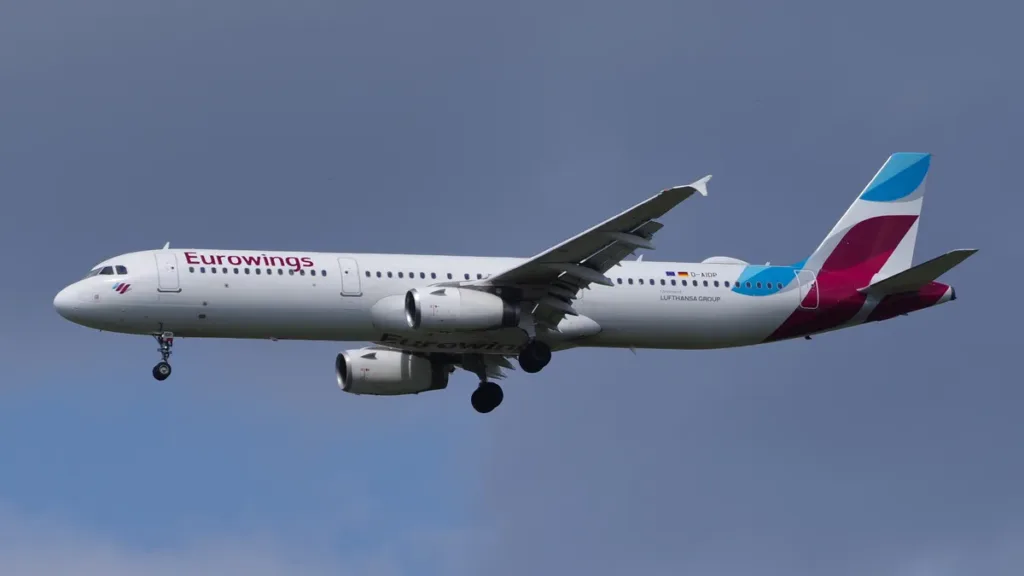
Three passengers were taken to hospital after several people became seriously unwell aboard Eurowings flight EW9631 from Rhodes to Düsseldorf on Sunday, 18 October 2026. The pilots requested priority to land, and airport authorities assembled an extensive medical response. Eurowings has yet to establish what caused the illnesses.
The service was carrying holidaymakers home from the Greek island of Rhodes. Eurowings told RTL that 212 passengers and seven crew members were on board. Aviation incident reporting identifies the aircraft as an Airbus A321-200, registered D-AIDT. The flight was still bound for its scheduled destination when several travellers reported feeling unwell.
One woman who spoke to RTL said a passenger behind her appeared nauseous early in the journey. Around an hour after departure, she noticed cabin crew wearing masks. Her account offers a glimpse of the atmosphere in the cabin, but is not a medical assessment of everyone on board. Eurowings has not published a complete symptom breakdown or an exact count of affected passengers.
As the jet neared Düsseldorf, the flight crew requested priority landing clearance, the airline confirmed to German public broadcaster WDR. This was not a diversion: the aircraft continued to its intended airport. Giving an aircraft priority can help medical teams reach patients sooner and does not necessarily indicate a fault with the aircraft itself.
Emergency teams prepare for a larger number of patients
Düsseldorf Airport activated a MANV alert, the German mass-casualty response procedure used when the number of people requiring care could be substantial. It is a precautionary mobilisation based on the potential scale of an emergency, rather than a count of confirmed casualties. The airport told WDR that eight airport fire-service vehicles attended, supported by Düsseldorf’s municipal fire and ambulance services. Teams met the aircraft on the apron following its Sunday evening arrival.
Once passengers were assessed, the situation proved less extensive than initially feared. Eurowings said three affected travellers received medical attention at the airport and went to hospital as a precaution. The remaining passengers were able to return home. Düsseldorf Airport said normal operations were not disrupted.
For some of those on board, however, landing was not the end of the ordeal. The RTL interviewee said the captain had told passengers medical staff were waiting. She described three people in protective clothing boarding to ask travellers whether they had symptoms. According to her account, passengers remained inside the aircraft for roughly 90 minutes and were allowed off at around 11.30 p.m. These timings come from her testimony, rather than an independently released airport timeline.
Why the suspected stomach virus remains unconfirmed
Local and specialist reports referred to gastrointestinal illness, with norovirus among the possible explanations. Norovirus can cause gastroenteritis, commonly including vomiting and diarrhoea, but no diagnosis linking the cases has been publicly confirmed. In its statements on 19 October, Eurowings said the reason for the illnesses was unclear and that it would examine the incident.
The timing matters when evaluating an apparent cluster of illness on a flight. Travellers could have shared an exposure before boarding; becoming sick during the same journey does not establish that an infection spread inside the aircraft. Establishing a cause would require details such as symptom onset, contacts and possible common exposures.
JOIN THE CONVERSATION
Let’s discuss this story.
A question, a clarification or a different perspective? Share it with us.