
British Airways A321 declares emergency over France after cracked window report
A British Airways A321 returned safely to London Gatwick after a cabin window was reportedly cracked. The crew squawked 7700 over France.
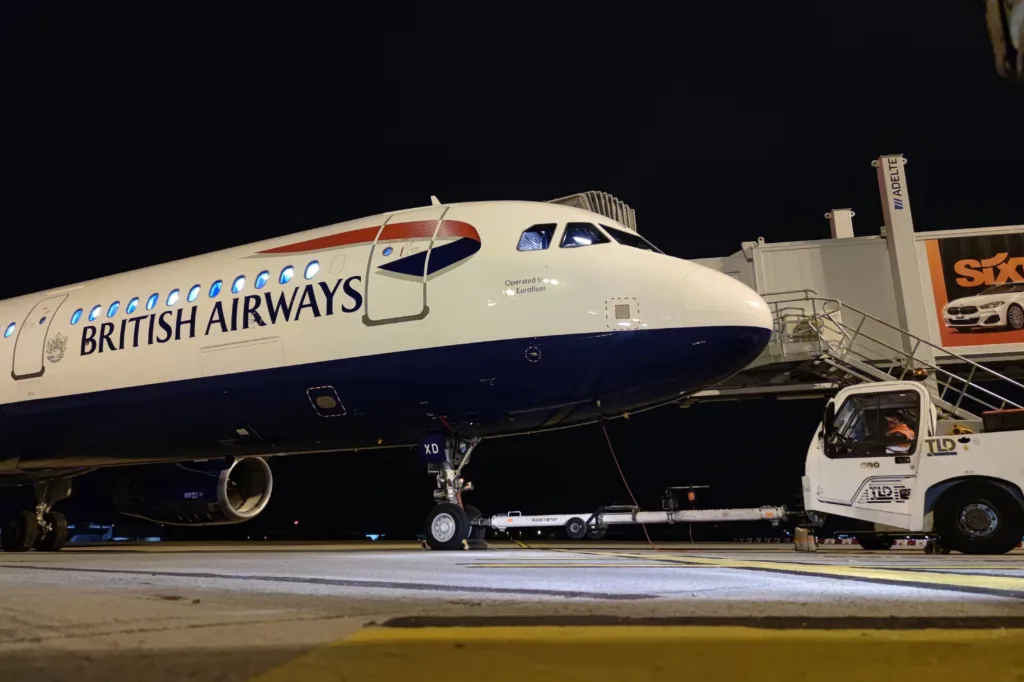
A report of a cracked cabin window, an emergency transponder code and a safe return to London Gatwick: British Airways flight BA2660 to Faro ended back at its departure airport on Tuesday, 13 October 2026. The Airbus A321, registered G-EUXD, was over France when its crew turned around. British Airways confirmed what it described as a “minor technical issue”, but did not publicly identify the affected layer of the window assembly.
The aircraft left Gatwick at around 9:06 a.m. local time and climbed to flight level 350, approximately 35,000 feet. Accounts published by AeroInside and AIRLIVE describe a crack reported on the right-hand side of the passenger cabin. A passenger report cited by AeroInside placed it near seat 3F; that precise location has not been independently confirmed by the airline. Rather than continue towards Portugal’s Algarve coast, the pilots began descending, reaching approximately flight level 180 within 15 minutes, according to AeroInside.
The crew selected transponder code 7700, the internationally recognised signal for a general emergency. It tells air traffic controllers that the aircraft may need priority handling or assistance. It does not mean the pilots have lost control. After reversing course over north-western France, the A321 landed safely at Gatwick roughly 90 minutes after taking off. No injuries were reported.
What a cracked window can — and cannot — tell us
Passenger windows on pressurised aircraft consist of several components with different functions, including an interior protective element and layers designed to withstand pressurisation loads. The significance of a visible crack depends on which component was affected. AeroInside reported normal cabin pressure and no oxygen-mask deployment. These are reassuring observations, but they do not establish the extent of the damage. A ground inspection would be needed before drawing conclusions about the defect or repairs.
Returning to Gatwick could also make operational sense: the airline could draw on its maintenance facilities and arrange onward travel for affected customers. That is not proof of why this particular diversion was chosen. The crew would have had to weigh applicable procedures, suitable airports, weather and the possibility that a problem of uncertain severity might worsen.
Returning to Gatwick was a precautionary response to uncertainty over the reported window damage. Squawking 7700 signals a need for priority assistance; it does not, by itself, establish depressurisation. The decisive evidence would come from inspection of the aircraft, including which part of the window assembly was affected, rather than from the emergency code alone.
Selecting squawk 7700 alerts air traffic control to an emergency and supports a priority response, but does not by itself demonstrate cabin depressurisation or serious structural damage. Reports about the window’s precise location remain separate from the airline’s confirmed statement. The technical inspection, rather than the diversion alone, is what can establish the actual nature of the fault.
British Airways apologised to passengers and said it was working on alternative arrangements. Equally important is what has not been established: public reporting does not describe a sudden decompression, and no detailed engineering findings have been released. An emergency declaration is a precautionary mechanism, not evidence of a narrowly avoided crash. Passengers’ rights to assistance, rerouting and any compensation depend on the circumstances and applicable law, not on the 7700 code alone.
Archive photograph: Airbus A321 G-EUXD photographed in 2024. Dylan Agbagni / Wikimedia Commons, CC0 dedication.
Sources: AeroInside, 13 October 2026; AIRLIVE, 13 October 2026; The Independent, 13 October 2026.
JOIN THE CONVERSATION
Let’s discuss this story.
A question, a clarification or a different perspective? Share it with us.