Europe–Middle East flights remain 14% below 2025 levels, EUROCONTROL says
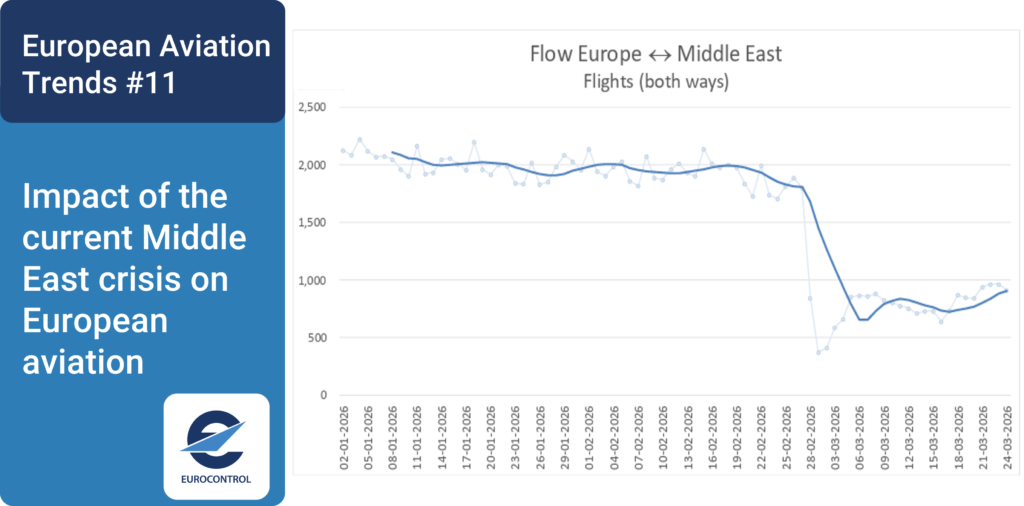
Air traffic between Europe and the Middle East remains 14% below its 2025 level, and the recovery is anything but even. EUROCONTROL’s aviation overview published on 15 October shows a network in which Gulf airlines, European carriers and Israeli operators are following sharply different paths. Flights are operating, but the shape of the connections has changed.
The 14% decline is a year-to-date comparison for 2026, excluding overflights. It does not mean that traffic fell 14% during the single week of 5–11 October. In January and February, before the crisis, services between the regions averaged 9% above their 2025 level. EUROCONTROL says the gap against that earlier trajectory is approximately 20%. Both comparisons matter when judging how much activity has disappeared from the network.
The three large Gulf hub carriers — Emirates, Etihad and Qatar Airways — are still operating about 23% below pre-crisis levels. European airline groups serving the market are roughly 82% below that benchmark, while Israeli operators are recording around 56% more flights than before the crisis. These figures measure flight volumes. They do not establish load factors, yields, profits or the number of passengers carried.
For passengers, the disruption often appears in the connection rather than the headline statistic. Losing a nonstop service can force a traveller to change hubs, add a stop or use an alternative airport. Airlines must reposition aircraft and crews when airspace routes become unavailable or less attractive. The cost and journey-time effects depend on the specific itinerary: a network-wide decline does not prove that every fare has increased.
The wider European picture has its own strains. EUROCONTROL recorded an average of 33,491 daily flights in Week 41, including overflights. That was unchanged from the equivalent week in 2025 but 2.7% below the preceding week. Arrival punctuality was 74.1% and departure punctuality 69.8%. Air traffic control capacity and staffing remained the leading cause of en-route flow-management delays.
Jet fuel adds another layer of pressure. The reference price reached $4.82 a gallon on 9 October amid volatility. Longer diversions can increase the fuel required for a service, though the report does not provide a reliable basis for assigning an exact extra cost to each individual airline.
The 14% shortfall describes a reshaped network, not the disappearance of all Europe–Middle East flying. Some operators are restoring services considerably faster than others, changing the relative strength of hubs and the journey choices available to travellers.
Illustration: EUROCONTROL historical chart dated March 2026, provided for context and not depicting the Week 41 figures.
Source officielle : EUROCONTROL, European Aviation Overview, semaine 41, publié le 15 octobre 2026.