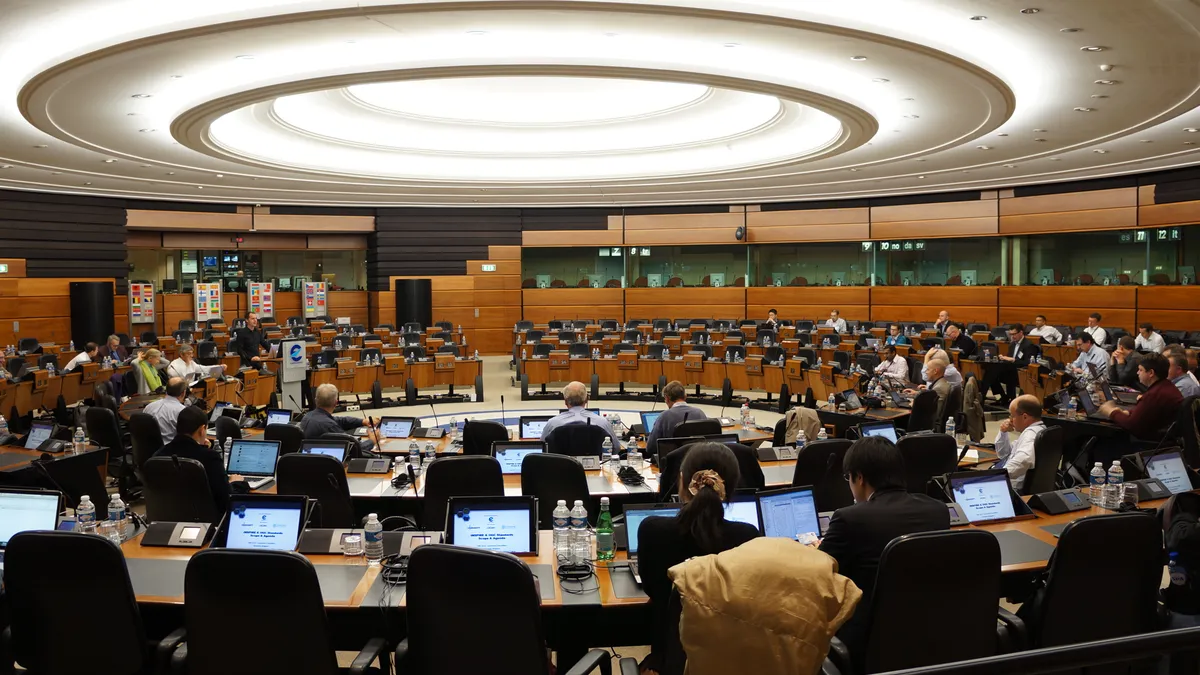
EUROCONTROL is one of the names that appears whenever Europe’s air-traffic network comes under pressure: storms, ATC strikes, closed airspace, sector overloads or cascading delays. Yet despite its name, EUROCONTROL does not “control” every aircraft over Europe. Its real influence is both more subtle and more structural: it coordinates the network, processes flight plans, regulates traffic flows, collects route charges, produces performance data and directly operates one multinational control centre.
What EUROCONTROL actually does
EUROCONTROL is the European Organisation for the Safety of Air Navigation, an intergovernmental organisation created under a convention signed in 1960. It is not an EU agency.
Its membership is wider than the European Union. The organisation brings together 42 member states and works with additional states through comprehensive agreements. That wider footprint matters because the operational European network extends well beyond EU political borders.
EUROCONTROL does not replace national air-navigation service providers. In France, the DSNA controls most civil traffic; in the UK, NATS; in Germany, DFS; in Spain, ENAIRE.
Those organisations separate aircraft tactically and provide the day-to-day control service. EUROCONTROL works one level above them, trying to ensure that the number of aircraft heading toward each sector remains compatible with the capacity that national providers can actually deliver.
The Network Manager organises traffic across the continent
The most important function is the Network Manager, designated by the European Commission within the Single European Sky framework. It builds a continent-wide picture of demand, available capacity, weather, military restrictions, airport constraints and national ATC limitations.
That matters on a network handling more than 30,000 flights a day in busy periods. A capacity problem in one country can affect departure times hundreds or thousands of kilometres away.
Before many flights depart, their flight plans are submitted through the Network Manager Operations Centre. The IFPS: Integrated Initial Flight Plan Processing System checks the consistency of the plan, validates the format and distributes it to the relevant control units.
That centralisation means airlines do not have to file independently with every control centre along the route. More importantly, it gives EUROCONTROL a forward view of how many aircraft intend to use each part of the network and when.
If a sector or airport cannot safely accept all planned traffic, the problem is managed before too many aircraft converge on it. Holding dozens of flights in the air would waste fuel and increase controller workload.
The Network Manager can therefore impose flow regulations. Flights may receive a Calculated Take-Off Time, or CTOT. This is the so-called “EUROCONTROL slot”: not the same thing as a commercial airport slot.
The logic is simple: it is often safer and more efficient to keep an aircraft on the ground than to send it toward a sector that will already be overloaded by the time it arrives.
Maastricht is the exception where EUROCONTROL directly controls aircraft
EUROCONTROL does directly control aircraft at the Maastricht Upper Area Control Centre (MUAC). From Maastricht, it provides air traffic control in the upper airspace of Belgium, Luxembourg, the Netherlands and north-west Germany.
MUAC is one of Europe’s clearest examples of genuinely multinational air traffic control. In 2025 it handled more than 1.8 million flights, illustrating that cross-border control can work operationally even though most of Europe remains organised around national providers.
Data, performance and route charges: EUROCONTROL’s other role
Every time an airline uses air-navigation services in European airspace, it contributes to their financing through route charges. Rather than sending separate invoices from every state, EUROCONTROL’s Central Route Charges Office (CRCO) calculates, bills and collects the charges before redistributing revenue to states and service providers.
In 2025 the system processed roughly 11 million flight messages and billed about €11.8 billion in route charges. That money is not EUROCONTROL’s own operating budget; it is mostly collected on behalf of national systems.
The organisation has become one of Europe’s most important sources of aviation traffic, delay and network-performance data.
Its Performance Review Commission provides independent analysis of the ATM system. In 2025, average en-route ATFM delay fell from 2.13 minutes per flight in 2024 to about 1.67 minutes, but the economic cost of those delays still exceeded €2 billion.
One striking finding was the concentration of delay: a small number of control centres generated a disproportionate share of total network delay. That shows why one weak point can reduce performance far beyond its own borders.
EUROCONTROL, EASA, the Commission and states: who decides what?
The overlap between European aviation institutions is a common source of confusion.
- EUROCONTROL: network coordination, flight-plan processing, flow management, data, route charges and direct ATC at MUAC.
- European Commission: EU transport policy and regulation, including the Single European Sky framework.
- EASA: aviation-safety rules, certification and oversight across many aviation domains, including parts of ATM/ANS.
- National ANSPs: day-to-day control of aircraft in most national airspace.
- National authorities: sovereign decisions on airspace, defence, security and national regulation.
EUROCONTROL is central to the system without being a supranational authority above every national controller.
When an airspace closes for military, security or geopolitical reasons, the decision belongs to the relevant state or authority. EUROCONTROL then has to absorb the network consequences.
That can mean rerouting flows through neighbouring countries, applying new regulations, lengthening tracks or redistributing traffic through sectors that were not originally expected to carry it.
The Network Manager can optimise routes, balance traffic, regulate demand and coordinate actors, but it cannot create extra controllers instantly, reopen a runway closed by weather or reverse a sovereign military restriction.
This is one of Europe’s core ATM paradoxes: traffic management is increasingly continental, while much of the infrastructure, staffing and political authority remains national.
The Single European Sky project has improved integration through centralised flight-plan processing, free-route airspace, common flow management, digital data exchange and performance monitoring.
But Europe still has many national service providers and control structures. The next phase includes the Network Manager’s iNM digital programme, designed to modernise ageing central systems and increase automated data exchange among airlines, airports and control centres.
Depending on context, EUROCONTROL may be the source of traffic statistics, forecasts, delay data, flight-plan processing, a CTOT regulation, route-charge billing or direct ATC at Maastricht.
That is why the organisation is difficult to summarise in one sentence. It is neither a “European DGAC” nor a giant continental control tower. It is best understood as the operational architect and coordinator of the pan-European network.
EUROCONTROL’s real power is its network-wide view
Its influence does not come from commanding every national controller. It comes from seeing the whole system at once: flight plans, capacity, weather, closures, sector constraints and the knock-on effects between countries.
A passenger may never see EUROCONTROL, but the flight plan has probably passed through its systems, the departure time may have been influenced by its Network Manager, and some of the route charges paid by the airline will have passed through its billing system.
Main sources
EUROCONTROL institutional documentation; Network Manager and IFPS material; MUAC statistics; CRCO route-charge reports; Performance Review Report 2025; European Commission Single European Sky documentation; EASA ATM/ANS material.
Leave a Reply