Turkish Airlines is no longer simply a large connecting carrier between Europe and Asia. In 2026, the group is building something much broader around Istanbul: a vertically integrated aviation system spanning passenger transport, cargo, maintenance, training, catering and logistics. With 566 aircraft reported at the end of August, 358 destinations, 64 million passengers carried in the first eight months of the year and a target of more than 800 aircraft by 2033, the airline is moving into a different scale of competition.
Istanbul turns geography into network power
Turkish Airlines’ core advantage remains geography. Istanbul sits within practical one-stop reach of Europe, the Middle East, the Caucasus, Central Asia, much of Africa and large parts of Asia. That allows the carrier to combine business traffic, leisure demand, diaspora flows and long-haul connections on a single hub platform.
The network effect becomes stronger as frequencies and destinations grow. By August 2026, the group reported 358 destinations. International passenger traffic rose 6.1% year over year to 41.8 million in the first eight months, while the overall load factor reached 84.7%.
Growth has not been evenly distributed. Capacity to the Far East rose 18.3% over January-August, while Middle East capacity fell 27.4%. That matters because it shows an airline actively reallocating capacity rather than simply adding seats everywhere.
More than 800 aircraft: fleet growth becomes an execution challenge
The fleet is the most visible part of the strategy. Turkish Airlines reported 566 aircraft at the end of August 2026, up 13% from 501 a year earlier. The group’s 2033 plan calls for more than 800 aircraft, with 90% of the fleet expected to be next-generation by then and 100% by 2035.
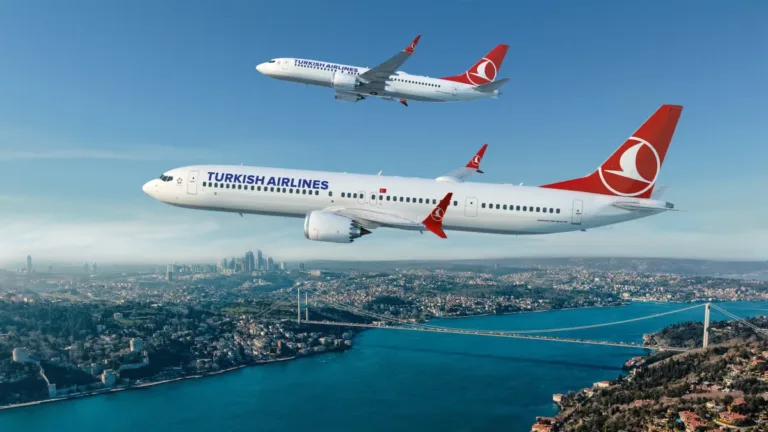
The orderbook is enormous. Airbus announced a 220-aircraft package in December 2023 covering 150 A321s and 70 A350-family aircraft, including A350-900s, A350-1000s and five A350F freighters. In September 2025, Turkish Airlines announced a Boeing agreement for 75 787-9 and 787-10 aircraft, 50 firm and 25 options. Then on September 24, 2026, it finalized 100 firm Boeing 737-8s plus 50 options, with substitution rights for the larger 737-10.
AeroSillage covered that deal separately in Turkish Airlines’ order for up to 150 Boeing 737 MAX aircraft. Taken together, these commitments show that the carrier is deliberately maintaining a dual Airbus-Boeing strategy rather than betting the future on a single manufacturer.
A mixed fleet creates complexity. It requires multiple pilot qualifications, maintenance programs, spare-parts pools and training systems. But at Turkish Airlines’ scale, diversification also creates negotiating leverage and reduces exposure to a single manufacturer or engine program.
On long-haul routes, the A350 and 787 give the group two modern widebody platforms with different strengths. On short- and medium-haul routes, the A321neo and 737 MAX provide capacity growth while older aircraft are gradually replaced. The future A350-1000 will add another layer for high-demand long-haul markets.
The operational challenge is substantial. Ordering hundreds of aircraft is one thing; absorbing them without damaging punctuality, crew availability or maintenance resilience is much harder. Turkish Airlines’ next phase is therefore less about purchasing power and more about execution.
Turkish Airlines carried 64 million passengers between January and August 2026, up 5.4% year over year. August alone reached 10 million passengers and an 88% load factor.
The group carried 92.6 million passengers in 2025. In early August 2026, Turkish Airlines and low-cost subsidiary AJet set a combined daily record of 352,715 passengers and 2,034 flights when cargo services were included.
Financially, the expansion is expensive. Turkish Airlines reported consolidated net profit of roughly $395 million for the first half of 2026, lower than a year earlier, while revenue rose sharply to $12.3 billion. Net debt climbed above $13 billion. The carrier is growing quickly, but it is also committing substantial capital to aircraft and infrastructure.
Cargo, maintenance and infrastructure: the ecosystem behind the airline
Passenger traffic tells only part of the story. Cargo and mail volume reached about 1.565 million metric tons in the first eight months of 2026, up 11.2% year over year.
The SmartIST Phase 2 project is central to the next stage. Turkish Airlines says annual cargo handling capacity will rise from 2.2 million tons to 4.5 million tons during the 2027-2028 period. That would reinforce Istanbul’s position as a logistics bridge between Europe, Asia, the Middle East and Africa.
The A350F order fits the same strategy. Cargo gives the group another revenue stream and a different demand profile from passenger travel, which can improve resilience when individual regions weaken.
Turkish Technic is a crucial part of the plan. The group does not only want to operate more aircraft; it also wants greater control over how those aircraft are maintained.
A new engine maintenance center is scheduled for completion in 2027 and is expected to handle Rolls-Royce Trent XWB-84, XWB-97 and Trent 7000 engines. Additional hangars are intended to raise maintenance capacity by about 20%, with room to service 12 more aircraft simultaneously.
This vertical integration matters strategically. It can reduce dependence on outside maintenance capacity, create third-party revenue and give the airline more control over aircraft downtime as the fleet expands.
AJet, service and competition: multiple commercial weapons
AJet allows Turkish Airlines to compete in more price-sensitive markets without forcing the flagship brand to do every job. It gives the group a platform for domestic and regional low-cost traffic, particularly in Türkiye, Europe and the Middle East.
The logic increasingly resembles a multi-brand airline group. Turkish Airlines focuses on network connectivity, long-haul service and premium positioning, while AJet addresses lower-fare demand. That segmentation is closer to the way large European airline groups operate, even though Istanbul remains far more central to Turkish Airlines’ system.
It is tempting to compare Turkish Airlines directly with Emirates, Qatar Airways or Lufthansa Group, but their structures differ significantly.
Emirates is built around Dubai and a predominantly widebody global network. Qatar Airways uses a similar connecting model through Doha. Lufthansa Group operates multiple hubs and brands across Europe. Turkish Airlines sits somewhere between these approaches: it has a very powerful single hub, but also a large domestic market, a low-cost subsidiary, dense regional flying and increasingly integrated industrial businesses.
That is why fleet size alone does not explain the model. The more important question is how effectively aircraft, Istanbul Airport, Turkish Cargo, Turkish Technic and AJet can work as one system.
In September 2026, Skytrax named Turkish Airlines “Best Airline in Europe” for the 11th time and placed it fifth in its global airline ranking. Those awards come from a private aviation rating organization and should not be treated as an absolute measure of quality, but they reinforce the carrier’s international brand positioning.
Turkish Airlines continues to differentiate through catering, lounge investment, network breadth and the ability to connect city pairs that would otherwise require more than one stop.
The investment program announced in January 2026 exceeds TRY 100 billion. It covers far more than fleet expansion: SmartIST Phase 2, a catering facility designed to serve more than 500,000 passengers per day, an engine maintenance center, additional hangars, a data center, flight training infrastructure and a new crew terminal are all included.
This is one of the strongest signs that the strategy is not simply “buy more airplanes.” Turkish Airlines is trying to build the industrial capacity required to operate a much larger fleet before the heaviest delivery years arrive.
The risks behind the ambition
Rapid expansion creates several vulnerabilities. The group needs large numbers of pilots, cabin crew, technicians and ground staff. Istanbul Airport must continue to absorb rising wave complexity. Airbus, Boeing and engine manufacturers must deliver close enough to plan for the fleet strategy to work smoothly.
Geopolitics is another structural risk. Turkish Airlines flies into a wider range of politically sensitive markets than many competitors, and 2026’s sharp reduction in Middle East capacity shows how quickly schedules can change.
Financing also matters. A fleet of more than 800 aircraft plus major infrastructure projects requires sustained cash generation and disciplined capital allocation. High passenger growth does not automatically guarantee high returns if costs rise faster.
The real test will come between 2027 and 2033
The 2026 numbers suggest Turkish Airlines has moved beyond a catch-up phase. It already has a global network, a major hub, enormous Airbus and Boeing orderbooks, a fast-growing cargo business and industrial units capable of supporting further expansion.
The real test will come between 2027 and 2033. Taking delivery of hundreds of aircraft is only the first step. Keeping load factors high, service consistent, punctuality acceptable and the balance sheet manageable will decide whether the strategy creates durable advantage.
Istanbul’s bet is therefore not simply to build a bigger airline. It is to build an aviation ecosystem in which more of the value chain is controlled inside the same group. If execution matches ambition, Turkish Airlines could enter its centenary with one of the world’s most integrated airline platforms.
Sources and methodology
January-August 2026 traffic data: Turkish Airlines Investor Relations / KAP disclosures; fleet and aircraft orders: Turkish Airlines, Boeing and Airbus; 2033 infrastructure program: Turkish Airlines; first-half 2026 financial figures: consolidated company disclosures reported by Anadolu Agency. Fleet totals can change as aircraft are delivered, returned or leased.
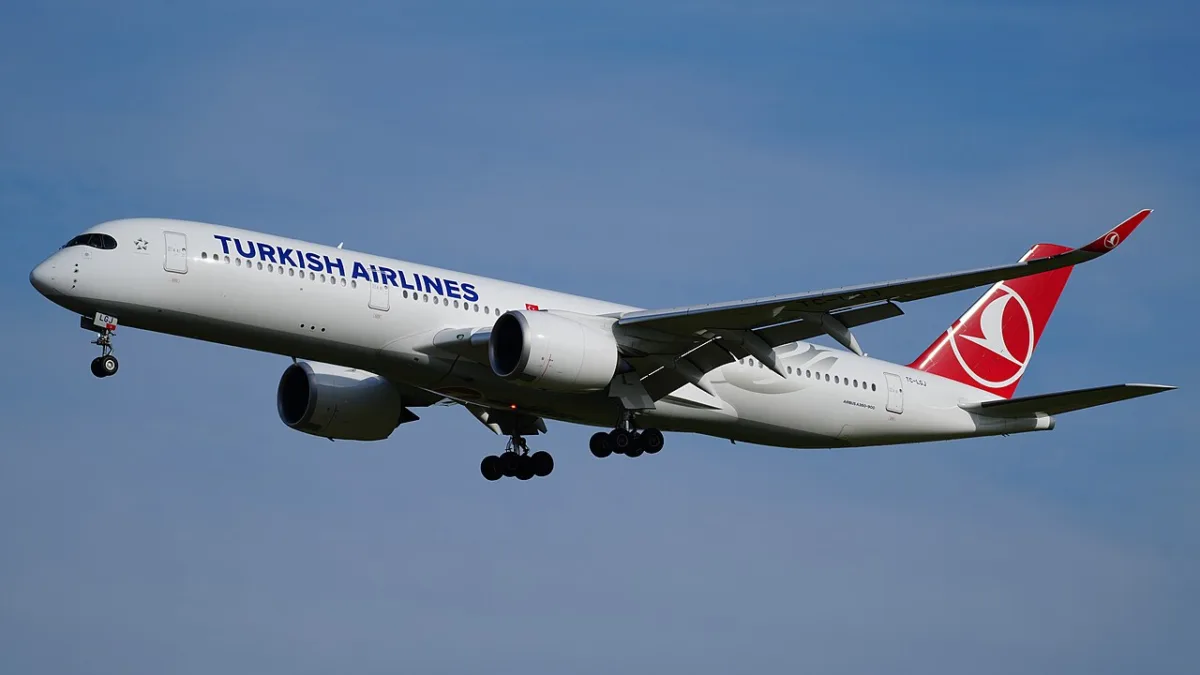
Photo: Turkish Airlines Airbus A350-900 at Berlin Brandenburg Airport: MarcelX42 / Wikimedia Commons, CC BY-SA 4.0. Optimized version for AeroSillage.