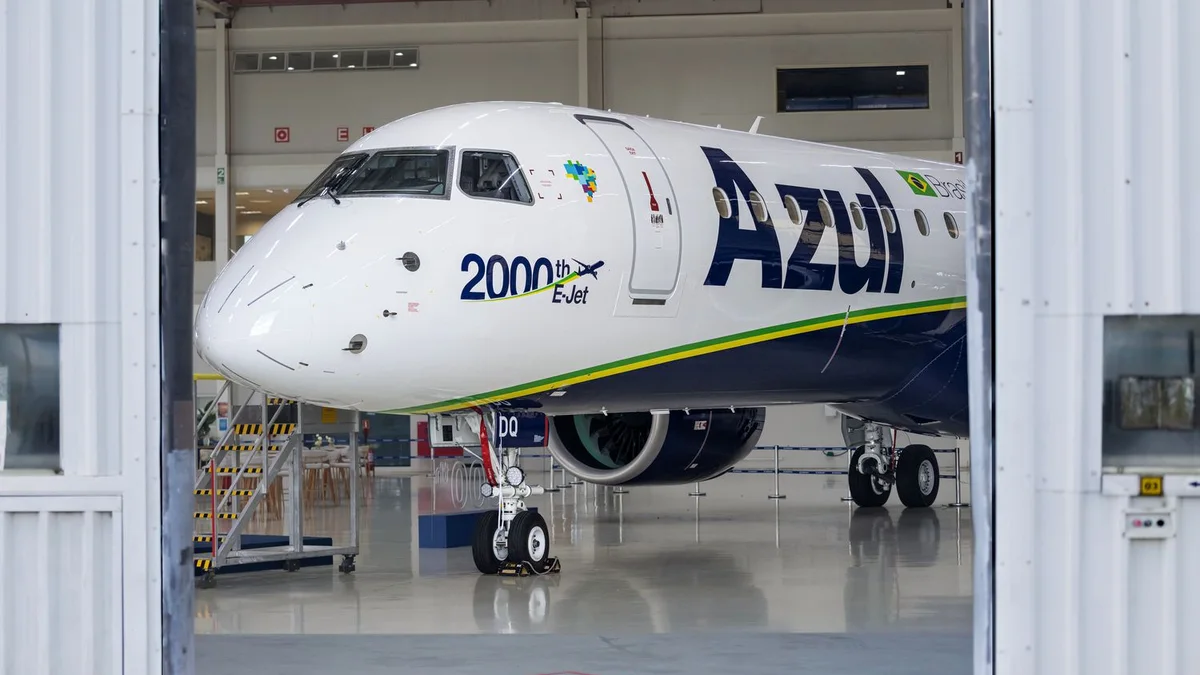
Embraer has delivered the 2,000th E-Jet, an E195-E2 for Azul, marking a major milestone for a family that has carved out a durable space between traditional regional jets and larger single-aisle aircraft. Twenty-two years after the first E-Jet entered service, the programme shows that many airlines still need capacity below the typical A320neo or 737 MAX size.
A programme that began in 2004
The E-Jet family entered service in 2004 and has grown through the first-generation E170, E175, E190 and E195 and the newer E190-E2 and E195-E2.
Embraer says more than 90 airlines in over 60 countries have operated E-Jets. The family has accumulated about 48 million flight hours and carried more than 2.85 billion passengers.
Those figures underline how far the programme has moved beyond the narrow “regional jet” label under which it was originally viewed.
Why the E195-E2 matters
The 2,000th aircraft is an E195-E2, the largest member of the current generation. It is aimed at airlines that need more seats than a classic regional jet but do not necessarily want the capacity or trip cost of a larger narrowbody.
That position can be valuable on thinner routes, high-frequency regional services and developing city pairs where 180 or 200 seats would be difficult to fill consistently.
Azul is part of the programme’s history
Azul has operated E-Jets since the airline launched in 2008 and became the launch customer for the E195-E2, receiving the first example in 2019.
According to Embraer, Azul has operated more than 140 E-Jets over its history. The 2,000th E-Jet delivered worldwide is also the airline’s 50th E2.
That relationship illustrates the type’s role in connecting secondary Brazilian markets where a smaller aircraft can support frequency without forcing an airline to carry the cost of excess capacity.
The E2 is moving beyond the traditional regional-jet market
First-generation E-Jets became common in European and North American regional networks. With the E2, Embraer is pushing further into the small-narrowbody segment.
The strategy avoids a direct head-on contest with Airbus and Boeing across the entire single-aisle market while giving Embraer a strong position at the lower end of the capacity spectrum.
For airlines, the argument is straightforward: a smaller aircraft can support more frequency, reduce the risk of empty seats and make marginal routes viable that would be harder to justify with a larger jet.
The milestone is commercial, not just ceremonial
Reaching 2,000 deliveries puts the E-Jet programme among the world’s most widely used commercial-aircraft families. But the future of the programme depends less on the milestone itself than on operating economics, financing, range and repeat orders for the E190-E2 and especially the E195-E2.
What comes next
Embraer continues to sell the E2 family while also extending the economic life of first-generation E-Jets through the E190F and E195F passenger-to-freighter conversion programmes.
That creates a second-life cargo path for some older airframes and broadens the platform beyond passenger operations.
AeroSillage takeaway: the 2,000th delivery confirms that airline economics are not always about using the largest aircraft available. Matching capacity to demand can be just as important as headline seat count.
Sources
Embraer; FlightGlobal.


Leave a Reply