The replacements for today’s Airbus A320 and Boeing 737 families are not arriving tomorrow, but the next generation of airliners is already taking shape. New single-aisle concepts, ultra-thin wings, disruptive propulsion, hydrogen research, electrification and the rise of new manufacturers could make the 2030s one of commercial aviation’s biggest technology shifts in decades.
Airbus is already planning beyond the A320
Airbus has made clear that it is preparing a new single-aisle aircraft for potential entry into service in the second half of the 2030s. The European manufacturer is targeting roughly 25–30% lower fuel burn than today’s modern narrowbodies and compatibility with up to 100% sustainable aviation fuel.
No commercial name or final configuration has been selected. Airbus is studying longer, more efficient wings, new materials, revised aerodynamics, more-electric systems and, above all, a new generation of engines. The manufacturer argues that the technology step must be large enough to justify replacing an A320 family that will itself continue evolving beyond 2030.
Airbus also continues hydrogen research. Its ZEROe work has shifted toward an electric architecture powered by fuel cells, although the timetable is now more cautious than in the program’s early years. Hydrogen remains a longer-term pathway rather than a direct near-term A320 replacement.
Boeing has not launched a 737 successor
Boeing is still focused on stabilizing and ramping up the 737 MAX program and certifying the 737-7 and 737-10. It has not formally launched a replacement for the 737.
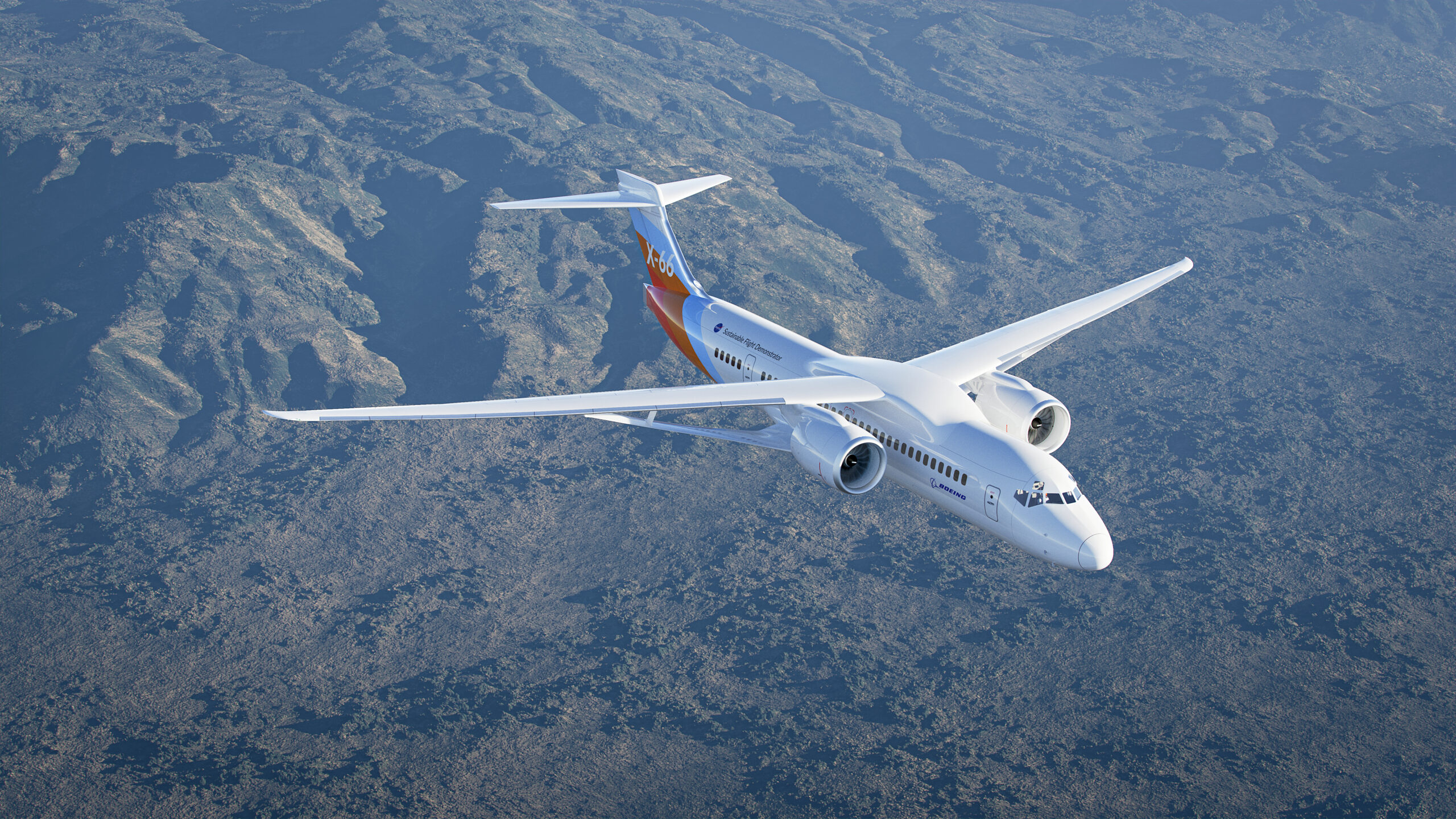
Research is nevertheless active. The X-66 work with NASA explored a very long, thin wing supported by aerodynamic trusses, known as a Transonic Truss-Braced Wing. Combined with other technologies, concepts of this type aim at major reductions in drag and fuel consumption.
One distinction matters: the X-66 is not a designated future 737. NASA and Boeing redirected the program in 2025 toward ground demonstration of thin-wing technologies while continuing studies of the truss-braced architecture.
Engines may determine the timetable
The decisive trigger for the next clean-sheet narrowbody could be propulsion. Airbus and Boeing both need a large enough engine-efficiency step to justify tens of billions in development spending.
Industry concepts include very-high-bypass engines, open-fan architectures, lighter propulsion systems and hybrid-electric solutions. A gain of only a few percent would probably not be enough. A combined aircraft-and-engine improvement approaching 20–30% could fundamentally change the business case.
Embraer is pursuing a different segment
Embraer is not trying to replace the A320 or 737 directly. Its E2 family continues to evolve while the Energia program studies lower-emission aircraft concepts for smaller passenger capacities.
That could become increasingly relevant as airlines look for aircraft better matched to thinner routes and demand profiles rather than simply maximizing gauge.
COMAC is becoming the third manufacturer to watch
China’s C919 is already in commercial service, while COMAC is developing the larger C929 widebody. At the 2026 Farnborough International Airshow, COMAC presented its C909, C919 and C929 families and said design work on the roughly 290-seat C929 was progressing.
COMAC remains heavily focused on China and Asian markets, but by the 2030s its growth could alter the traditional Airbus-Boeing balance if the C919 gains more certifications and customers outside China.
Will 2030s aircraft actually look radically different?
Perhaps less than many expect. The tube-and-wing layout remains highly efficient. The biggest changes may be subtler: much thinner and longer wings, lighter composites, smarter flight controls, predictive maintenance and radically optimized propulsion.
Cabins will evolve too, but the central economic goal will remain familiar: carry passengers with less fuel, lower noise and lower operating costs.
The major break may come around 2035–2040
Airbus is openly targeting the second half of the 2030s for its next single-aisle generation. Boeing has not published an equivalent launch timetable. That means the A320neo, A321neo and 737 MAX families are likely to remain central to airline fleets for many years.
The real shift may therefore arrive around 2035–2040, when three forces converge: new propulsion technology, emissions pressure and the need to replace thousands of narrowbodies delivered since the 2000s.
A contest bigger than Airbus versus Boeing
The next industrial cycle may be more open than the last. Airbus and Boeing will remain dominant, but Embraer, COMAC and emerging technology programs could gain ground. The key question is not simply which aircraft replaces today’s narrowbodies, but which technology becomes mature enough to justify an entirely new generation.
Sources
Airbus annual press conference 2026; Airbus next-generation single-aisle research; NASA X-66 / Subsonic Flight Demonstrator material; Embraer Energia; COMAC Farnborough 2026.
Related on AeroSillage: Airbus A350F completes maiden flight, testing begins.
Leave a Reply