
COMAC CE-25A Completes First Crewed Flight in China
COMAC's CE-25A electric aircraft flew with two pilots and a flight-test engineer in Binzhou, China, on November 14, 2026. Its 60.4-km test marks a step toward a planned 19-passenger aircraft, not commercial certification.
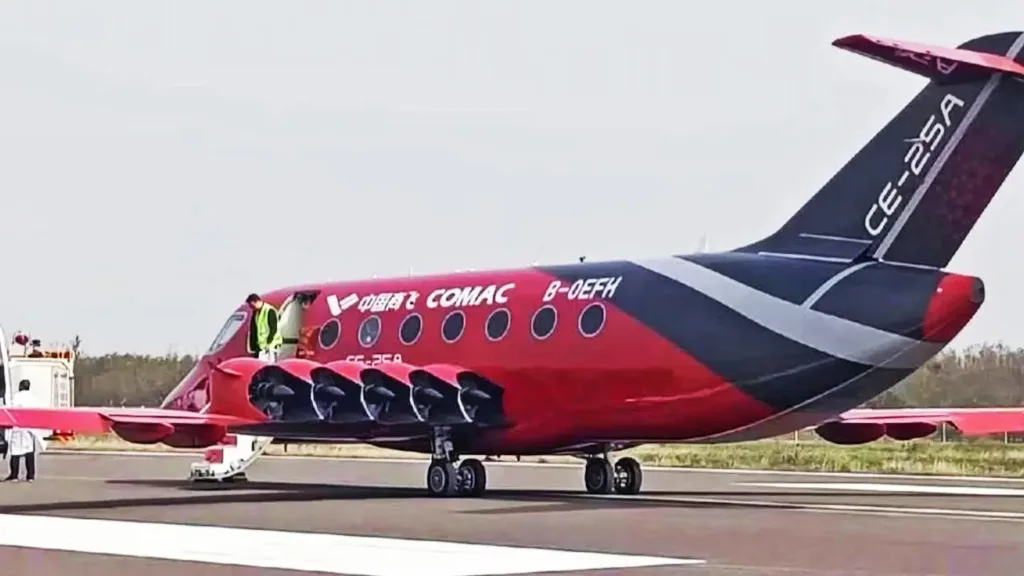
COMAC’s CE-25A electric aircraft carried three people on its first crewed flight in Binzhou, China, on November 14, 2026. Two pilots and a flight-test engineer flew 60.4 kilometers (37.5 miles) in 16 minutes and 38 seconds. The flight moved China’s 19-passenger electric-aircraft project into piloted testing. However, the airplane has not been cleared to carry fare-paying passengers.
COMAC CE-25A flies 60.4 km with three aboard
The aircraft took off and landed in Binzhou, in eastern China’s Shandong province. COMAC said the CE-25A performed normally and met test objectives, according to China’s Xinhua news agency. Those aboard were two pilots and a flight-test engineer.
Qatar’s Civil Aviation Authority aviation news service reported the flight time and distance. Those numbers describe airborne time, not a test program’s total activity. Other reporting puts the broader test activity at 57 minutes and 46 seconds. That should not be confused with time in the air.
Saturday’s milestone followed months of flights without anyone aboard. COMAC said the CE-25A first flew autonomously on February 2, 2026. It subsequently completed 19 uncrewed flight validations before carrying people.
The 19-seat electric airplane targets a 400-km range
COMAC is developing the CE-25A for short flights between cities. The company gives a maximum takeoff weight of 10 metric tons and room for up to 19 passengers. It also lists a cruise speed of 300 km/h (186 mph) and a cruising altitude of 2,400 meters (7,900 feet). Its stated range is 400 km (249 miles).
These figures are design specifications, not performance demonstrated with 19 passengers aboard. The flight on November 14 covered 60.4 km, about 15% of the projected range. That distance comparison does not establish how far a fully loaded CE-25A could fly.
Electric motors drive enclosed fans mounted along the wings. The arrangement spreads propulsion among multiple units rather than using conventional fuel-burning jet engines. Engineers call it distributed electric ducted-fan propulsion.
According to Xinhua’s report published by CCTV, the project’s partners include battery manufacturer CATL and Shanghai Jiao Tong University. COMAC has not publicly detailed the complete battery mass, charging requirements or energy capacity of the aircraft.
China has accepted the certification application
China’s Civil Aviation Administration (CAAC) has accepted COMAC’s application for a type certificate, Xinhua reported. Acceptance starts regulatory assessment; it is not an issued certificate. As a result, COMAC has not confirmed a launch date for commercial passenger service.
Testing must demonstrate safe and repeatable performance before routine airline operations. Regulators need evidence on aircraft systems, handling and the limits of operation. Meanwhile, future operators need answers about passenger load, charging and turnarounds.
A battery-powered regional aircraft could serve short routes without burning jet fuel during flight. Yet a claimed 400-km range alone cannot establish which routes will work. Weather, reserve energy, payload and airport charging facilities all affect real-world operations.
What the COMAC test means for North American aviation
The Chinese program arrives amid separate U.S. electric-aviation trials. FAA-backed demonstrations in Florida examine potential flight routes and operating procedures. Similarly, electric-aircraft trials in New Mexico aim to gather operational evidence.
Many American projects involve electric vertical takeoff and landing aircraft, known as eVTOLs. The CE-25A instead uses a fixed-wing airplane design. These approaches differ in energy demands, takeoff procedures and airport needs. Neither the U.S. demonstrations nor the Chinese test establishes an approved scheduled airline service.
The CE-25A is not the world’s first crewed electric airplane. According to the World Air Sports Federation, the Militky-Brditschka MB-E1 carried a pilot in Austria in 1973. COMAC’s milestone is the first crewed test of its own 19-passenger electric aircraft design.
What comes next for COMAC’s CE-25A
COMAC has advanced from autonomous tests to a flight with two pilots and an engineer. Further trials must show the aircraft’s performance under a wider set of conditions. Certification will determine whether the design can eventually enter commercial service.
For now, the verified result is a 60.4-km flight lasting 16 minutes and 38 seconds. The planned 19-seat capacity and 400-km range remain targets for an aircraft not yet approved to carry passengers.

JOIN THE CONVERSATION
Let’s discuss this story.
A question, a clarification or a different perspective? Share it with us.