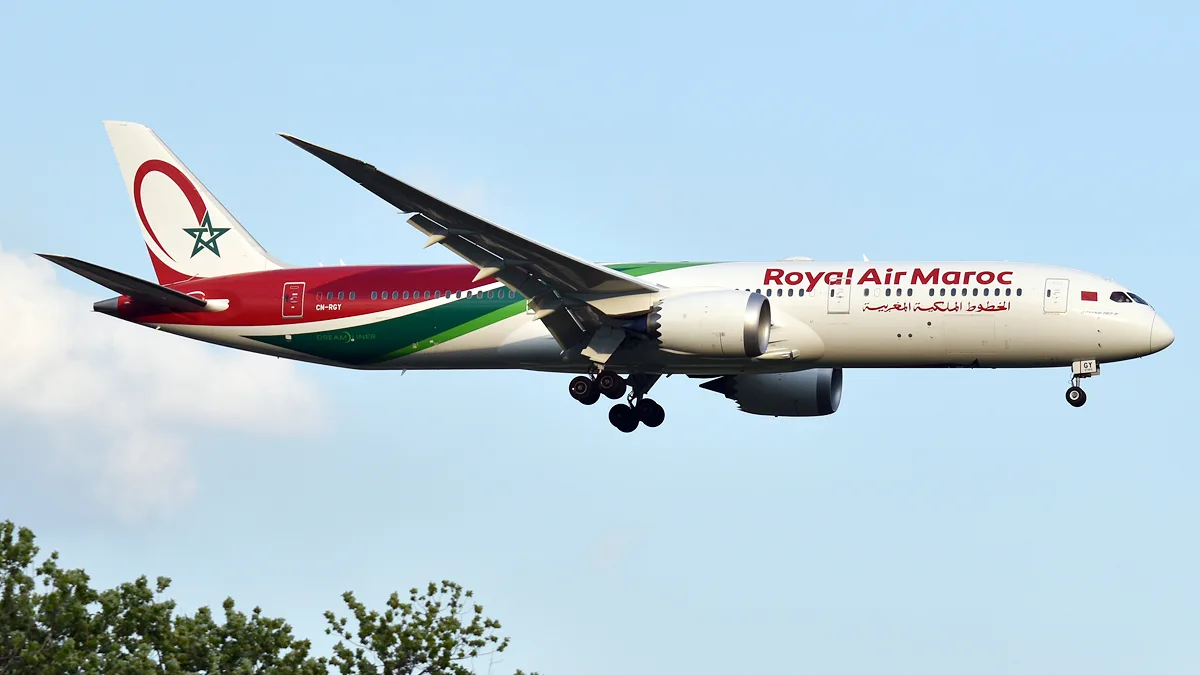
Since June 7, 2026, Royal Air Maroc has linked Casablanca directly with Los Angeles on a roughly twelve-hour flight, opening one of the longest and most strategically ambitious routes in its network. RAM presents it as the first nonstop link between Africa and the US Pacific coast.
A first direct bridge between Africa and the US Pacific coast
The route complements Royal Air Maroc’s existing North American network around New York, Washington, Miami, Montreal and Toronto.
Its potential goes beyond Morocco–California traffic. RAM is targeting the Moroccan diaspora, leisure demand to California and connecting passengers from West and Central Africa through Casablanca.
The 787 is the tool that makes the route possible
Royal Air Maroc operates both Boeing 787-8 and 787-9 Dreamliners, which form the backbone of its long-haul fleet.
The 787 offers the range and economics required for a roughly twelve-hour sector without the very large capacity of older widebody types. Using the same aircraft family across North America and other long-haul markets also simplifies operations and helps RAM maintain a more consistent cabin product.
Casablanca is the real strategic product
The route cannot rely only on local demand between Morocco and California. Its economics depend heavily on the ability to gather passengers from African cities such as Dakar, Abidjan, Lagos, Accra and Libreville and connect them efficiently through Mohammed V.
For those passengers, transfer times, baggage reliability and schedule coordination at Casablanca may matter as much as the Los Angeles flight itself.
The new Casablanca terminal is directly linked to this strategy
The future terminal at Mohammed V, targeted for 2029, is designed around transfer flows and should help increase the hub’s total capacity to around 35 million passengers a year.
That infrastructure matters because very long-haul routes become much more viable when they are fed by a dense bank of connecting flights.
Why the route matters strategically
Los Angeles is more than a prestige destination. It is a test of whether Royal Air Maroc can extend its hub model beyond traditional East Coast markets and position Casablanca as a connector between Africa, Europe and North America.
AeroSillage view: the route’s success will be measured less by the number of passengers travelling only between Morocco and California than by how effectively RAM can aggregate multiple African markets through one hub.
Main sources
Royal Air Maroc corporate communications and fleet information; ONDA documentation on the future Casablanca terminal.

Leave a Reply