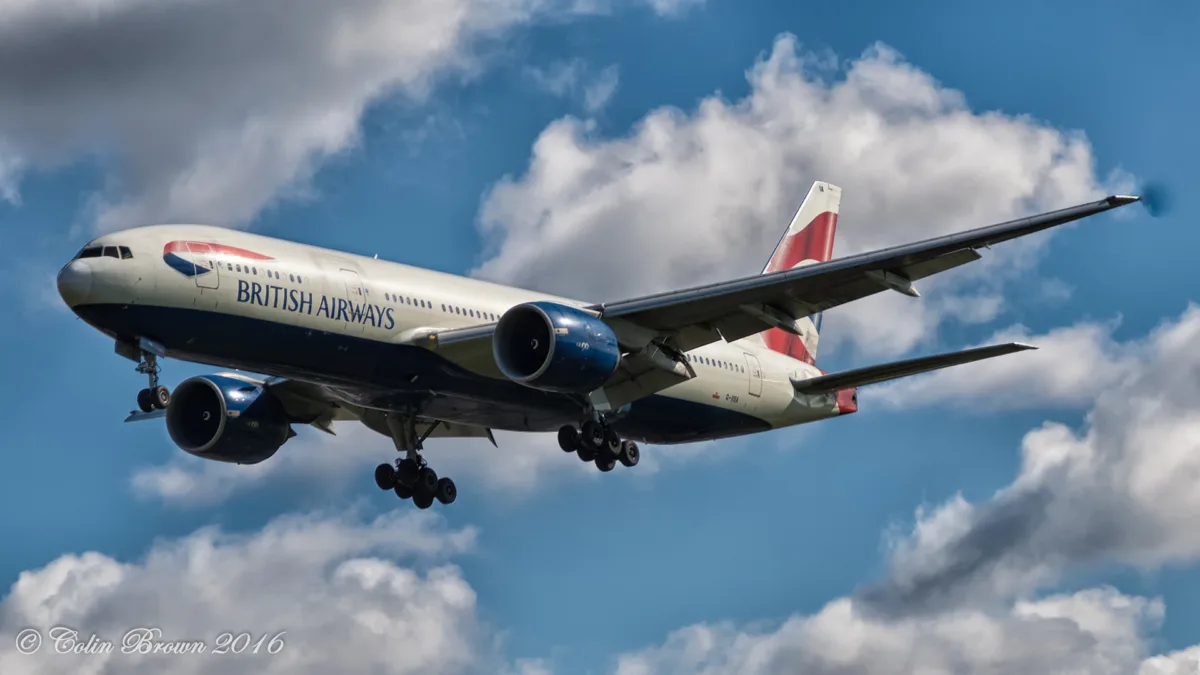
British Airways flight BA295 from London Heathrow to Chicago O’Hare abandoned its Atlantic crossing on 5 October 2026 after making an emergency descent over Ireland. The Boeing 777-200ER, registration G-VIIA, descended from about 37,000 feet to roughly 9,000 feet within minutes as oxygen masks deployed in the cabin. The aircraft later returned safely to Heathrow. British Airways confirmed a technical issue but has not publicly released a detailed diagnosis.
The emergency developed over Ireland
Flight-tracking data show BA295 climbing normally after departure from Heathrow before beginning a rapid descent over Ireland. The crew transmitted squawk 7700, the general emergency code used to alert air traffic control that an aircraft requires priority handling.
The 777 levelled at around 9,000 feet. That altitude is consistent with the response to a cabin pressurisation event because a rapid descent brings the aircraft back into an altitude range where occupants can breathe without relying on a normally pressurised cabin.
Oxygen masks deployed in the cabin
Passenger images and reports showed oxygen masks hanging from the cabin ceiling. That is an important piece of evidence because it is consistent with a cabin-altitude warning or another event requiring supplemental oxygen.
It still does not identify the failed component. British Airways described the incident as a technical issue, so AeroSillage does not present a specific pressurisation-system failure as confirmed until the airline or investigators provide further technical detail.
Why BA295 stayed airborne before landing
After turning back, the aircraft remained at lower altitude for an extended period before landing at Heathrow. Tracking data show prolonged manoeuvring over the UK rather than an immediate approach.
A Boeing 777 departing for Chicago carries a substantial fuel load. If the underlying emergency is stable, remaining airborne can allow the aircraft to reduce weight before landing. Some early reports described fuel dumping, but the available public evidence does not establish that fuel was actually jettisoned. What can be confirmed is that BA295 remained airborne before returning.
An emergency descent is not the same as an uncontrolled fall
The rapid altitude loss was dramatic, but it should not be described as the aircraft simply “plunging” without control. Emergency descent procedures are designed to move an aircraft quickly to a safer altitude when cabin conditions require it.
Likewise, squawk 7700 signals a general emergency but does not reveal its cause. The combination of the descent and oxygen-mask deployment makes a pressurisation-related event plausible, not yet a final technical finding.
What is confirmed and what remains open
Confirmed: BA295 declared a general emergency, descended rapidly to around 9,000 feet, deployed oxygen masks, abandoned the London to Chicago crossing and returned safely to Heathrow.
Still open: the precise technical fault, the exact sequence that triggered the emergency procedures and whether any further engineering or investigative action will follow.
British Airways said affected passengers were being assisted with their onward travel. The BA295 service operated again on subsequent days with other Boeing 777 aircraft, indicating that the event was specific to the 5 October rotation rather than a suspension of the route.
Main sources
The Guardian, 5 October 2026
AIRLIVE, BA295 emergency tracking
Flightradar24, BA295 flight history
Plane Finder, BA295 history for 5 October
Related on AeroSillage: British Airways, easyJet and Ryanair put NATS under pressure.
Leave a Reply