
Boeing to Cut 5% of Commercial Jet Jobs as Output Slows
Boeing plans to eliminate 5% of jobs in its commercial-airplane division as production growth slows. Layoff notices could begin in December.
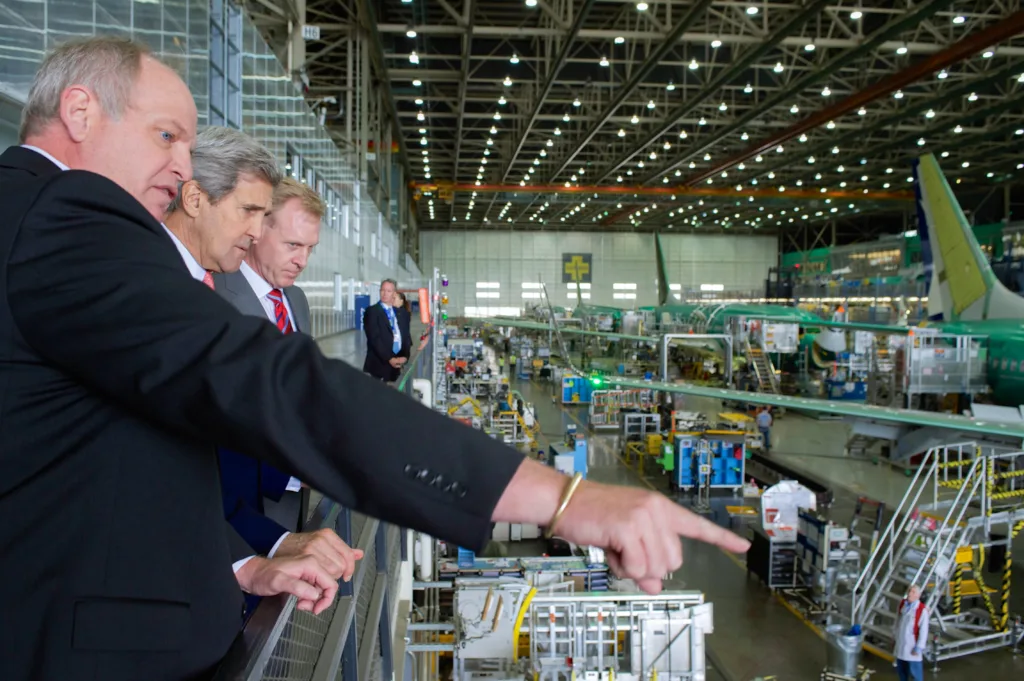
Boeing will cut roughly 5% of jobs in its commercial-airplane division as slower production growth leaves the business overstaffed. Division chief Stephanie Pope announced the plan to employees on November 9, 2026. The reductions will combine attrition and involuntary layoffs, according to a memo reviewed by Reuters. However, layoff notices will not begin before December.
What Boeing’s 5% workforce reduction means
Boeing’s official employment figures show 50,494 people in its Commercial Airplanes division at the end of December 2025. Five percent of that total is approximately 2,525 positions. However, this is only a calculation using the previous year’s staffing level. Boeing has not announced an exact number of individual layoffs under the new plan.
In practice, attrition removes positions when employees retire or leave without being replaced. Involuntary layoffs, by contrast, mean workers lose their jobs through an employer-led reduction. As a result, the number of people receiving notices could be lower than the total reduction in positions.
So far, the employee memo does not identify the factories, teams or job classifications affected. It also does not give a final date for completing the reductions. Employees and local suppliers must await more detail. The 5% figure is not a confirmed layoff count for any particular site.
737 production targets move further into 2027
Meanwhile, the staffing move follows a slower recovery in Boeing’s jet production. In its October 27 third-quarter results, Boeing said its 737 program was working toward a stable rate of 47 aircraft per month. Reuters reported that management now expects to reach that rate in early 2027, later than previously anticipated.
The distinction matters because a production target is not the same as a sustained output rate. Factories must assemble aircraft consistently, suppliers must deliver usable parts, and completed jets must pass required checks before delivery. Therefore, raising the monthly target does not immediately translate into more aircraft reaching airlines.
For the 787, Boeing reported stable production of eight jets a month in the third quarter. Reuters said the manufacturer was struggling to advance toward ten. These figures describe production, not guaranteed deliveries; delivery timing also depends on inspections, customer acceptance and other operational requirements.
Demand remains strong, but factory economics are under pressure
Aircraft demand is not the principal reason Boeing gave for the job reductions. Its third-quarter report showed a companywide backlog of $745 billion, including orders for more than 6,300 commercial aircraft. Nevertheless, Boeing Commercial Airplanes posted a $697 million operating loss for the quarter on $10.7 billion in revenue.
Boeing attributed the division’s results partly to anticipated production-rate changes and supply-chain costs. A slower production increase spreads some costs across fewer finished aircraft. Meanwhile, retaining a workforce sized for a faster expansion becomes harder to justify, even when customer orders remain substantial.
For airlines awaiting new jets, the immediate issue is delivery reliability, not a reported cancellation of orders. Less predictable output can complicate fleet retirement plans, aircraft leasing and route growth. However, no specific carrier delivery delay can be assigned to the November 9 staffing announcement without a separate schedule confirmation.
For additional context, AeroSillage has covered the interruption affecting Boeing 777 freighter production and FAA certification developments for the Boeing 737 MAX 10. Those stories concern different programs and should not be mistaken for the causes of this workforce decision.
What workers and airlines should watch next
The next concrete step is the start of employee notifications, expected no earlier than December. Boeing has not published a site-by-site breakdown or a confirmed final tally of involuntary layoffs. Workers should rely on formal employer notices and applicable employment requirements rather than estimates based on the division’s historical headcount.
Separately, airlines and suppliers will watch whether Boeing stabilizes the 737 production rate and increases 787 output. Boeing’s next production and financial updates will provide a clearer measure of progress. For now, the confirmed decision is a planned 5% workforce reduction tied to a slower manufacturing ramp-up, not a reported collapse in aircraft demand.
Read next
JOIN THE CONVERSATION
Let’s discuss this story.
A question, a clarification or a different perspective? Share it with us.