
Afraid of turbulence? Where to sit to feel fewer bumps on a flight
A practical explanation of how seating position may affect the feeling of turbulence and why wearing a seat belt matters.
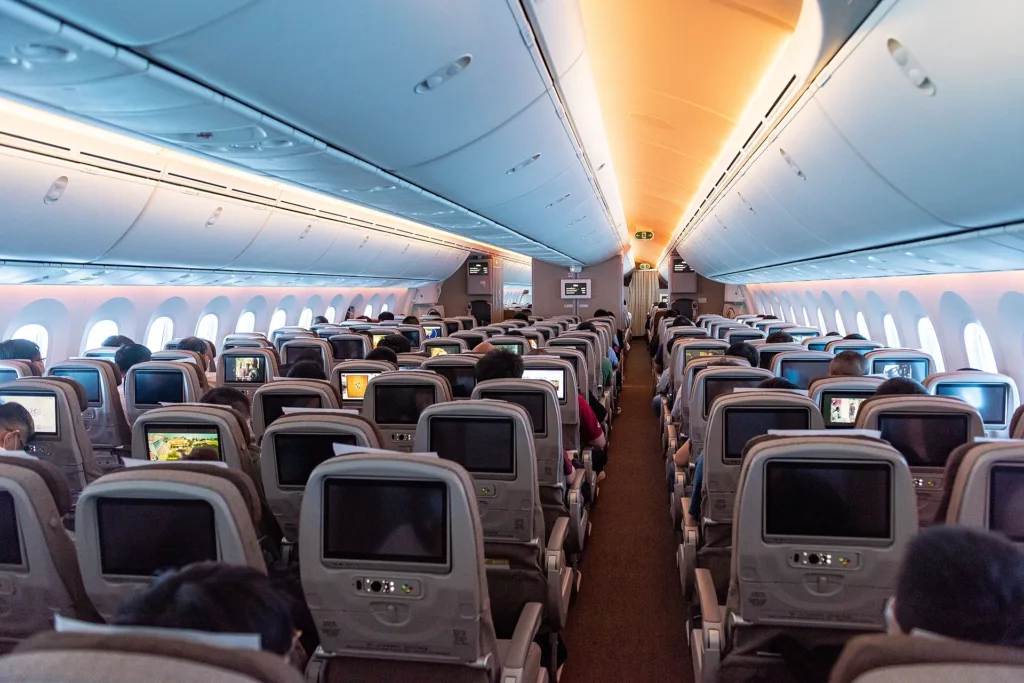
Afraid of turbulence? Seats around the wings are often a sensible choice for passengers hoping to feel fewer bumps. Their proximity to the aircraft’s centre of gravity can reduce how strongly some pitching motions are perceived. But no seat can eliminate turbulence, and sitting in a smoother-feeling part of the cabin is not a substitute for keeping your seat belt fastened.
An aircraft in turbulent air does not move in a single simple direction. It can accelerate up or down, pitch nose-up or nose-down, roll around its longitudinal axis or combine several motions. Every passenger travels through the same patch of atmosphere, but their distance from the aircraft’s axes of rotation can change how much of a particular movement they feel.
Why the wing area is often the calmer-feeling option
On a conventional passenger jet, the centre of gravity tends to lie in the wing area, although its exact position changes with loading and fuel. When the aircraft pitches, seats far forward or aft move through a larger arc than seats closer to the centre of rotation. In that limited, meaningful sense, the middle of the aircraft is often a better bet for reducing perceived motion. Travellers prone to motion sickness may find that useful, too.
The rear of a long aircraft can amplify certain pitch oscillations. This does not mean that all turbulence is strongest in the last rows. A whole-aircraft vertical acceleration can be felt throughout the cabin, while different aircraft designs and turbulence encounters produce different responses. Front seats may feel gentler than the very back in some conditions, but there is no universal rule that the front will outperform the area near the wings.
Roll introduces another consideration: passengers farther from the centreline may move through a slightly larger arc in a roll. Yet any difference between a window and an aisle seat is usually a less useful predictor than the kind and strength of the atmospheric disturbance. No aviation authority publishes a universal ranking of seat letters by turbulence intensity. Paying extra for a purportedly ‘turbulence-proof’ seat is therefore not supported by the evidence.
Feeling fewer bumps does not mean being safer
The US Federal Aviation Administration warns that turbulence can occur suddenly, even in apparently clear skies. Unbelted passengers can be thrown from their seats or into cabin fittings. Choosing a seat near the wings does not prevent that. The practical, evidence-based protective measure is to keep your belt buckled whenever seated and obey cabin crew instructions.
The FAA’s passenger safety guidance says a lap belt should sit low and snug across the hips. Families should use appropriate approved child restraints when applicable; holding a small child on an adult’s lap is not equivalent protection against an unexpected jolt. Following hand-baggage rules also reduces the chance of loose objects becoming hazards.
Pilots and dispatchers use weather information, forecasts and reports from other aircraft to avoid the worst conditions when possible. Nevertheless, atmospheric disturbances cannot always be forecast precisely. A route change, altitude adjustment or a calm spell does not guarantee a turbulence-free trip.
Seats near the wings may make some rotational movements feel less pronounced, but they cannot remove the vertical accelerations encountered in turbulent air. That is a comfort distinction, not evidence that one cabin section is inherently safer. Keeping the belt fastened while seated remains the practical precaution, including when the seat-belt sign is off.
Making a practical seat choice
If movement makes you anxious, selecting a seat around the wings is a reasonable comfort strategy, as long as you do not treat it as a safety guarantee. Being able to see the horizon may help some travellers reconcile visual and physical sensations, while others find a different view more reassuring. An aisle seat can be convenient for access, but it does not reliably avoid turbulence.
During a rough patch, stay seated with the belt secured, stow loose objects and follow crew announcements. Do not walk down the cabin to find a ‘better’ row while turbulence is in progress. For severe or persistent fear of flying, structured anxiety-management support can be more useful than pursuing a seat that promises no bumps.
The takeaway: around the wings may reduce some motion sensations, particularly pitch; seat position cannot eliminate atmospheric turbulence; a securely fastened lap belt matters more for injury prevention than the row number.
Related reporting: an Avianca flight diverted to Miami after severe turbulence, with eight people reported hospitalised. It illustrates why seat belts matter.
Sources: FAA, Turbulence: Staying Safe ; FAA, Passenger Safety Tips. The FAA guidance concerns protection from injury, while the wing-area comfort explanation follows general flight dynamics rather than an FAA seat-ranking scheme.
Illustration: economy cabin of China Eastern Boeing 787 B-209N, photographed on 15 June 2021. N509FZ / Wikimedia Commons, CC BY-SA 4.0, resized. This image does not depict a turbulence event.

Read next
JOIN THE CONVERSATION
Let’s discuss this story.
A question, a clarification or a different perspective? Share it with us.