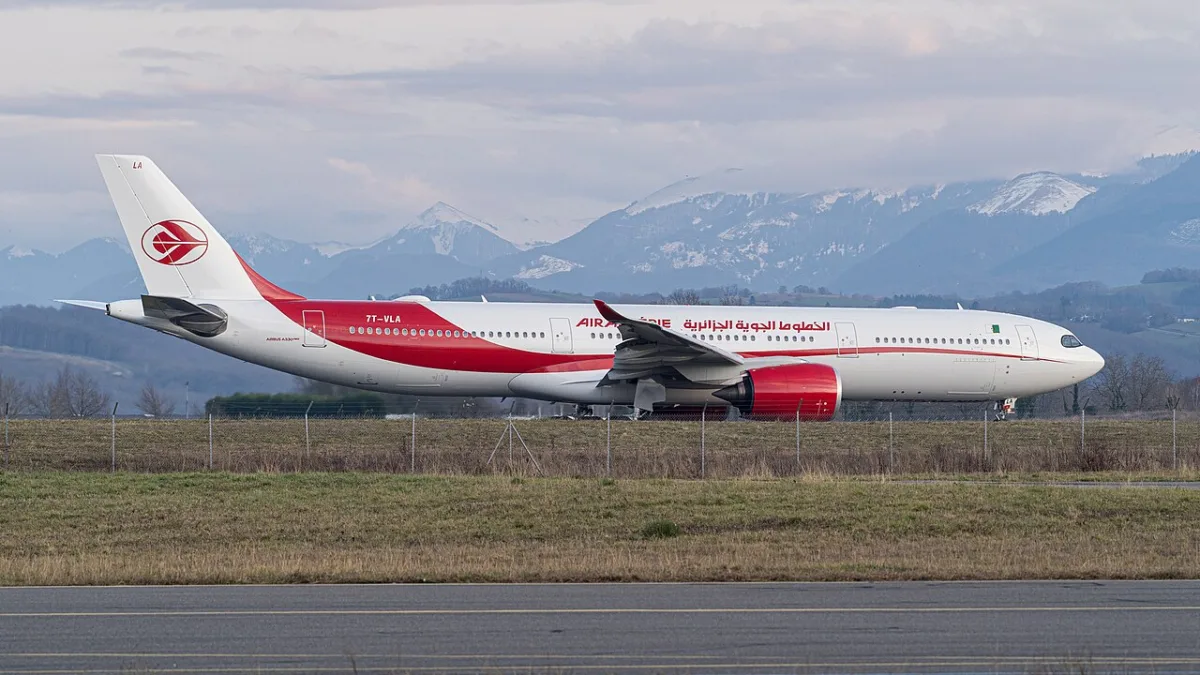
Air Algérie is entering one of the biggest investment cycles in its recent history, but the public data reveal a difficult gap between ambition and performance. Capacity is growing, new aircraft are arriving and the network is expanding. Yet load factor, productivity, punctuality and customer reputation remain far below the standard expected from an airline that wants Algiers to become a major connecting hub.
Growth, load factor and productivity reveal the first gap
AACO data show that Air Algérie increased available seat-kilometres from 14.159 billion in 2023 to 15.734 billion in 2024, up 11.1%.
Revenue passenger-kilometres rose only from 11.035 billion to 11.616 billion, up 5.3%.
AeroSillage therefore calculates a load factor of about 73.8% in 2024, down from 77.9% in 2023.
IATA’s 2024 global average was about 83.5%, while African airlines averaged around 74.5%. Air Algérie is therefore far below the global benchmark but close to the African average.
The key issue is not that 73.8% is catastrophic; it is that capacity expanded much faster than demand actually monetised.
Air Algérie reported 9,274 employees in 2024, up from 8,289 a year earlier: an increase of 11.9% while RPK growth was only 5.3%.
Apparent productivity therefore declined from roughly 1.33 million RPK per employee to 1.25 million.
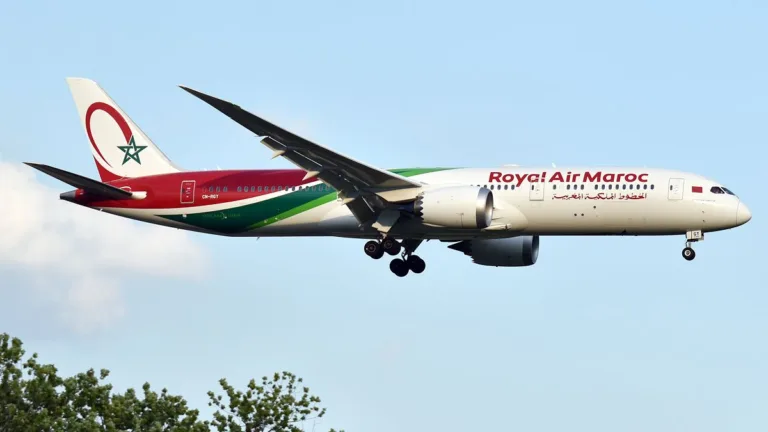
AACO data for Royal Air Maroc show a much higher ratio: about 4.65 million RPK per employee versus 1.25 million for Air Algérie.
That comparison must be treated carefully because airlines internalise or outsource different functions such as ground handling, maintenance, catering and training.
Still, the gap is large enough to make organisational structure a real strategic issue.
The group has begun separating activities through Air Algérie Ground Operations, an aviation academy, planned maintenance subsidiaries and Domestic Airlines.
The direction presents this holding-style structure as a way to improve specialisation and performance. In practice, it is also an attempt to make a very large organisation more transparent and efficient.
Fleet renewal and operational transformation
Air Algérie communicates an average fleet age of about 11 years, while independent databases showed a much older figure: around 16.3 years for 64 aircraft in early September 2026.
The difference reflects a fleet in transition and changing scope after new deliveries and the integration of domestic operations.
AACO/Cirium data earlier in 2026 still showed older generations at roughly 17.2 years for legacy A330s, 17.4 years for Boeing 737s and 19.4 years for ATR 72s.
The first A330-900 arrived in November 2025. By summer 2026, five A330neos had joined the airline according to specialist reporting.
The first Boeing 737 MAX 8 entered service in July 2026, with additional aircraft arriving later that month. Air Algérie has also ordered more MAX aircraft.
Domestic Airlines is due to receive 16 new ATR 72-600s between 2026 and 2028.
The new fleet should cut fuel burn, reduce technical downtime and improve the cabin product: but it begins from a base in which many 737NGs, ATRs and A330ceos are close to two decades old.
Punctuality, customer experience and service quality
Air Algérie does not publish a transparent annual punctuality rate comparable with major industry datasets. But FlightStats data on several Paris–Algiers rotations during summer 2026 are worrying.
Observed on-time rates included roughly:
- AH1003 CDG–ALG: 15%
- AH1013 CDG–ALG: 16%
- AH1001 CDG–ALG: 28%
- AH1004 ALG–ORY: 31%
- AH1005 ORY–ALG: 38%
- AH1231 CDG–ALG: 58%
Across those six flight numbers, AeroSillage counted about 110 on-time arrivals out of 355 observed flights: roughly 31%. Delayed flights averaged about 54 minutes late.
These are route-specific summer observations, not a company-wide annual punctuality rate, but France is Air Algérie’s biggest international market. Peak-season reliability therefore matters enormously.
In early September 2026, Trustpilot showed about 1.5/5 from 399 reviews, with 86% one-star ratings. Tripadvisor showed roughly 2/5 from 836 reviews.
The recurring complaints concern delays, poor information during disruption, baggage problems, customer-service accessibility and some ground-staff interactions.
Positive reviews still regularly mention meals, baggage allowance, some cabin crews and pilot professionalism.
Skytrax certifies Air Algérie as a three-star airline. Its assessment points especially to staff service and the Algiers transfer experience as weaknesses, while viewing the product on newer A330s more positively.
Air Algérie did not appear in Skytrax’s 2025 African top 10, even though by network size and passenger volume it remains one of the continent’s larger airlines.
AirlineRatings gives Air Algérie 6/7 for safety and confirms IOSA registration.
The airline is not on the EU Air Safety List. It should not be confused with Air Express Algeria, a separate private operator added to the EU list in June 2026.
The paradox: strong demand, weak conversion into performance
Air Algérie has assets many African airlines would like to have: a large diaspora in Europe, a substantial domestic market, a favourable geographic position between Europe and Africa and strong state backing.
It serves more than 80 destinations and enjoys structural demand from France, Canada, the Middle East and African markets.
The new A330neo also represents a product leap, with 18 lie-flat Business seats, 24 Premium Economy seats and 266 Economy seats in a more modern Airspace cabin.
But new aircraft alone do not solve punctuality, hub management, communication, productivity or revenue-management weaknesses.
2026–2028 will test whether the transformation is real
The airline says it wants to exceed 9.8 million passengers in 2026, expand internationally and reorganise activities into specialised subsidiaries.
The real test is not the number of aircraft received. Air Algérie needs to improve five areas at the same time:
- raise load factor;
- improve labour productivity;
- make schedules more reliable;
- professionalise disruption management;
- turn Algiers into a genuinely competitive connecting hub.
Air Algérie is not condemned by its past. It is investing, growing and finally renewing the fleet at meaningful scale.
But the available data also show that the airline still generates too little traffic for the capacity it places on the market and the human resources it mobilises.
The decisive question is therefore not when the next A330neo or 737 MAX arrives. It is whether by 2028 Air Algérie can carry more passengers with higher load factors, fewer delays, better productivity and a customer experience that matches the billions invested in new aircraft.
Methodology
Load factors are calculated by AeroSillage from AACO RPK and ASK data. Employee ratios are indicators of apparent productivity and do not adjust for different outsourcing or subsidiary structures. FlightStats punctuality observations cover selected Paris–Algiers flight numbers during summer 2026 and must not be interpreted as a company-wide annual rate.
Main sources
Air Algérie; AACO; IATA; Airbus; ATR; FlightStats; Skytrax; AirlineRatings; public review platforms.
Leave a Reply