
Western Sydney Airport opens to passengers before its railway is ready
Western Sydney International began scheduled passenger flights on 25 October 2026 with a Jetstar departure. Passengers must use buses or roads until the metro opens.
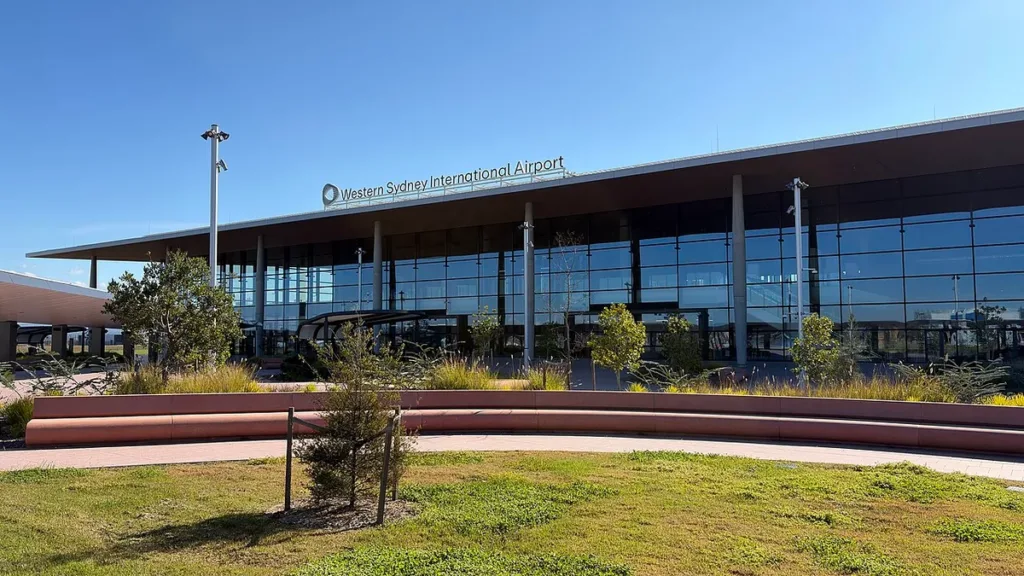
Western Sydney International welcomed its first airline passengers on Sunday 25 October 2026, when Jetstar flight JQ362 took off for the Gold Coast just before 11.30am local time. The departure marked the beginning of scheduled passenger operations at the new airport in Badgerys Creek, according to ABC News. Yet one important part of the project remains unfinished: the railway intended to connect the terminal to Sydney’s wider transport network. For its first passengers, the journey to the terminal still depends on roads and buses.
The airport is around 45 kilometres from central Sydney, on the western side of the metropolitan area. It is not another terminal at Kingsford Smith. Named for aviator Nancy-Bird Walton, the new facility has a 3.7-kilometre runway and an initial design capacity of ten million passengers annually. It promises something Sydney’s established airport cannot routinely offer: unrestricted overnight operations.
The journey begins before the flight
At opening, there is no train running directly to the passenger terminal. The planned Sydney Metro – Western Sydney Airport line is a 23-kilometre, six-station project connecting the terminal with St Marys and Bradfield. Once the line opens, the journey between St Marys and the airport is expected to take around 15 minutes, but that link is still under construction.
For now, the WSI Link runs free between St Marys railway station and the airport. It is scheduled every 30 minutes, from 4.30 am until midnight Sunday to Thursday, and until 1 am on Fridays and Saturdays. Passengers board at Nariel Street by St Marys station or Stand A at the airport. They are asked to tap on and off using an Opal card or contactless payment card, even though the shuttle fare is zero.
Five paid bus routes, numbered 772, 790, 825, 845 and 860, also serve the airport from areas including Penrith, Mount Druitt, Liverpool and Campbelltown. The published network generally operates at half-hourly intervals between 5 am and 10 pm. Road passengers can approach on the M12; taxis, rideshare services, parking and drop-off facilities are available. The practical choice between Western Sydney and Kingsford Smith will therefore depend on the complete journey, not just the airfare.
That transport compromise matters more while the route network is young. Jetstar is beginning with Gold Coast, Melbourne and Brisbane services. Air New Zealand plans Auckland flights from 26 October and Singapore Airlines daily Singapore services from 23 November. QantasLink is expected to join on 28 March 2027 using Embraer E190 aircraft to Melbourne and Brisbane. The first weeks will not offer the breadth of destinations already available at Sydney’s long-established hub.
What Sydney gains from an airport without a curfew
Western Sydney can accept flights day and night. By contrast, Sydney Kingsford Smith is normally subject to restrictions between 11 pm and 6 am, with defined statutory exceptions. The new flexibility matters to airlines planning aircraft schedules and to freight operators whose movements do not fit conventional daytime patterns. It does not mean all routes will suddenly have overnight departures.
Freight operations began before the first scheduled passenger service. Qantas Freight confirmed that its domestic operations at Western Sydney International started on 27 July 2026. The federal government identified 1 November as the intended date for adjustments affecting certain overnight freight movements previously accommodated under Kingsford Smith’s curfew arrangements. That is a change to specified operations, not a wholesale transfer of Sydney’s freight industry.
The absence of a curfew also has a human cost for some neighbours. People in Luddenham interviewed by ABC have described disturbed sleep from night cargo services and questioned the provision of sound insulation. Their concerns are a reminder that additional capacity and flexibility for the aviation sector can create new pressures on communities living beside a flight path.
A decision made forty years before opening day
The opening follows a debate much older than the terminal itself. Sydney had been discussing the need for a second major airport since 1946, as ABC’s historical reporting recounts. In February 1986, the federal government chose Badgerys Creek as the site. Land was acquired, but arguments over location, noise and development delayed construction for decades.
Major works finally started in September 2018. By June 2025, the runway and terminal had been completed, according to the Australian infrastructure department. Opening a working airport still required extensive testing. A Jetstar A320 arrived from Melbourne on 1 September for an operational rehearsal covering taxiing, turnaround, boarding arrangements and terminal processes. That flight was a trial, not the launch of public passenger services.
The metro’s six stations remain under construction. Until the railway opens, passengers using St Marys must continue by the WSI Link shuttle or another road service.
Read next
JOIN THE CONVERSATION
Let’s discuss this story.
A question, a clarification or a different perspective? Share it with us.