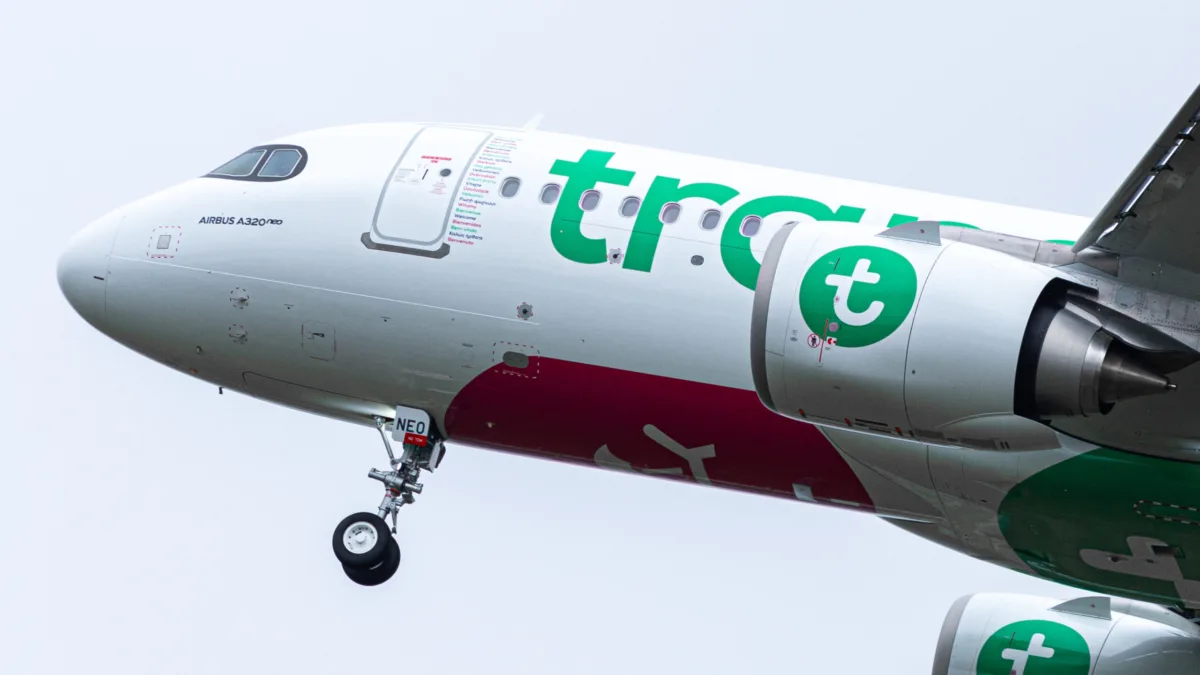
March 29, 2026 marked a structural turning point for French aviation. Air France completed the concentration of most of its Paris operations at Charles de Gaulle, apart from selected Corsica public-service routes, while Transavia France took over as Air France-KLM’s reference carrier at Paris-Orly.
Created in 2007 as a leisure-focused low-cost airline, Transavia France has become one of the group’s strategic pillars. Air France-KLM says it now controls around 50% of all Orly slots through Transavia. The airline has returned to dense domestic markets such as Nice, Toulouse and Marseille, is integrating more Flying Blue benefits and is replacing Boeing 737-800s with Airbus A320neos.
The strategic question is now larger than simple growth: can Transavia keep low-cost economics while progressively taking over missions that used to belong to Air France?
Orly and domestic routes: Transavia is changing business
Air France-KLM has separated the roles of its two main Paris airports more clearly than ever. Air France is concentrating on CDG, where a hub-and-connection model generates the most value. Transavia is becoming the group’s main point-to-point operator at Orly.
By recovering slots previously used by Air France, Transavia now holds roughly half of Orly’s available slots. In a capped and highly constrained airport, that is an exceptional strategic asset.
Orly itself remains strong. DGAC data showed around 14 million passengers in the first five months of 2026, up 3.7% year on year and 7.8% versus the same period in 2019.
The handover is most visible on three historic domestic routes: Orly–Nice, Orly–Toulouse and Orly–Marseille.
Transavia can schedule up to eight daily flights to Nice, eight to Toulouse and two to Marseille. Air France continues to serve these cities from CDG, so the group is now splitting domestic demand between a hub model at CDG and a lower-cost point-to-point model at Orly.
Eight daily frequencies to Nice and Toulouse are not simply leisure flying. They allow same-day business trips and force Transavia to serve customers who once used Air France’s shuttle-style domestic product.
To make that transfer work, Transavia has had to evolve its product.
On domestic routes, the Max fare can allow same-day flight changes up to one hour before departure, subject to availability. It also includes seat selection and priority airport treatment.
Flying Blue members can earn Miles and XP on Transavia flights, while higher-status customers receive additional benefits. Lounge access has also entered the product in selected contexts.
These are unusual features for a classic low-cost model. The challenge is obvious: every extra service can increase cost. Transavia has to become more attractive to frequent and business travellers without inheriting the full cost structure of a network airline.
Growth has become structural in France
Transavia France began at Orly in 2007. Nantes and Lyon followed in 2010, Montpellier in 2020, Marseille in 2023 and Bordeaux in 2024. It now has six French bases.
Those regional bases let Air France-KLM remain present in leisure and VFR markets where Air France’s cost structure would be harder to sustain. Transavia connects French cities directly with Europe, North Africa, the Middle East and holiday markets without routing every passenger through Paris.
For summer 2026, the airline again added routes from Orly and regional bases. In Marseille, seat capacity rose by nearly 48% for the summer season according to the airline.
Fleet: the Airbus transition and heavy reliance on leasing
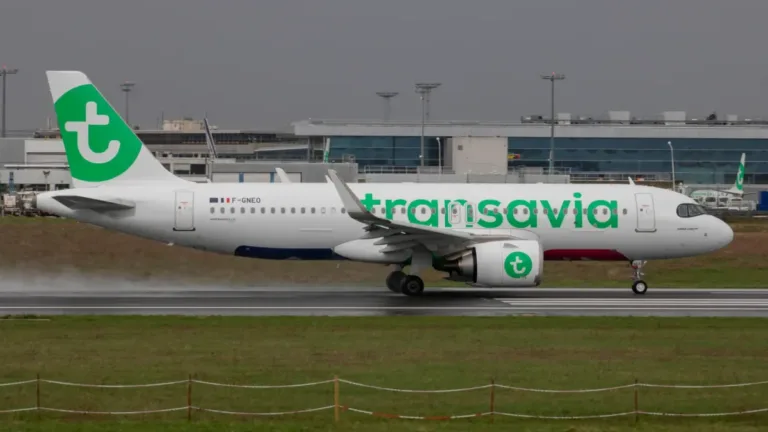
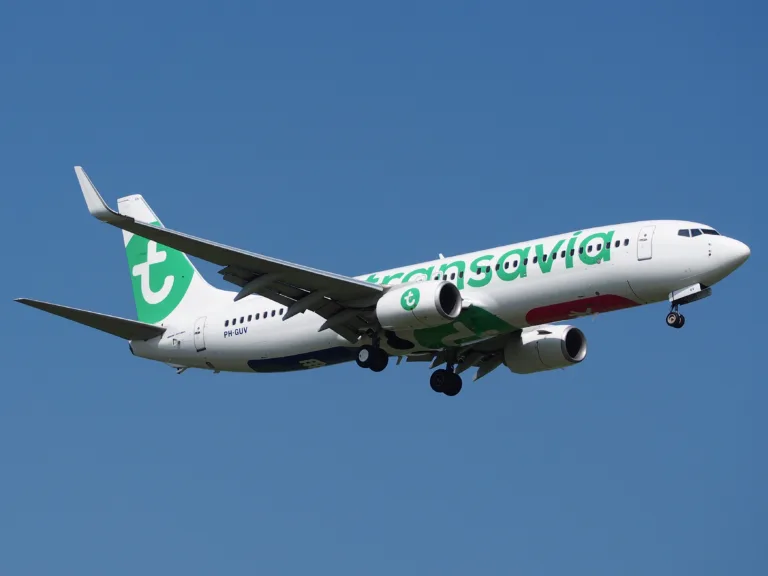
Transavia France is progressively replacing the Boeing 737-800: the aircraft around which its model was built: with the Airbus A320neo family.
The airline’s published fleet currently lists 22 Airbus A320neos and 68 Boeing 737-800s, around 90 aircraft in total. At the end of 2025, Air France-KLM counted 91 aircraft in the French Transavia fleet, 90 of them in operation, with 13 A320neos delivered during that year alone.
Air France-KLM said the average age of the French fleet had fallen to 9.4 years at the end of 2025. The newer generation is intended to cut fuel burn and CO₂ emissions by more than 15% compared with previous-generation aircraft and reduce noise.
But the transition also creates temporary complexity. Moving from Boeing to Airbus requires pilot conversion, new simulators, adapted maintenance, procedures and technical organisation. For several years, Transavia has to operate two aircraft families at once: reducing the simplicity that low-cost airlines normally seek.
At the end of 2025, only about 9.9% of Transavia France’s fleet was owned outright. Around 5.5% was under finance lease and 84.6% under operating lease.
Leasing is normal in modern aviation and allows faster growth with less capital tied up in aircraft. It also creates recurring contractual commitments and greater exposure to financing conditions when the market turns.
The financial challenge: turning growth into profit
The financial picture needs careful wording because Air France-KLM publishes detailed operating results for the Transavia segment as a whole, combining Transavia France and Transavia Netherlands. It would therefore be misleading to attribute the entire segment result to the French airline alone.
In 2025, the Transavia segment generated €3.451 billion in revenue, up 12.3%, while capacity rose 14.9%. Yet operating result fell to –€49 million, versus a small profit a year earlier, representing a –1.4% operating margin.
Air France-KLM explicitly said Transavia France was temporarily penalised by the preparation for taking over Air France operations at Orly. France’s higher solidarity tax on airline tickets also weighed on unit revenue.
The first half of 2026 remained difficult. Transavia carried 13.583 million passengers, up 12.5%, with an 89.1% load factor, but adjusted operating result was –€265 million. The second quarter alone lost €35 million.
Fuel was a major factor. In Q2, Transavia fuel expense excluding ETS rose 50.1% year on year; over the half-year it increased 25.1%.
The group is looking beyond one year’s margin.
Air France wants to concentrate aircraft, crews and connecting traffic at CDG. But abandoning Orly would mean surrendering rare slots in one of Europe’s most constrained airports to competitors.
Transavia lets the group defend Orly with a lower-cost operating model better suited to point-to-point competition.
The strategic bet is that once the transfer phase is complete, a larger A320neo fleet, network optimisation and more ancillary revenue will improve profitability.
Competition, governance and the risk of moving upmarket
Transavia is not expanding into an empty market. easyJet has a strong French presence and competes directly on several routes. Ryanair has an extremely aggressive cost structure and huge commercial scale across Europe.
Transavia’s specific advantage is its Air France-KLM ecosystem: Flying Blue, group distribution, Air France complementarity and above all access to around half of Orly’s slots.
That advantage also creates risk. The closer Transavia moves toward Air France-style services: lounges, loyalty, business flexibility: the more carefully it has to prevent costs from drifting upward.
On September 3, 2026, Air France-KLM appointed Oltion Carkaxhija as chief executive of Transavia at group level, with a mandate to strengthen the brand, particularly within the intra-European market.
This does not replace the individual management teams of Transavia France and Transavia Netherlands. It does, however, show that Transavia is no longer being treated as a peripheral activity.
Transavia was originally Air France-KLM’s answer to the rise of low-cost competition. In 2026 it is also becoming the tool with which the group is redesigning its French network.
Success will no longer be measured only in aircraft and destinations. Transavia must prove it can run a large and complex network, maintain high domestic frequencies, serve more business travellers, replace its entire fleet and still preserve strict cost discipline.
How far can Transavia become France’s point-to-point reference?
Air France remains the group’s central network carrier and still operates a large domestic and international system from CDG.
But at Orly the change is already real: Transavia has become Air France-KLM’s main face.
The next test is financial. Market share without sustainable profit is not enough. The 2025 and first-half 2026 numbers show that the transformation is expensive, even if much of the pressure is linked to the Orly transition and fuel.
Transavia France has already won the battle for scale. It now has to win the battle for profitability.
Main sources
Air France-KLM; Transavia France; DGAC; Air France-KLM fleet and 2025/Q2 2026 financial results. Financial figures cited for Transavia refer to the Air France-KLM Transavia segment unless explicitly stated otherwise.
Leave a Reply