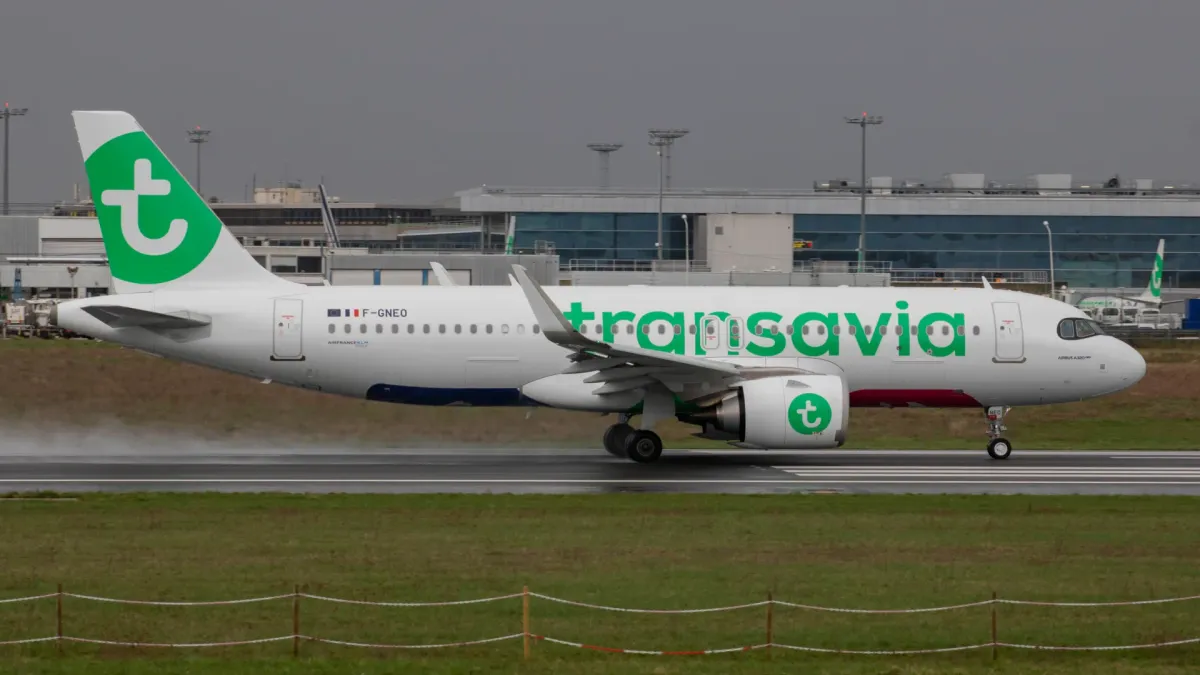
Air France’s retreat from Paris-Orly is now a structural shift inside the Air France-KLM Group, not a temporary schedule adjustment. Since March 29, 2026, most Air France Paris operations have been concentrated at Charles de Gaulle, while Transavia has become the group’s reference operator at Orly.
No public decision says Air France will disappear completely from Orly after 2027. But the present strategy is clear: CDG is the Air France hub; Orly is increasingly Transavia territory.
Since March 2026, Orly and CDG have played different roles
Air France had announced in 2023 that it intended to centralise almost all Paris operations at CDG, except Corsica services covered by public-service obligations.
The company pointed to a profound change in domestic demand: between 2019 and 2023, traffic on domestic routes from Orly fell by about 40%, while same-day return business trips fell by roughly 60%.
Video conferencing, lower corporate travel and high-speed rail competition weakened the economics of the old “La Navette” model. The group therefore sharpened the division of labour: Air France and connections at CDG; point-to-point flying increasingly operated by Transavia at Orly.
From March 29, Air France reinforced CDG frequencies to Toulouse, Nice and Marseille, with up to 12, 12 and 10 daily rotations respectively. Transavia simultaneously took over or expanded Orly services to those domestic markets, including up to eight daily flights to Toulouse, eight to Nice and two to Marseille.
The group is therefore not simply abandoning routes. It is assigning different traffic types to different brands and airports.
Transavia keeps the group powerful at Orly
Air France-KLM says Transavia now holds around 50% of all slots at Paris-Orly after taking over capacity previously used by Air France.
At a slot-constrained airport, that is strategically significant. Air France the airline has reduced its footprint, but Air France-KLM the group remains exceptionally powerful at Orly through Transavia.
Corsica is the last major exception
The principal remaining Air France presence is Corsica, operated with Air Corsica under a public-service framework linking Orly with Ajaccio, Bastia, Calvi and Figari.
The current public-service delegation runs from March 25, 2024 to December 31, 2027. It includes specific obligations on frequencies, capacity and continuity of service.
That is why it would be wrong to assume Transavia will automatically replace Air France on those routes. The post-2027 outcome depends on the next public-service framework and tender process.
The end of the current Corsica contract is therefore the most important date to watch. Possible outcomes include a renewed Air Corsica-Air France arrangement, a different operating split or another operator.
Strategically, Corsica is now the last major exception to the group’s new Paris logic.
Why CDG and Orly now serve two different network logics
Charles de Gaulle works as a global connecting hub. A passenger from Toulouse, Nice or Marseille can connect there to North America, Asia, Africa or the rest of Europe without changing airports.
That gives domestic flights multiple traffic sources: local Paris passengers, connecting customers and international flows. Orly’s legacy domestic operation relied much more heavily on pure point-to-point demand.
The same logic explains the transfer of Air France’s long-haul French overseas services to CDG.
From outside, Air France appears to be leaving Orly. From the group’s perspective, much of the change is an internal transfer of capacity.
Slots remain within the group, Flying Blue remains a shared loyalty tool, and passengers are still captured through an Air France-KLM brand. The group is changing the operating vehicle rather than surrendering the airport.
The commercial test: keeping frequent travellers
This is one of the main strategic risks. Business travellers historically valued Air France for frequency, flexibility, status benefits and a fuller service proposition.
Transavia can reproduce some of the frequency and loyalty advantages, especially on Nice and Toulouse, but it remains a low-cost airline with different baggage, catering and fare-flexibility rules.
The success of the transfer therefore depends on whether travellers who prefer Orly consider the simpler product good enough.
The extension of Paris Metro Line 14 to the airport has materially improved access from central Paris. That strengthens the airport precisely as Transavia is becoming the group’s dominant operator there.
For Paris-region passengers, the combination of easy access and dense point-to-point frequencies gives Orly continuing strategic value.
By late 2026, most of Air France’s normal commercial network has already moved away from Orly. What remains is no longer a broad portfolio waiting to be transferred; it is mainly the special Corsica public-service block.
The next decisive period is therefore 2027–2028, when the current Corsica framework expires and the next arrangement becomes clear.
After 2027, the key question is Corsica and the Air France brand
Technically, yes. Strategically, it is possible. But no current public announcement says that decision has been made.
The only firm conclusions today are that Air France is concentrating at CDG and Transavia is the reference operator at Orly.
Air France-KLM is building a clearer architecture: Air France for the hub, connections and premium network; Transavia for point-to-point, leisure and an increasing share of price-sensitive domestic demand.
The paradox is that Air France is retreating from Orly while Air France-KLM is not. Orly has become the clearest laboratory for the group’s two-brand strategy.
Main sources
Air France-KLM, April 9, 2026; Air France summer 2026 programme; Air France domestic-network adaptation plan; Air Corsica / Air France public-service delegation for Orly-Corsica 2024–2027.
Leave a Reply