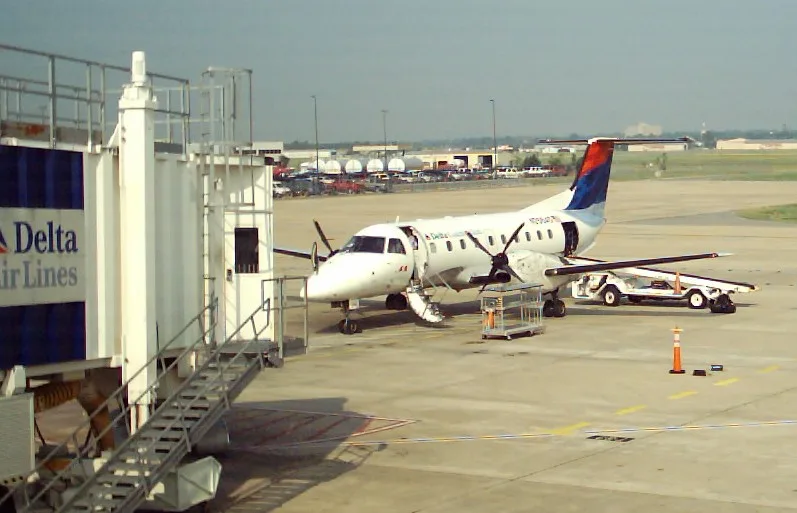
A regional airliner leaving Tanzania’s Serengeti National Park struck a zebra during takeoff on 4 October 2026, then made an extraordinary main-gear-up landing at Kilimanjaro International Airport. All 26 passengers and four crew survived without reported injuries. The sequence was dramatic, but the engineering question it raises has yet to be resolved: did the animal strike directly cause the landing-gear malfunction, and if so, how?
A safari flight takes an unexpected turn
The aircraft was an Embraer EMB-120 Brasilia, registration 5H-HLL, travelling from Seronera airstrip in the Serengeti to Zanzibar. According to Airportia’s summary of The Aviation Herald’s reporting, the turboprop struck and killed a zebra during departure.
The crew subsequently found that the main landing gear could not be extended normally. Instead of continuing toward Zanzibar, they diverted to Kilimanjaro International Airport. The aircraft landed on runway 09 with its main landing gear retracted, sustaining substantial damage as it slid to a stop. All 30 people aboard escaped injury, according to the initial reports.
AeroTime’s account of the incident also cites footage of the landing and reports that airport operations were disrupted while the runway was cleared. The available accounts establish the succession of the zebra strike and the gear-up landing; they do not, by themselves, prove exactly what failed within the landing-gear system.
The airline name and the official aircraft register
Most aviation reports identify the service as a Sindbard Air flight. An important distinction emerges from the official paperwork, however. The Tanzania Civil Aviation Authority’s aircraft register lists Angelic Handlers Company Limited as the registered operator of 5H-HLL and South Sudan’s Ministry of Interior as its owner. The record gives the aircraft’s serial number as 120-276.
These details do not necessarily contradict the trade name used in the aviation coverage: a registered operator, owner and marketed service can be different entities. Without further documentation, the precise contractual or operating arrangement for this flight should not be assumed.
Why wildlife strikes at small airstrips deserve attention
The Serengeti is famous for its wildlife, and that is precisely what makes an airstrip within the wider ecosystem different from a large metropolitan airport. Animals may be present close to movement areas, creating a hazard during high-workload phases such as departure and landing. A large animal entering the runway environment can pose a serious threat even to a turboprop operating a relatively short route.
The consequences of an animal strike depend on where contact occurs and on the aircraft’s condition after the impact. A crew’s decision to divert is also influenced by available runways, emergency services, aircraft performance and the nature of any malfunction. For this occurrence, the reported inability to lower the main landing gear is clear; the technical cause requires investigative evidence rather than speculation.
Reports indicated that Kilimanjaro’s runway was unavailable for a period while airport teams recovered the aircraft and checked the landing area. AeroTime reported a closure lasting several hours before operations resumed. Even without passenger injuries, a runway-blocking emergency can disrupt arrivals and departures across an airport’s schedule.
The survival of everyone on board is the central outcome. The longer-term lessons will depend on investigators establishing the sequence of damage and assessing wildlife-management arrangements at the departure airstrip. For further context, explore AeroSillage’s African aviation coverage.
Still outstanding: the exact failure mechanism, a full technical assessment of the aircraft and any formal safety recommendations. These details should not be treated as settled before the investigation reports them.
Illustration: a different Embraer EMB-120 photographed at Dallas–Fort Worth, not Tanzania’s 5H-HLL. Photo: Paul Victor Novarese / Wikimedia Commons, CC BY-SA 2.0.

Leave a Reply