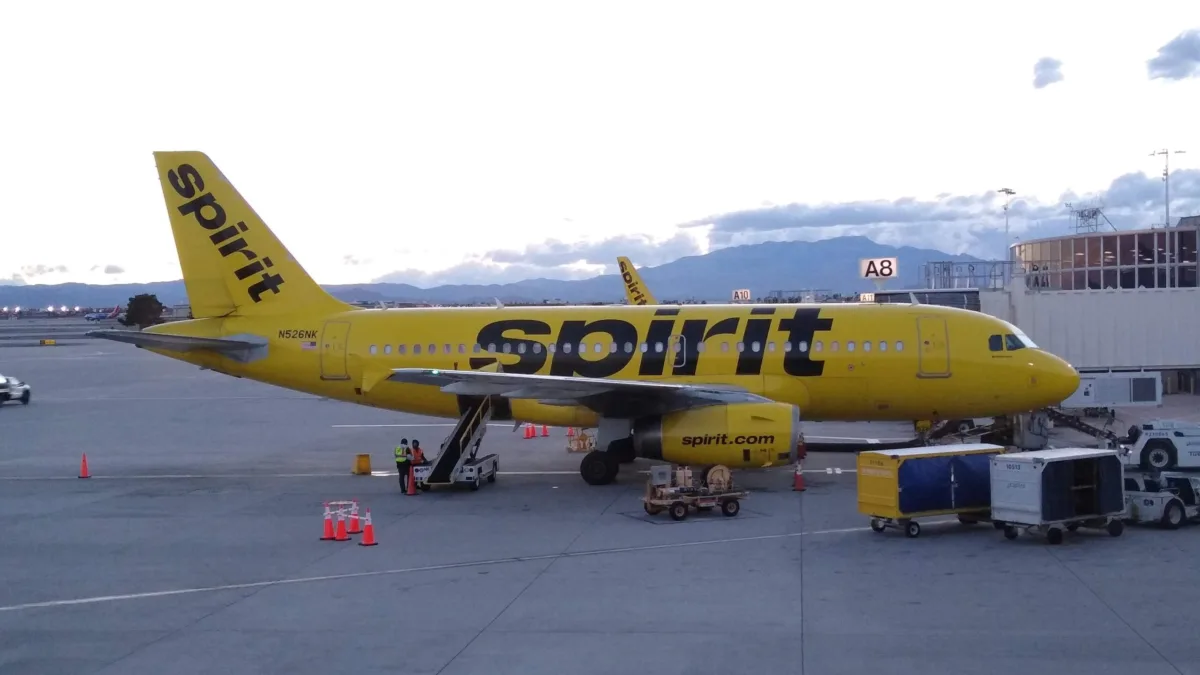
Spirit Airlines’ yellow aircraft became one of the defining symbols of ultra-low-cost travel in the United States. The airline built its growth around extremely low headline fares, dense cabins and fees for almost every optional service. Yet within a few years the model unravelled. Two Chapter 11 restructurings, the blocked JetBlue merger, persistent losses, Pratt & Whitney engine groundings, stronger competition and finally a major fuel shock pushed the carrier beyond recovery. On May 2, 2026, Spirit stopped flying.
From growth to two Chapter 11 filings: the chronology of a collapse
January 16, 2024: a federal judge blocks JetBlue’s planned acquisition of Spirit.
November 18, 2024: Spirit enters Chapter 11 for the first time.
August 29, 2025: less than six months after emerging from restructuring, Spirit returns to Chapter 11.
May 2, 2026: operations cease and restructuring gives way to an orderly liquidation.
Those dates tell only part of the story. Spirit did not fail because of one event. It was hit by several structural problems at the same time.
Spirit’s first bankruptcy filing was designed to keep aircraft flying while the company restructured debt and its balance sheet.
That distinction matters. US Chapter 11 can allow an airline to continue operating while negotiating with creditors, lessors and investors.
The problem for Spirit was that fixing debt did not fix the economics of flying.
Why the ultra-low-cost model stopped working
Spirit had once been one of the most feared competitors in US aviation because its low fares forced larger airlines to respond.
But after the pandemic, operating costs rose while the domestic leisure market became increasingly competitive.
Spirit went for years without producing an annual profit and accumulated very large losses. The airline needed high aircraft utilisation, cheap operating costs and strong ancillary revenue to make the ULCC formula work. Several of those assumptions weakened at once.
The original proposition was simple: sell a seat very cheaply, pack the aircraft densely and charge separately for bags, seat selection and other services.
That model stimulated traffic and attracted highly price-sensitive customers. It also put pressure on the large US carriers even when passengers ultimately booked elsewhere.
Spirit’s presence on a route often forced competitors to keep entry-level fares lower.
Over time, American, Delta and United became better at segmenting the cabin and selling basic-economy fares at the back of aircraft while earning high margins from premium cabins, credit-card partnerships and loyalty programmes.
That squeezed Spirit from both ends: the majors could compete for low-fare customers without giving up the profitable premium and loyalty businesses that Spirit largely lacked.
US domestic capacity expanded rapidly after the pandemic, especially in leisure markets.
Spirit could fill aircraft, but filling aircraft is not the same as earning enough revenue per seat. When several carriers compete aggressively on price, a high load factor can coexist with poor profitability.
GTF engines, fleet cuts and liquidity turned an industrial problem into a financial crisis
Spirit had invested heavily in Airbus A320neo-family aircraft powered by Pratt & Whitney geared turbofan engines.
The GTF inspection and durability crisis forced a significant number of aircraft out of service. That was particularly painful because the newer aircraft that were supposed to improve fuel efficiency and economics instead became unavailable for extended periods.
The airline received compensation, but money from the engine manufacturer could not fully replace productive aircraft capacity or eliminate the operational disruption.
As the financial pressure intensified, Spirit moved from expansion to contraction.
Aircraft deliveries were deferred, aircraft were sold or returned, routes were cut and pilots were furloughed.
The strategy that had been built around rapid growth gradually turned into one focused on shrinking fast enough to preserve cash.
Frontier and JetBlue were two strategic exits that closed
Spirit and Frontier had initially pursued a merger that made industrial sense: both were ultra-low-cost carriers with similar fleets, overlapping customer segments and comparable operating philosophies.
That transaction was abandoned after JetBlue offered a higher-value alternative.
The choice would later become important because Frontier remained one of the best-positioned airlines to absorb traffic and routes when Spirit disappeared.
JetBlue’s proposed acquisition valued Spirit at around $3.8 billion.
JetBlue planned to phase out the Spirit brand and use its aircraft, pilots and airport positions to accelerate its own growth.
But the US Department of Justice opposed the transaction on competition grounds.
The DOJ argued that eliminating Spirit as an independent ultra-low-cost competitor would harm price-sensitive consumers.
On January 16, 2024, a federal judge blocked the deal. JetBlue and Spirit initially appealed, then abandoned the merger on March 4.
Legally, the ruling was designed to preserve Spirit as an independent source of low fares.
Economically, however, Spirit was already becoming too weak to remain independent indefinitely.
It would be simplistic to say the regulator “killed” Spirit. Debt, losses, engines and weak economics existed independently. But blocking the merger unquestionably removed one of Spirit’s main strategic exits.
Spirit entered Chapter 11 on November 18, 2024, the first bankruptcy filing by a major US airline since American Airlines in 2011.
The company said flights would continue while it restructured the balance sheet.
Spirit formally emerged from Chapter 11 on March 12, 2025.
About $795 million of funded debt was converted into equity, and investors injected around $350 million of new capital.
That was a substantial financial reset.
But the central problem remained: the airline was still losing money through normal operations.
Removing debt can repair a balance sheet. It does not automatically repair a business model.
Spirit tried to change its product without restoring a viable model
The airline began moving away from the pure ultra-low-cost formula.
It introduced more bundled products, more comfort and a customer proposition closer to the mainstream airlines it had once challenged.
The logic was understandable: customers had changed and competitors were selling low fares with broader products.
But the move contained a contradiction. The more Spirit looked like larger carriers, the more it risked losing the extreme cost and product differentiation on which its identity had been built.
The first restructuring did not last.
Spirit reported another net loss of roughly $246 million in the second quarter of 2025, according to information presented around its second filing.
On August 29, 2025, less than six months after emerging from Chapter 11, the airline filed again.
This time the objective was not just to reduce debt. Spirit needed to become dramatically smaller.
By March 2026, management was still presenting a pathway out of the second Chapter 11.
The fleet was expected to fall to only 76–80 aircraft by the third quarter of 2026, mainly older-generation Airbus A320 and A321 aircraft.
A deal with AerCap illustrated the scale of the retrenchment: Spirit planned to return or reject numerous aircraft and cancel its remaining direct Airbus backlog of 52 A320neo-family aircraft plus ten options.
Under the restructuring plan, debt and lease obligations were expected to fall from around $7.4 billion to $2.1 billion.
In spring 2026, jet-fuel prices rose sharply at exactly the wrong moment.
Spirit estimated that between March 1 and April 30, 2026, it incurred almost $100 million in additional fuel cost.
A healthy airline might have absorbed several months of very expensive fuel. Spirit no longer had that margin.
The company searched for new financing, including discussions around possible public support of roughly $500 million, but no workable package was completed.
During the night of May 1–2, Spirit ceased operations.
Flights were cancelled and the restructuring shifted into an orderly liquidation.
Hundreds of thousands of travellers still had near-term bookings, and thousands of jobs were directly affected.
The shutdown was historically significant: no US airline of Spirit’s scale had been liquidated in roughly two decades.
It would be misleading to present the collapse as an oil-price story.
By the time fuel spiked, Spirit had already endured:
- years without an annual profit;
- billions of dollars of cumulative losses;
- intense fare pressure;
- Pratt & Whitney engine groundings;
- higher labour and maintenance costs;
- the failed Frontier combination;
- the blocked JetBlue acquisition;
- a first restructuring that fixed debt more than economics;
- a late shift toward a more premium product;
- a second restructuring requiring massive fleet reduction;
- and very little remaining liquidity buffer.
The fuel shock was therefore the final injury, not the original disease.
After Spirit: dispersed aircraft, less competition and weaker fare pressure
Liquidation turned Spirit’s fleet into a source of aircraft, engines and parts for the wider industry.
That is particularly notable for A320neo-family aircraft with Pratt & Whitney GTF engines. Those engines became highly valuable at a time when airlines around the world were waiting for shop capacity and replacement components.
Aircraft that had been grounded by engine problems could now become sources of engines, landing gear, auxiliary power units and other components.
Spirit’s disappearance did not produce an exact one-for-one replacement of its capacity.
Frontier was among the main beneficiaries on markets where the two ULCCs had competed. JetBlue also strengthened its presence at Fort Lauderdale, once one of Spirit’s strongest bases.
But removing millions of ultra-low-cost seats inevitably reduces pricing pressure on some routes.
This may be the airline’s most important legacy.
Spirit did not only sell cheap tickets to its own customers. Its presence forced competitors to respond.
A traveller who never intended to board a yellow aircraft could still benefit indirectly because a legacy carrier had more reason to offer a low entry fare when Spirit competed on the route.
What Spirit’s collapse says about the US ULCC model
Not entirely.
Frontier still operates, while Allegiant has remained resilient with a different strategy focused more heavily on leisure markets with lower direct competition.
But Spirit’s collapse shows how much harder the economics have become.
Pilots, mechanics, maintenance, aircraft, engines and fuel all cost more, while larger airlines have learned to sell basic fares at the back of the cabin and earn substantial profits from premium products and loyalty programmes.
In 2024, the court concluded that allowing JetBlue to buy Spirit would probably raise prices for the most price-sensitive consumers.
Two years later, Spirit no longer existed.
That does not automatically mean the legal decision was wrong. But it highlights the limits of static competition analysis.
With hindsight, the real-world choice may not have been simply “independent Spirit” versus “JetBlue-owned Spirit”. It may ultimately have been Spirit absorbed by a competitor versus Spirit disappearing entirely.
After the pandemic, Spirit still had a large fleet, a large Airbus orderbook and an expansion strategy.
Then came deferred deliveries, grounded aircraft, asset sales, network cuts, furloughs, debt restructuring, a second bankruptcy, a planned fleet below 80 aircraft and finally zero operations.
Spirit did not die from one crisis. It died where multiple crises met at the same time.
The broader lesson is uncomfortable for the ultra-low-cost model: selling the cheapest ticket is not enough if the cost of producing that ticket can no longer be controlled.
Main sources
Spirit Airlines and SEC filings; US Bankruptcy Court; Reuters; US Department of Justice and federal court material on JetBlue–Spirit; Pratt & Whitney / RTX information on PW1100G inspections.

Leave a Reply