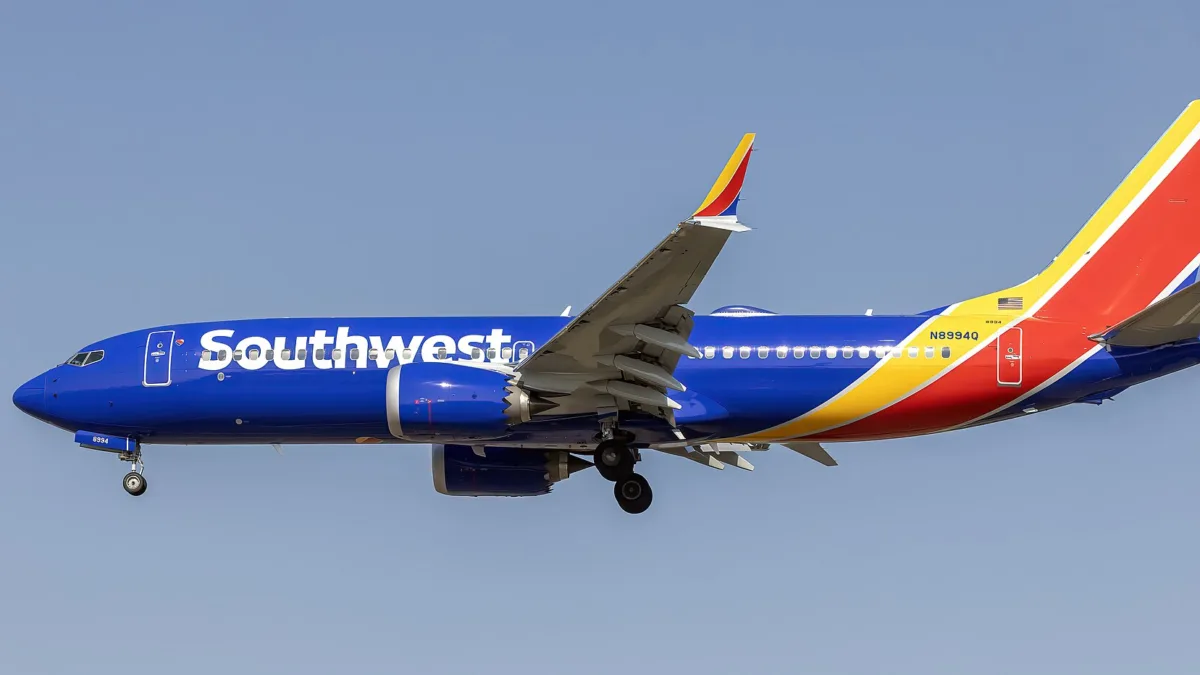
For decades, Southwest Airlines stood apart from the rest of the US airline industry. Two checked bags free, open seating, an all-Boeing 737 fleet, a simple product and a corporate culture that was easy to recognise made the Dallas-based carrier unusually distinctive for an airline of its scale. In 2026, much of that model has already changed.
Assigned seating, differentiated seat products, more ancillary revenue, reduced universality of free checked bags, internal restructuring, new international partnerships and continued dependence on Boeing now define one of the biggest transformations in Southwest’s history.
The airline remains a major operator: it serves 121 airports in 12 countries and says it carried more than 134 million customers in 2025. The central question is therefore not whether Southwest can survive, but whether it can become more profitable without erasing the identity that made passengers choose it in the first place.
The historic model that made Southwest distinctive
Southwest built its success around a simple proposition: competitive fares with less complexity than the traditional US airline product. The company now employs more than 73,000 people and says it carries more nonstop domestic passengers within the United States than any other airline.
Its industrial model is equally distinctive. At the end of 2025, Southwest operated 803 aircraft, all Boeing 737s, including 300 Boeing 737-8s. That common fleet simplifies crew training, maintenance and spare-parts management, but it also concentrates risk on one manufacturer.
Seats, fares and bags: Southwest is changing the product itself
The most visible break came with assigned seating. From January 27, 2026, Southwest began operating flights with assigned seats and extra-legroom products. The airline says it reconfigured roughly 780 aircraft to support the change.
For decades, Southwest passengers did not receive a conventional seat number. Boarding position largely determined where they sat once on board. That system became part of the brand. It has now been replaced by a more familiar structure built around Standard, Preferred and Extra Legroom seating, with access depending on fare, loyalty status and other benefits.
Assigned seating is only one part of a broader revenue strategy. Southwest now sells four principal fare products: Basic, Choice, Choice Preferred and Choice Extra: with different rules for seat selection, boarding, refunds and flexibility.
The financial results show why management is pursuing the change. In the first quarter of 2026, Southwest reported $7.2 billion in revenue, up 12.8% year on year and a record for a first quarter. The airline has linked part of the passenger-revenue improvement to new ancillary products, including baggage fees and seat-related revenue.
Free checked bags were one of Southwest’s clearest competitive advantages. For years, the “Bags Fly Free” message made the airline easy to compare with competitors that charged separately for checked luggage.
That policy is no longer universal. Since 2025, baggage fees have applied to many fare products, while exemptions remain for certain fares, loyalty tiers and eligible cardholders. Southwest itself says the change has contributed to stronger passenger revenue.
A financial transformation that is already producing results
Operating cash flow provides another signal. Southwest generated $1.4 billion in operating cash flow in the first quarter of 2026, up from $860 million a year earlier.
The airline is therefore no longer focused only on carrying very large passenger volumes. It is trying to increase the value of each seat through segmentation, ancillary sales and premium options: a model long used by Delta, United and American.
The transformation also affects employees. In February 2025, Southwest announced the elimination of about 1,750 corporate positions, roughly 15% of its corporate workforce. Its annual report puts the savings at about $230 million in 2025 and around $310 million expected in 2026.
For a company that historically promoted a strong internal culture, the move was symbolically important. It showed that a more aggressive financial discipline was becoming part of the new Southwest model.
Boeing: an operating advantage that is also a dependency
Fleet strategy is the other structural issue. Every one of Southwest’s 803 aircraft at the end of 2025 was a Boeing 737. That delivers strong operating efficiencies, but it also leaves the airline unusually exposed to Boeing production and certification delays.
Southwest expected 66 Boeing 737-8 deliveries in 2026 while planning the retirement of around 60 older aircraft. Its documents also make clear that longer-term fleet planning depends heavily on Boeing’s production system and on certification progress for the 737-7.
As of January 29, 2026, Southwest’s order book contained 467 firm Boeing 737 MAX orders plus 150 options. The airline has some flexibility between variants, but not between manufacturers.
That distinction matters. A specific technical issue affecting one MAX variant does not invalidate Southwest’s overall fleet strategy. The structural risk is that any prolonged production or certification problem at Boeing can have a disproportionate effect on an airline with no alternative aircraft family in service.
A powerful network opening more widely to partnerships
The commercial transformation does not mean Southwest is abandoning its enormous domestic network. It remains heavily focused on point-to-point US flying while gradually adding more international connectivity through partnerships.
By the first quarter of 2026, Southwest said it had implemented or announced agreements with seven partner airlines since February 2025. One of the most notable is All Nippon Airways, with connections planned through airports including Honolulu, San Francisco, Seattle-Tacoma and Los Angeles.
For an airline that historically relied overwhelmingly on its own network, that is a significant strategic shift.
Southwest used to be easy to describe: one aircraft family, no assigned seating, free bags, a mainly US network and a strong internal culture. In 2026, the product is more complex. Different fares unlock different benefits, seat location has a price, loyalty status and credit-card relationships matter more, and partnerships extend the network beyond Southwest-operated flights.
The Southwest paradox: more profitable, but less different
Early financial results suggest there were solid reasons to change. Revenue is rising, ancillary products are generating more income and cash generation has improved. The product can also attract customers willing to pay more for comfort and certainty.
But the more Southwest adopts the tools used by its rivals, the more important one question becomes: if Southwest becomes less different, what will continue to make it special?
The airline is not changing because its old model never worked. It is changing because a model that was extraordinarily successful for decades no longer necessarily produced the returns management wanted in the current US market.
It would be wrong to describe the transformation as Southwest’s decline. The airline still carries more than 134 million passengers a year, operates more than 800 aircraft, invests heavily in fleet renewal and is building new partnerships.
The issue is identity. Open seating is gone. Universal free checked bags are gone. Fare segmentation is central. Ancillary revenue matters more. Financial discipline is tougher. And fleet renewal still depends overwhelmingly on Boeing.
Southwest’s challenge is to become a better business without becoming just another large US airline. That tension may ultimately determine whether the transformation succeeds.
Sources
Southwest Airlines Form 10-K 2025; Southwest Airlines Form 10-Q, first quarter 2026; Southwest Assigned Seating documentation; Southwest Airlines Investor Relations.