
LATAM Boeing 767 Returns to Lima After Emergency Descent and Oxygen Mask Deployment
LATAM flight LA2424 returned to Lima on 16 October after a reported cabin pressurisation problem prompted an emergency descent.
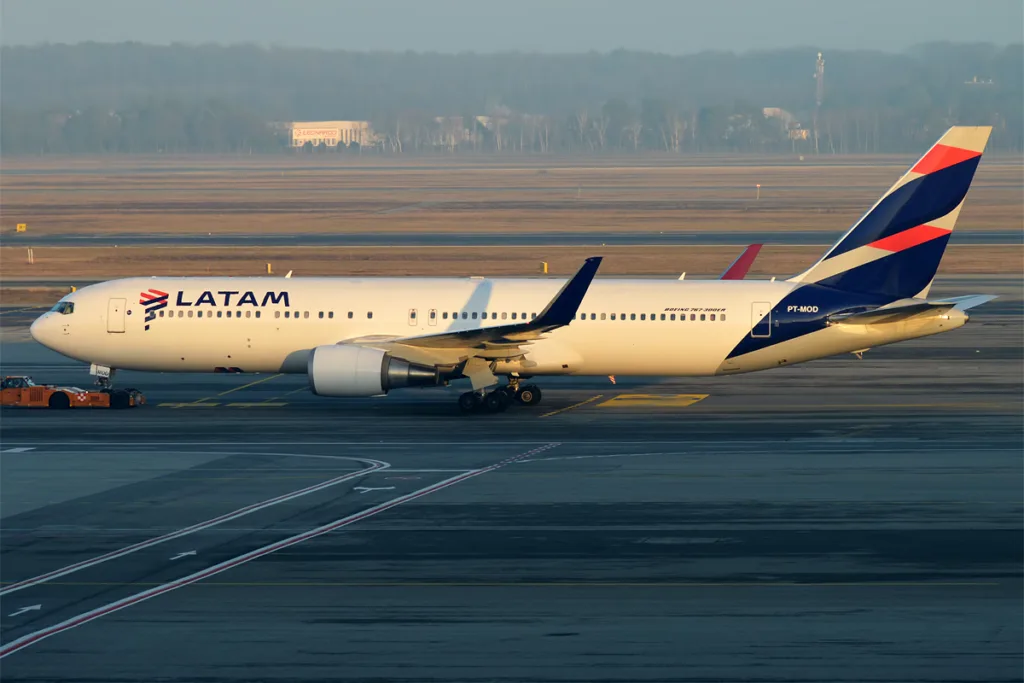
Oxygen masks dropped aboard LATAM flight LA2424 on Friday, 16 October 2026, as the Boeing 767 headed from Lima towards São Paulo. The crew began an emergency descent and turned back to Peru. The aircraft landed safely, but for its passengers the planned journey to Brazil had become an unexpected return to the airport they had left less than two hours earlier.
According to The Aviation Herald’s account, republished by Airportia, Boeing 767-300 CC-CWV was cruising at approximately 33,000 feet, some 300 nautical miles southeast of Lima, when the crew responded to a loss of cabin pressure. The aircraft descended to around 10,000 feet and returned to Jorge Chávez International Airport, landing safely on runway 16R about 105 minutes after departure.
The sudden change in altitude and the appearance of oxygen masks are the details passengers are most likely to remember. Yet an emergency descent is a controlled response to an unsafe cabin environment, not an uncontrolled fall. At normal cruising height, the surrounding air is too thin to breathe comfortably. Oxygen masks offer temporary protection while the aircraft descends to a level where supplemental oxygen is no longer needed.
The sequence establishes what the pilots did, rather than precisely what failed. In a statement reported by Peruvian newspaper La República, LATAM Airlines Perú acknowledged a technical problem, said safety procedures had been activated and confirmed that the aircraft landed without incident. The airline did not identify the underlying fault in that statement. The newspaper cited sources pointing to a pressurisation problem, while the specialist aviation report described a loss of cabin pressure; neither provided a detailed mechanical diagnosis.
LATAM said it assisted the travellers and arranged a different aircraft to complete the service. The replacement was another Boeing 767-300, registration CC-CWF, which reached São Paulo approximately six hours and fifteen minutes late, according to The Aviation Herald. That gives a more tangible measure of the disruption than the diversion alone, although the airline’s public statement did not specify exactly what assistance each passenger received.
The original aircraft, CC-CWV, was still on the ground in Lima roughly 26 hours after landing, according to the report published on 17 October. Its continued presence there does not establish what maintenance was performed or which component caused the pressure problem. For passengers, the incident ended with a substantial delay and a replacement flight; for the airline, the operational consequences extended beyond the safe return to Lima.
JOIN THE CONVERSATION
Let’s discuss this story.
A question, a clarification or a different perspective? Share it with us.