
A flash in the night, 107 missing and no wreckage, what happened to Flying Tiger Flight 739?
In March 1962, Flying Tiger Flight 739 vanished with 107 people aboard. A flash witnessed at sea, no wreckage and a cause never established.
15 March 1962, 15:30 GMT. Moonlight washes across the Philippine Sea as the tanker T. L. Lenzen steams on a heading of 077 degrees. The air is clear, the sky dotted with small cumulus clouds, according to its captain. A lookout raises his eyes. Just north of the ship, a pale trail cuts across the night from east to west and slips behind a cloud. Then the sky catches fire. A white centre, a reddish-orange corona, two bursts of extraordinary light. Two burning objects seem to tumble towards the ocean, one faster than the other.
The captain reaches the deck soon enough to watch the slower object fall for about ten seconds. A small echo has appeared on radar, 17 miles due west. Taking his bearing from a star, he turns the vessel back. The search continues until 21:05 GMT. No wreckage. No clue to what has fallen. Calls to US Navy stations go unanswered. Some aboard suspect military or naval activity. Five crew members will later give evidence about what they witnessed. None could identify an aircraft.
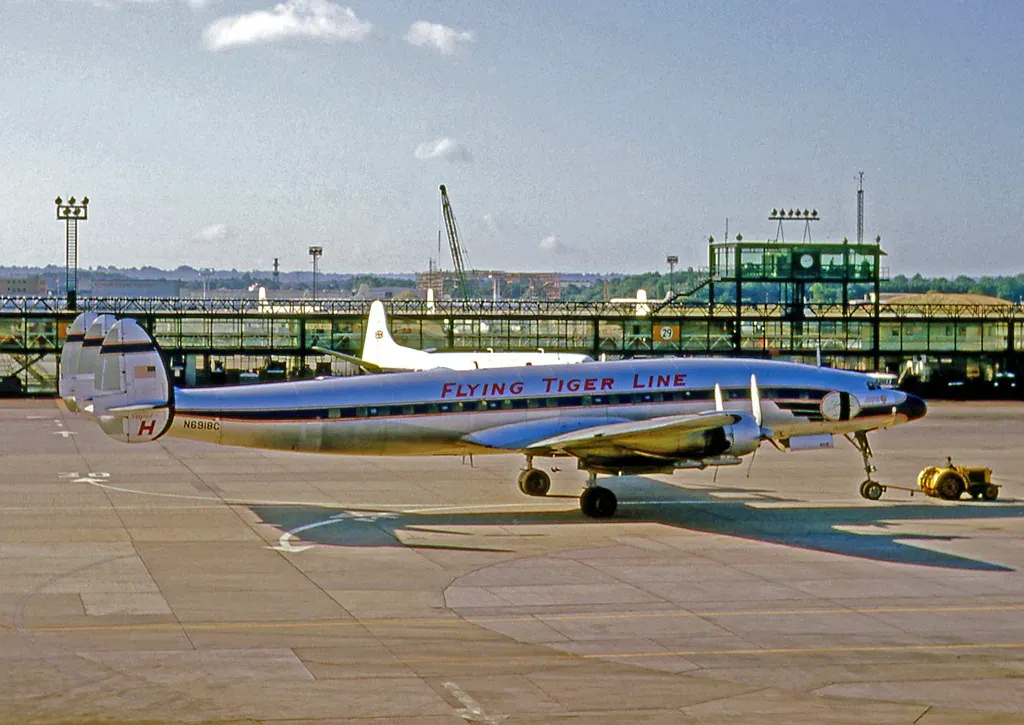
At almost that same moment, a Lockheed Super Constellation operated by Flying Tiger Line is approaching the time of its next position report above this stretch of ocean. There are 107 people aboard. N6921C transmitted a routine message a little over an hour earlier. Only later will investigators bring together the tanker’s testimony and the aircraft’s disappearance. Even then, the central questions will remain: did these five men witness Flight 739 breaking apart, and what, if anything, could have caused it?
The long journey of N6921C
To follow the evidence, the story must leave the tanker for a moment and return to California, where the aircraft began its journey the previous day. Every time in this account is expressed in GMT, as in the official investigation, so the crossing can be traced without confusion between Pacific time zones.
14 March 1962, 05:45 GMT. At Travis Air Force Base in California, the Lockheed L-1049H Super Constellation N6921C takes off under the command of Captain Gregory P. Thomas. Flying Tiger Line is operating Flight 739/14 as a charter for the US Military Air Transport Service. Saigon is its final destination, reached through Honolulu, Wake Island, Guam and Clark Air Base in the Philippines. The passengers are 93 US Army personnel, many trained in electronics and communications, and three members of the Vietnamese armed forces. With eleven crew members aboard, the total is 107.
The route crossed a vast chain of islands at a time when propeller-powered airliners still performed many long-distance military support flights. The Super Constellation, distinguished by its four piston engines and three tail fins, was designed for extended journeys. Yet an aircraft’s range was only one part of the challenge. Crews travelling over open ocean had to navigate between far-separated reporting points and maintain contact by radio, while any emergency response depended on aircraft or ships that could be hours away.
The Pacific crossing requires relief crews: pilots, navigators and flight engineers take their turns. Four flight attendants replace their colleagues at Wake Island. The personnel working the flight change, but the 96 military passengers remain aboard. At Honolulu, Sgt. Raymond “Bill” Myers sends his family a postcard later reproduced by Stars and Stripes: “Tell the kids hello. Love forever.” No one knows that the stop is among his last chances to send news home.
At 17:44 GMT on 14 March, N6921C arrived in Honolulu after around twelve hours in flight. Mechanics worked on the ignition systems of engines one and three, replacing coils, leads and spark plugs. A complaint about flight attendants’ rest facilities delayed departure by half an hour, while an accommodation was arranged. At 20:40 the Super Constellation took off again. It reached Wake Island at 03:54 GMT on 15 March, where further ignition components on those same engines were replaced. Those entries would later be scrutinised, although they did not establish the cause of the disappearance.
The aircraft left Wake at 05:15 GMT and reached Guam at 11:14. There it was refuelled for the passage to the Philippines. The recorded take-off weight remained below the permitted maximum, with the centre of gravity within its limits. No mechanical discrepancy was reported during the stop. At 12:57 it departed for Clark Air Base, due at 19:16. For the planned six-hour-and-nineteen-minute flight, its fuel supply was calculated to last about nine and a half hours.
The last transmission at 14:22
The forecast for most of the flight was not especially severe: scattered or broken clouds, generally good visibility and no significant turbulence expected at cruising altitude. Farther west, showers and poorer visibility were anticipated. Investigators would not identify weather as the cause of the loss. Shortly after departing Guam, the flight also established radar contact with air traffic control.
At 14:22 GMT, Flight 739 sent its last known radio transmission. It was not a distress call. The aircraft reported a position calculated for 14:16, approximately 13°40′ north and 140° east. Clearance had been given to climb to 18,000 feet, about 5,500 metres, from an original plan of 10,000 feet. The report described an aircraft in normal cruise. There was no warning of an existing or impending emergency.
Another message was due around 15:30, near 14° north and 135° east. That time has a terrible significance in the documents: it was also when the sailors aboard T. L. Lenzen saw the sky flash. Heavy radio static affected Guam around 15:33. At 15:39 an operator called N6921C for the missing position report. No answer came. Further calls would bring no voice from the crew.
One missed radio transmission over a vast ocean would not, by itself, establish a catastrophe. But the aircraft remained silent and would never reach its destination. Between the message sent at 14:22 and the light seen at 15:30, the surviving records reveal nothing of what happened aboard. That absence became the central obstacle facing the investigators.
Five witnesses and an unexplained light
When investigators compare the aircraft’s route with the sailors’ account, the agreement is striking. The T. L. Lenzen was near 13°44′ north, 134°49′ east, close to Flight 739’s expected reporting point. The trail moved east to west, along the aircraft’s general route, and the times coincided. The captain searched towards the radar bearing but recovered no debris. Three clues converge, yet no sailor recognised N6921C. Without a single identifiable fragment, the connection could not be proved.
An immense search across the Philippine Sea
The alarm develops before the scheduled landing time. An uncertainty phase begins at 16:00 GMT, followed by an alert at 16:33. At 19:16 Flight 739 does not arrive at Clark. The distress phase is declared at 19:43. By 22:27, the estimated time at which its fuel should have been exhausted, the aircraft is formally missing. Search operations are organised from Guam and the Philippines. The aircraft carries five life rafts with capacity for 25 people each, 120 life jackets, an emergency transmitter and a flare gun. None leads rescuers to its occupants.
As recorded on page 9 of the CAB report, the scale of the search is extraordinary: 1,300 people, 48 aircraft, eight ships and 377 sorties totalling more than 3,417 flying hours. Searchers cover approximately 144,000 square miles, more than 370,000 square kilometres. A last known position cannot show where an aircraft was an hour later; even a detailed account from a ship cannot pinpoint a wreck without identifiable material.
To understand the search, step aboard another aircraft. In a Stars and Stripes dispatch published on 20 March 1962, reporter Robert G. Fisher describes six hours in a C-47 operating from Clark. The mission begins before six in the morning. He is given binoculars and a life preserver. Far below, the sea passes under the wings, dark and at times obscured by squalls that reduce visibility to a few hundred feet. The longer the observers search, the more the shadows seem to resemble people. They look again. Nothing. The aircraft returns, while other crews continue the hunt.
No wreckage or debris definitively associated with Flight 739 was recovered. The search did not produce a confirmed crash site, an identifiable part of the airframe or evidence that could be tested for an accident sequence. All 96 passengers and eleven crew members were presumed dead. For families, the absence of physical recovery meant not only the loss of loved ones but uncertainty over the place and circumstances of their final moments.
In 2013, Stars and Stripes revisited the families. The son of Sgt. Raymond “Bill” Myers still had the postcard sent from Hawaii. Other relatives, including the family of Roger Oliver, a US Army communications specialist aboard the flight, were seeking recognition for the soldiers at the Vietnam Veterans Memorial in Washington. Decades had passed, but the lack of wreckage still left them without a confirmed place of loss or an explanation.
What the evidence could establish
The Civil Aeronautics Board, whose report was adopted on 8 April 1963, examined the radio exchanges, the aircraft’s preparation and maintenance, and the tanker’s testimony. The strongest conclusion in its report, adopted on 8 April 1963, concerned the lights over the sea: they most likely marked N6921C breaking apart in flight. That left a question no witness could answer. What had brought the aircraft down?
Investigators also examined an incident on 12 March, before Flight 739 departed. During a journey from Honolulu to Travis, a loss of power in the fourth engine had required the crew to feather its propeller, reducing drag. Ignition components were replaced afterwards. The earlier crew reported no sign of impending failure, and an inspection on 13 March found the aircraft airworthy. That history warranted scrutiny, but it did not establish a cause of the later loss.
Questions about deliberate interference also led investigators to examine security at the stopovers. The report describes weaknesses in access control and a period when the aircraft was reportedly left unattended in a poorly lit area at Guam. It also records that military checks of the passengers identified nothing suspicious. A security weakness does not prove that somebody boarded the aircraft or sabotaged it. Without wreckage, investigators cannot test such theories against damage to the aeroplane.
After months of investigation, one conclusion remained: the tanker crew had most likely witnessed N6921C breaking apart in flight. But its cause could not be established. The last confirmed position was the one transmitted at 14:22 GMT for 14:16. Beyond that lay five witnesses, thousands of hours of searching and no identified fragment of the aircraft. All 107 people were gone. The sea never yielded the wreck.

JOIN THE CONVERSATION
Let’s discuss this story.
A question, a clarification or a different perspective? Share it with us.