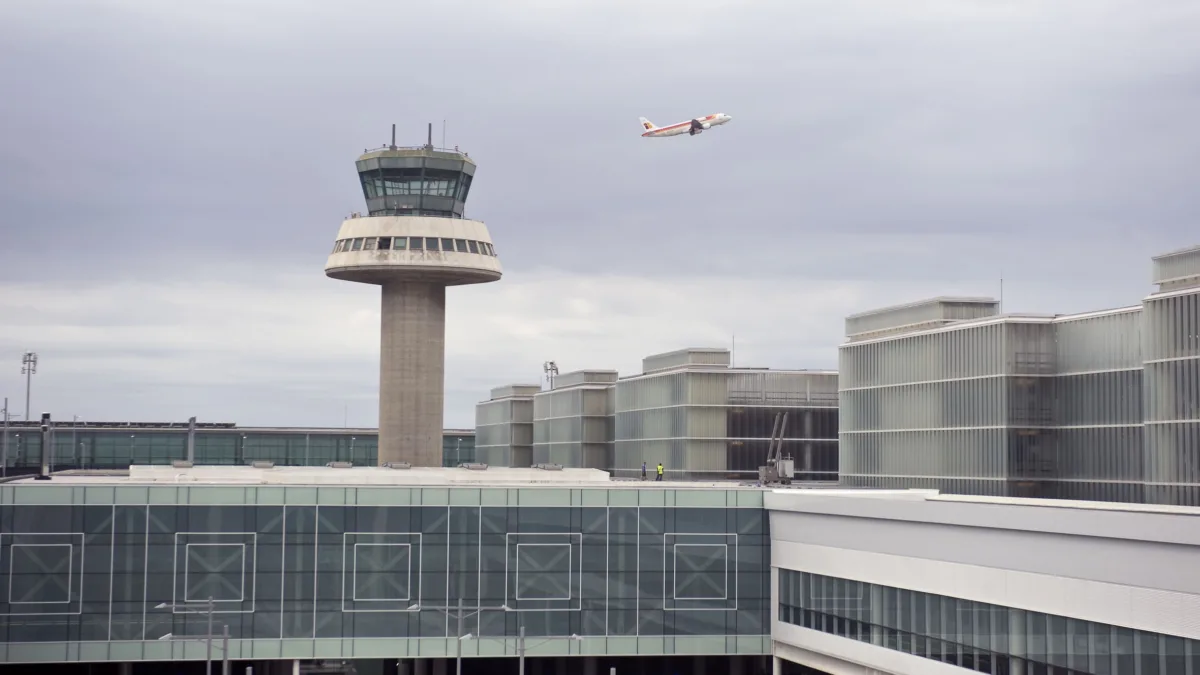
Barcelona-El Prat’s latest disruption exposed a vulnerability beyond the weather itself. During the evening of 6 October 2026, an electrical fault affected equipment in the airport’s control tower as thunderstorms crossed Catalonia. Airport operator Aena attributed the disruption to voltage problems affecting tower systems, according to local reporting. Ryanair says nearly 2,000 of its passengers were caught up in last-minute cancellations and delays.
The fault followed a punishing weekend for one of Spain’s busiest airports. It is important, however, to distinguish three separate measures: the number of flights disrupted by the storms, the operational interruption linked to the tower equipment, and the number of Ryanair customers affected. They are not interchangeable.
A control-tower interruption amid widespread delays
According to Metrópoli, citing Aena, the thunderstorm created voltage problems in some tower equipment and airport operations were interrupted for about an hour. This does not establish that the airport remained closed afterwards, nor that every delayed flight was caused by the power problem. Weather had already been affecting approaches, departures and ground handling.
El País, drawing on flight-tracking and Aena information, reported at least 47 cancellations and 511 delayed flights at Barcelona on 6 October. Delays represented about 48% of the day’s traffic in that reporting. The figures describe the broader day of disruption, not a verified power-fault-only tally.
In a statement dated 7 October, Ryanair called on Aena and air navigation provider ENAIRE to address repeated electricity-related interruptions. The carrier said almost 2,000 of its passengers were affected by the latest episode and pointed to a separate August incident that it said disrupted travel for more than 6,000 of its customers. Those passenger counts are the airline’s figures, not an airport-wide assessment.
The latest disruption came after Catalan Civil Protection counted 385 cancelled flights over 3 and 4 October, according to EFE: 220 on Saturday and 165 on Sunday. Those earlier cancellations form the background to the October 6 event, not part of its single-day count. AeroSillage’s earlier report examines the flooding and the knock-on effects on the airport and surrounding transport network.
What the fault reveals about airport resilience
A control tower relies on dependable communications and traffic-management systems to coordinate aircraft near runways and in the immediate airport environment. When critical equipment is unavailable or its reliability is uncertain, traffic may need to be restricted for safety. Once movements resume, disruption can persist because aircraft, crews and departure slots have fallen out of sequence.
The precise technical chain linking the storm, voltage irregularities and the affected equipment has not been independently established in the available public material. Nor is there sufficient evidence to claim a complete failure of every backup system. Those distinctions matter: a reported tower power fault is not automatically proof of a systemic failure across the entire airport.
What affected passengers should do
Passengers should check their flight directly with the operating airline and follow airport notices before travelling. Depending on the circumstances, European passenger-rights rules may require a choice of refund or rerouting and appropriate care; fixed cash compensation is not automatic when extraordinary weather conditions are involved. The specific cause of a cancellation matters.
For the earlier context, read our 5 October report on Barcelona-El Prat flooding and cancellations. The weekend’s cancellations should not be attributed to the subsequent 6 October tower fault.
Questions still unanswered
The outstanding questions are operational and technical: which systems were affected, what safeguards functioned, how much traffic was disrupted specifically by the power fault, and what measures Aena and ENAIRE will take. Until those answers are published, a combined storm-day total should not be portrayed as the direct result of the tower incident.
Sources: Ryanair statement, 7 October; Metrópoli, citing Aena; El País, 6 October traffic figures; EFE, weekend figures.
Historical illustrative photograph (2009): Iberia Airlines / Wikimedia Commons, CC BY 2.0. Converted to WebP; it does not depict the 6 October 2026 power fault.

Leave a Reply