
Delta Passenger Takes Airport Tug on Unauthorized Ride at John Wayne Airport
A Delta passenger entered the airfield at California’s John Wayne Airport, took a ground-handling tug and crashed into another vehicle. The case raises distinct questions about access controls and equipment security.
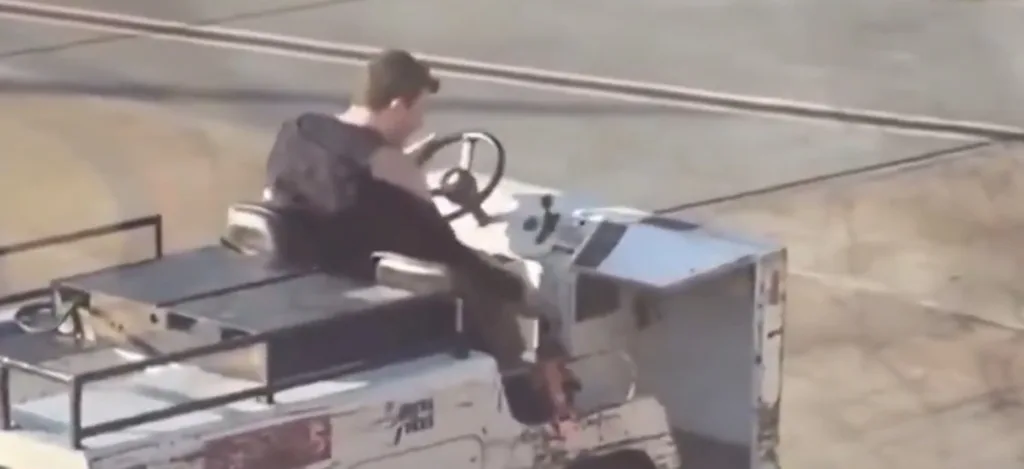
A traveler booked on a Delta Air Lines flight to Seattle allegedly entered a restricted airfield at John Wayne Airport in Orange County, California, and drove off in a ground-handling tug. What followed on October 6, 2026, included a collision near another departure gate, an attempted takeover of a lavatory-service truck and an arrest by airport police. The sequence deserves scrutiny for its implications for ramp access , without assuming that a wider airport security failure has already been established.
What investigators and airport officials have described
The incident began at approximately 5:30 p.m. Pacific time. Airport representatives said the passenger passed through an access point near Gate 12, entering an operational area where passengers are not permitted to roam. He then allegedly took a tug operated by ground-services company Alliance Ground International and assigned to Alaska Airlines.
He drove the equipment toward Gate 7, where it collided with another vehicle. Airport officials say he subsequently tried to take an American Airlines lavatory-service truck, but airport police detained him before he could leave in it. Footage circulating in the United States shows a person moving the tug around the apron, although the full circumstances cannot be established from video alone.
The man was identified in public reports as a 26-year-old resident of Everett, Washington. He was transported to a hospital for medical assessment. Authorities subsequently filed allegations including vehicle theft, vandalism and unlawful entry into an airport security area. The allegations remain subject to the judicial process.
Did the incident ground the airport?
Air-traffic-control communications referenced a temporary ground stop as personnel responded. ABC7 Los Angeles, however, reported the important distinction that no formal ground stop was issued, even though aircraft movements were briefly interrupted and the area around Gate 7 was secured. Airport representatives said overall operations were not materially affected.
That nuance matters: operational crews can halt local activity to contain an immediate hazard without the entire airport entering a formally declared traffic restriction.
Two different security questions on the ramp
The case highlights two separate safeguards rather than a single undefined “breach.” One is the passenger-to-airfield boundary: doors, permissions, alarms and personnel responses intended to keep travelers out of operational space. The other concerns the availability and control of powered ground-support equipment once someone has entered that space.
Unauthorised access to an airport ramp can put workers and aircraft at risk, but the reported sequence does not by itself establish a system-wide security failure. Investigators need to determine how the access point was crossed, what safeguards were in place and how responders contained the incident.
Investigators have not publicly provided a complete explanation of how the gate access was overcome, how the tug became available to the suspect or whether existing procedures were followed. Answers on those points, rather than speculation based on a short video, will determine whether any site-specific changes are necessary.
The episode is a reminder that ramp safety extends beyond aircraft movements. Ground vehicles operate in close proximity to people, airframes and service equipment, so even a short unauthorized drive can prompt a rapid, coordinated response.
The important security distinction is between an individual getting into a restricted area and gaining access to equipment already present there. Preventing one does not automatically prevent the other. A useful review would examine access controls, supervision of ramp vehicles and how quickly staff detected and contained the incident. Those are questions for investigation, not findings that a particular safeguard failed.
Further reading: Explore AeroSillage’s reporting on aviation safety and security.
Reporting and sources
This account draws on airport statements cited by FOX 11 Los Angeles, operational details reported by ABC7 Los Angeles and the charging information reported by the Los Angeles Times on October 8, 2026.
Read next
JOIN THE CONVERSATION
Let’s discuss this story.
A question, a clarification or a different perspective? Share it with us.