Aviation news on 18 September confirms several underlying trends: cargo remains a major industrial issue, low-cost airlines are exploiting weaknesses in some markets, air traffic control infrastructure is becoming increasingly expensive to modernise, and airlines are operating in a tighter financial and geopolitical environment. AeroSillage highlights six stories that go beyond the day’s headlines.
1. FAA gives the Boeing 777F a reprieve
The Federal Aviation Administration has granted Boeing an exemption from future emissions standards that will allow the manufacturer to sell up to 35 additional Boeing 777F aircraft through 2031. Without the exemption, rules taking effect from 2028 would have severely restricted sales of the current freighter. The 777-8F, which is due to replace it, is now not expected before 2029.
Why it matters: Boeing was trying to avoid an industrial gap between the end of the current 777F and the arrival of the 777-8F. In heavy air cargo, new-build alternatives remain limited, so extending 777F sales protects both Boeing’s production chain and airlines needing to renew fleets without waiting for the next generation.
Source: Reuters, 17 September 2026.
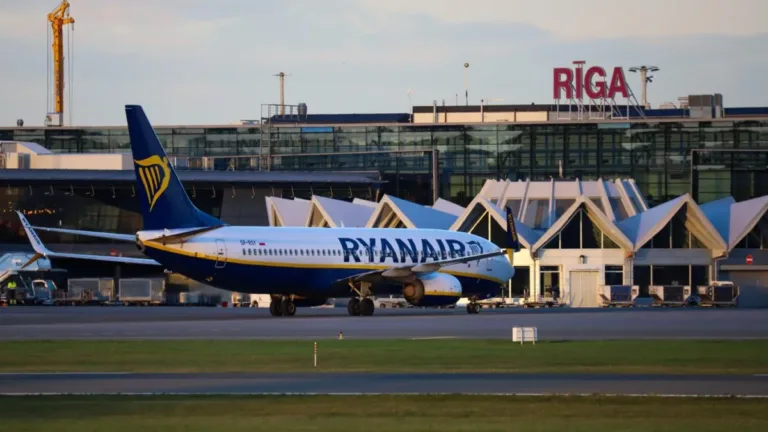
2. Ryanair wants to double traffic in the Baltic states
Ryanair has presented a plan targeting around 11 million annual seats in the Baltic states by 2031, with the number of based aircraft rising from seven to sixteen. The expansion comes in a market weakened by airBaltic’s financial difficulties, while the Irish carrier continues to cut capacity at airports where it considers charges too high.
Why it matters: Ryanair is turning the difficulties of regional carriers into network opportunities. Its advantage lies less in any one market than in its ability to move aircraft and seats quickly to bases offering the best economics. This is one of the mechanisms accelerating consolidation in European short-haul flying.
Source: Reuters, 17 September 2026.
3. easyJet faces strike action in Portugal
easyJet cabin crew based in Portugal have voted for strike action from 2 to 6 October and again from 19 to 23 December. The SNPVAC union cites working conditions, crew scheduling and the use of overtime. easyJet disputes the claims and says it wants talks to continue.
Why it matters: the choice of dates increases the leverage of the action. The second period falls at the heart of Christmas travel, in a Portuguese market where Lisbon, Porto and Faro depend heavily on leisure and diaspora traffic. Even limited disruption can therefore have a commercial impact greater than the raw number of cancelled flights suggests.
Source: Reuters, 17 September 2026.
4. Tariffs raise the cost of modernising US air traffic control
The FAA estimates that tariffs are adding about $100 million to the cost of the large US air traffic control modernisation programme. The work includes radars, telecommunications and replacement of ageing equipment.
Why it matters: the difficulties facing US air traffic control are no longer only technical or staffing-related. They are also becoming industrial: modernisation requires secure suppliers, budgets and schedules at a time when operational needs are urgent. Delayed investment eventually translates into capacity constraints, punctuality problems and sometimes weaker network resilience.
Source: Reuters, 17 September 2026.
5. Frontier accelerates expansion in Detroit
Frontier Airlines is continuing its growth in Detroit with a new route to New York-LaGuardia and additional frequencies to Florida. The airline expects to offer around 41% more seats in Detroit in March 2027 than a year earlier.
Why it matters: the withdrawal of Spirit Airlines capacity continues to reshape the US low-cost market. Frontier is moving quickly to occupy the slots and demand left behind. US consolidation is therefore also taking place through capacity shifts, without necessarily requiring a merger.
Source: Frontier Airlines, 17 September 2026.
6. Iranian aviation becomes increasingly isolated
Mahan Air has suspended several international routes, including services to Istanbul, Ankara and Muscat, amid tougher US sanctions targeting the commercial and operational ecosystem surrounding the airline.
Why it matters: the effect of sanctions goes beyond a simple flight ban. They can affect service providers, payments, insurance, maintenance, supplies and commercial partners. For Iranian carriers, every additional constraint reduces network flexibility and makes fleet renewal even more difficult.
Source: Financial Times, 17 September 2026.
The thread running through today’s news
These six stories have one thing in common: air capacity is increasingly dependent on factors beyond passenger demand alone. Environmental regulation, capital costs, sanctions, labour relations, infrastructure and airport strategy directly influence how many aircraft are available and which markets they can serve. For airlines, the question is no longer simply “where is the demand?” but “where can we operate sustainably and with sufficient margin?”
Also on AeroSillage
For further reading, explore the Safety & Regulation desk and the Passenger Rights desk, which track the operational and regulatory consequences behind these developments.
This press review is based on information published and verified on 17 September and early 18 September 2026. Fast-moving developments are presented according to the information available at the time of publication.