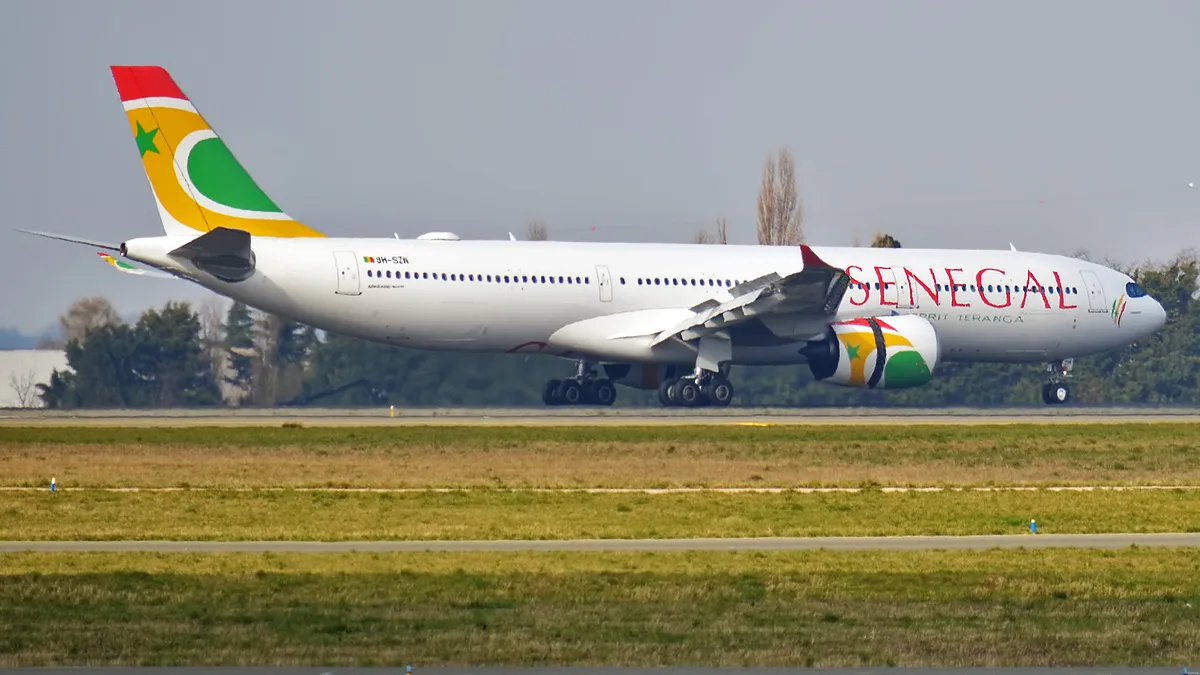
Air Senegal’s precautionary suspension of cabin crew assigned to the Dakar–Paris route goes far beyond an internal disciplinary matter. According to reporting by Seneweb, some crew members are suspected of carrying third-party parcels for payment, with figures of about €15 per kilogram cited. Those claims remain allegations under internal review: a precautionary suspension is not a final sanction and does not establish individual responsibility.
From the “GP” system to the special responsibilities of cabin crew
Informal parcel carrying is common on a number of diaspora routes. Travellers may agree to transport clothes, documents, spare parts, food products or other goods for third parties, usually in return for payment by weight. In Senegalese usage this is often referred to as “GP”.
The practice responds to a real need for fast movement of goods between families, diasporas and small businesses. But the risk profile changes when the person carrying the parcel is a crew member rather than an ordinary passenger.
Contents, screening and dangerous goods: where the real risk lies
Cabin crew operate within a regulated professional framework. They have professional access to restricted airport areas, work under airline baggage and security procedures and receive training on dangerous goods and emergency responsibilities.
That makes accepting a sealed or poorly documented parcel particularly sensitive. The issue is not that every parcel is dangerous; it is that the person carrying it may not know with certainty what is inside or who truly owns it.
A parcel described as clothes or electronics can also contain spare lithium batteries, aerosols, flammable liquids, damaged electronic devices or other restricted items. Some articles are forbidden in checked baggage, some must remain in the cabin, and others require specific packaging and declaration.
IATA rules, for example, require spare lithium batteries to remain out of checked baggage. The point is not to suggest that dangerous goods were actually carried in the Air Senegal case: no public evidence establishes that: but to explain why airlines treat uncertainty over contents seriously.
It would be wrong to suggest that crew baggage automatically bypasses screening. Crew members and their belongings are still subject to security controls when entering critical airport areas.
But X-ray screening is designed primarily to detect weapons, explosives and prohibited objects. It does not replace dangerous-goods declarations, customs procedures or full traceability of who sent a parcel and under what legal status it is travelling.
An item can therefore pass through a checkpoint without the screener knowing that it is commercial cargo carried on behalf of a third party or that it has been incorrectly declared or packaged.
Traceability, security and customs: different but connected issues
Aviation security depends not only on machines but on the reliability of people with trusted access and on the ability to trace how objects enter the airport system.
ICAO uses the concept of an “insider threat” for risks involving people who already hold professional access or positions of trust. That does not mean the Air Senegal crew under investigation should be described as a terrorist threat. The relevant point is narrower: a parallel parcel-carrying channel created through professional access weakens the normal chain of accountability.
In conventional air freight, the shipper, declared contents, destination and transport conditions are recorded and the shipment enters a controlled acceptance process.
Informal carriage does not automatically provide the same level of traceability. The concern is therefore less that a parcel is “commercial” than that its origin, ownership, contents and regulatory status may be unclear.
That is particularly relevant on Dakar–Paris because Air Senegal also sells formal cargo capacity. A parallel paid channel through employee baggage can conflict directly with the airline’s official freight procedures.
An item can be perfectly harmless to the aircraft and still create a customs problem. Clothes, phones, cosmetics or spare parts may be safe to fly but may constitute commercial goods subject to declaration, duty or import restrictions.
The case therefore sits at the intersection of three different areas: flight safety, aviation security and customs compliance. They overlap, but they are not the same thing.
Why Air Senegal can act firmly while keeping Dakar–Paris running
An airline has to show that its baggage, dangerous-goods and security procedures are clear and enforced. If an employee were to carry prohibited, hazardous or illegal goods, the operator would need to demonstrate that this happened outside approved procedure rather than through a tolerated parallel system.
The issue is also commercial. A carrier that sells regulated freight cannot easily ignore a paid informal cargo channel using staff baggage.
Public reporting indicates that Air Senegal has temporarily relied on MyWay Airlines cabin crew under an ACMI arrangement already used on Dakar–Paris.
ACMI stands for Aircraft, Crew, Maintenance and Insurance: the operating company supplies the aircraft and crew as well as maintenance and insurance to the customer airline. Air Senegal has already used a MyWay Boeing 777-200ER on some Dakar–Paris services, so using the ACMI operator’s own cabin crew is an operationally coherent way to preserve the schedule while the internal case is examined.
Dakar–Paris is one of Air Senegal’s most strategic routes, carrying diaspora, leisure, business and connecting traffic. That explains the effort to protect operational continuity despite the precautionary suspensions.
What is established and what is not
There is no public basis to say that every cabin crew member assigned to Dakar–Paris participated in parcel carrying. There is also no public evidence that dangerous goods, illicit products or items that bypassed security screening were actually transported.
Likewise, a precautionary suspension is not a disciplinary conviction. Its purpose is to reduce potential risk while the airline establishes the facts and individual responsibilities.
The real issue is protecting the chain of trust
Commercial aviation depends on a basic sequence of accountability: who introduced an object, who owns it, what it contains, how it was screened and under whose responsibility it travels.
If the allegations are confirmed, the central issue for Air Senegal will not be a few extra kilograms of baggage. It will be whether a parallel flow of goods was able to develop outside the traceability mechanisms on which aviation safety, security and customs compliance rely.
Sources
Seneweb for the reported precautionary suspensions and alleged paid parcel carrying; ICAO for security and insider-threat principles; IATA and EASA for dangerous-goods and crew-baggage rules; Air Senegal and public operational sources for the Dakar–Paris and ACMI context.