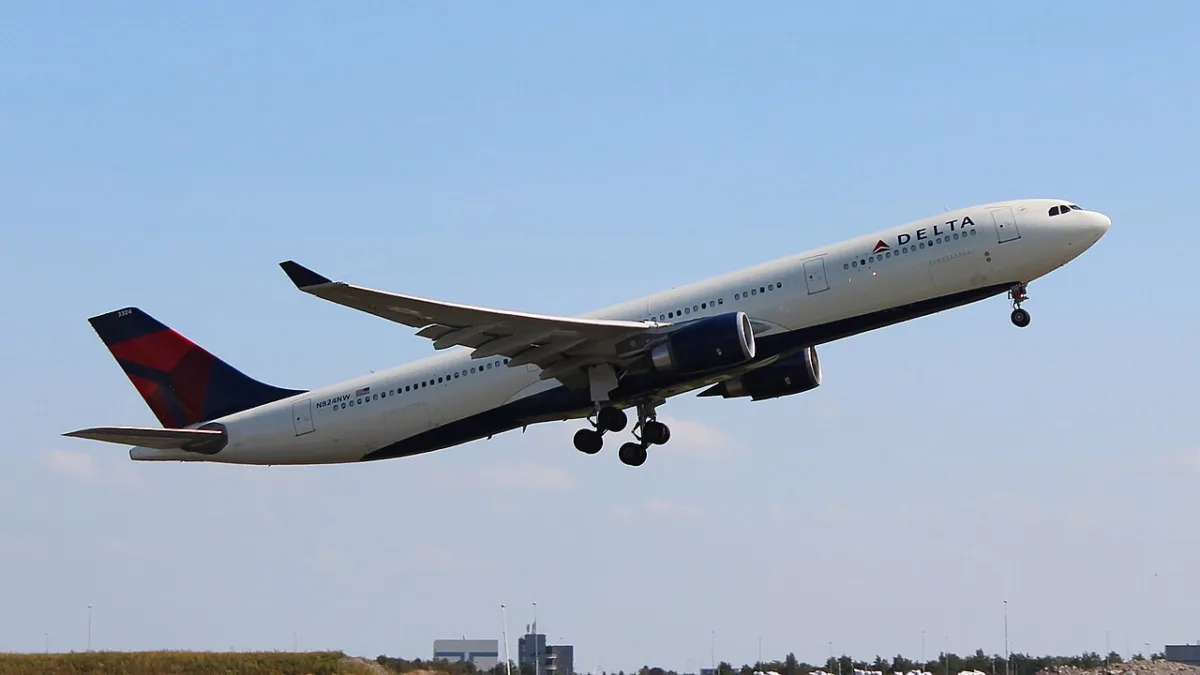
Delta Air Lines flight DL251 from Barcelona to Boston diverted to Porto on September 27, 2026 after smoke was reported in the cabin. The Airbus A330-300 landed safely at Francisco Sá Carneiro Airport, where emergency services were waiting.
The transatlantic crossing was interrupted early
Delta said the diversion followed a reported mechanical issue, while Portuguese authorities confirmed that cabin smoke prompted the emergency landing. Flight-tracking data show that DL251 departed Barcelona before turning toward the Portuguese coast rather than continuing farther over the Atlantic.
The aircraft involved was an Airbus A330-300, registration N824NW, according to flight-tracking and aviation database information.
The decision preserved diversion options
Continuing west across the Atlantic would have increased the aircraft’s distance from suitable airports. Porto offered a runway capable of handling a widebody, emergency services and the ground support required for an A330.
Unidentified smoke is treated conservatively because crews do not need to know its source before deciding to land. The priority is to reduce the time spent far from a suitable airport while the nature of the problem remains uncertain.
The medical picture changed after the first reports
The first information reported by Reuters said eight passengers were treated on the apron and three people were taken to hospital.
A later Portuguese civil-protection assessment, reported by CBS and AFP, raised that total to 14 people requiring assistance and four hospitalisations. The symptoms were described as minor. The revised figures explain why early reports and later articles gave different totals.
No major fire has been confirmed
Public information has referred to smoke and a burning smell, but no major onboard fire has been confirmed. As of October 2, no definitive technical source of the smoke had been made public.
It would therefore be premature to attribute the event to an electrical system, air-conditioning equipment, a battery or another component without an official technical finding.
What still needs to be established
The key technical question is the source of the smoke and what maintenance work was required on N824NW before it could return to service. That will determine whether the event was linked to a specific component, a transient fault or another cause.
AeroSillage takeaway: the diversion illustrates why aviation decisions are often made under uncertainty. The safest option can be to land before an unknown problem becomes harder to manage.
Sources
Delta Air Lines; Portuguese civil-protection authorities; Reuters; AFP/CBS News; RTP; flight-tracking data.
Leave a Reply