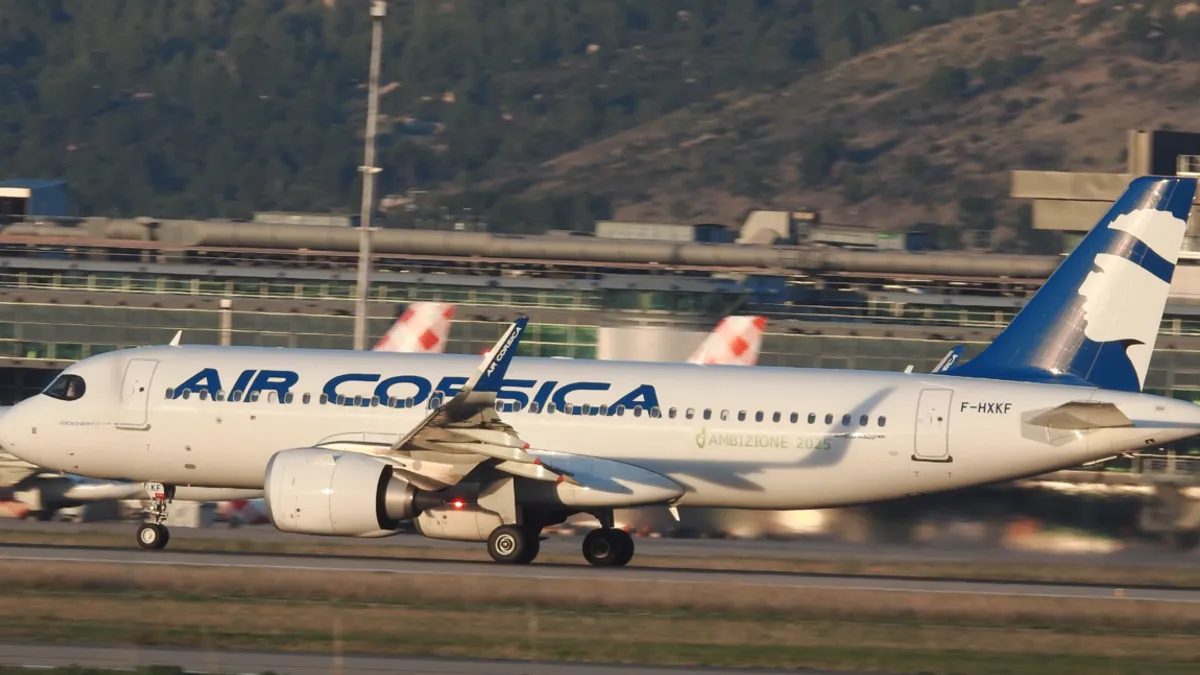
Air Corsica occupies a unique place in French aviation. Created in 1989 at the initiative of the Corsican Assembly and launched in June 1990 as Compagnie Corse Méditerranée, the airline was built around one central mission: maintaining territorial continuity between Corsica and mainland France.
It now carries close to two million passengers a year while also developing commercial routes across France and Europe. Its challenge in 2026 is to modernise and diversify without weakening the public-service role that justifies much of its existence.
An airline created to keep Corsica connected
Air Corsica’s origins are inseparable from island geography. Year-round air links are essential even when winter demand would not justify the same frequency on purely commercial grounds.
The airline is a mixed-economy company. Air Corsica says the Collectivité de Corse owns 66.84% of the capital, while the Air France group holds 13.19%.
This explains its hybrid position: it must operate with normal airline economics while also delivering a strategic public-transport mission.
Public-service routes are the core of the model
The network is built around Ajaccio, Bastia, Calvi and Figari and their links with Marseille, Nice and Paris-Orly.
Public-service obligations set precise requirements for frequencies, capacity, schedules, fares and continuity.
A French National Assembly response published in July 2026 said Air Corsica operates the “bord à bord” routes between Corsica and Marseille/Nice, while Corsica–Paris-Orly services are operated through an Air France–Air Corsica grouping. The current arrangements run through the end of December 2027.
DREAL Corse counted 4.4 million travellers through the island’s airports in 2025. Air Corsica says it carries nearly two million passengers annually, making it Corsica’s leading airline.
A 13-aircraft fleet tailored to island operations
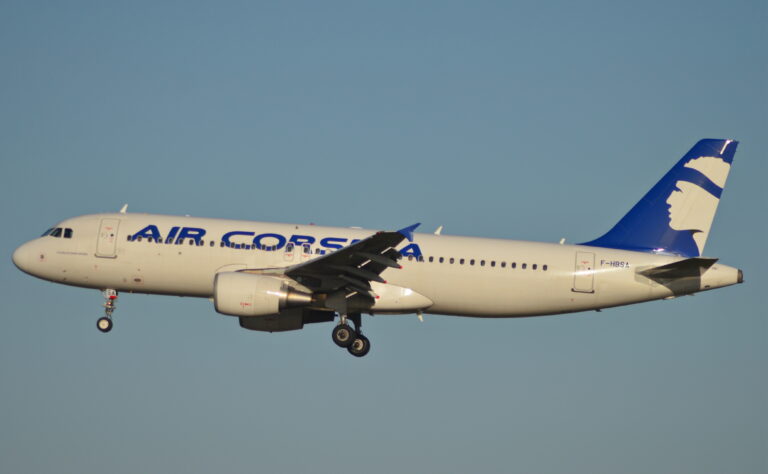
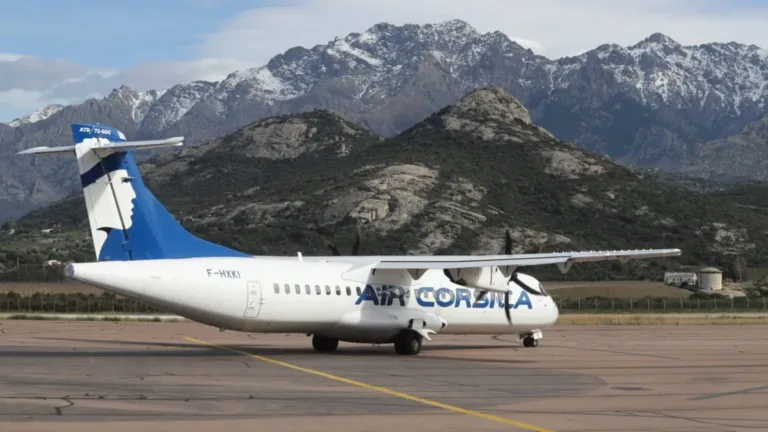
Air Corsica operates 13 aircraft: seven ATR 72-600s, four Airbus A320neos and two A320ceos.
The ATR 72-600s are suited to short sectors to Marseille and Nice and to thinner regional routes. Their 72-seat capacity allows high frequency without deploying a nearly 190-seat jet on every market.
The newest ATRs use Pratt & Whitney PW127XT engines. The Airbus A320 fleet is used on denser routes and much of the European network, with the A320neo bringing lower fuel burn and noise.
2026: a stronger European commercial pillar
Public service remains the foundation, but Air Corsica has been building a second, more commercial pillar.
Summer 2026 included new routes to Vienna, Munich and Rennes. Ajaccio was linked with Munich and Vienna; Bastia also gained Vienna. The three international services represented close to 30,000 seats, operated by Airbus A320s.
The airline also launched Rennes–Ajaccio and Rennes–Bastia, strengthening direct regional links without requiring passengers to connect through Paris.
The logic is clear: attract European visitors directly, extend the tourism season and diversify revenue beyond subsidised continuity routes.
A tightly used fleet creates operational vulnerability
Air Corsica’s high-frequency model makes it sensitive to ATC restrictions in south-eastern France. A delay early in the day can cascade across several rotations, especially during the summer peak.
Airport closing-time constraints can make the problem worse, sometimes forcing diversions or cancellations.
This vulnerability became concrete again in September 2026, when technical investigations led to the preventive grounding of several ATRs. Four of the airline’s seven ATRs were temporarily unavailable after reports of smoke events, forcing exceptional operational measures to protect the schedule.
The episode did not change the official fleet composition, but it showed how quickly the loss of only a few aircraft can affect a dense island network.
Resident fares are politically and socially sensitive
On public-service routes, fare levels are part of territorial accessibility rather than a purely commercial decision.
In June 2026, Air Corsica announced a €9.44 reduction in resident fares to Paris-Orly, Marseille and Nice after the removal of the solidarity-tax increase previously applied to those routes.
The airline must therefore reconcile expensive year-round operations, high frequencies and fleet renewal with fares that remain compatible with territorial-continuity policy.
An economic role that goes beyond passengers
Air Corsica employs more than 700 permanent staff, has its headquarters in Ajaccio and a secondary maintenance base in Bastia, along with stations on the mainland.
It also handles freight, charter activity, training and even organ transport on some scheduled services.
Its role therefore affects tourism, business travel, education, healthcare access and the wider island economy.
A regional airline that has become strategically important
Air Corsica does not aim to become a large European group. Its challenge is more specific: remain indispensable to residents, competitive on open commercial routes and robust enough to absorb the operational constraints of a highly seasonal island market.
Its success will be measured less by fleet size than by whether it can preserve reliable public-service connectivity while building enough commercial traffic to make the model more resilient.
Main sources
Air Corsica corporate and 2026 press releases; DREAL Corse; French National Assembly response on public-service obligations; ATR fleet material.
Leave a Reply