
Air Canada Cuts 2026 Profit Outlook Despite Record Revenue
Air Canada cut its 2026 adjusted earnings outlook by C$500 million despite record third-quarter revenue. Higher fuel costs are pressuring margins and cash flow.
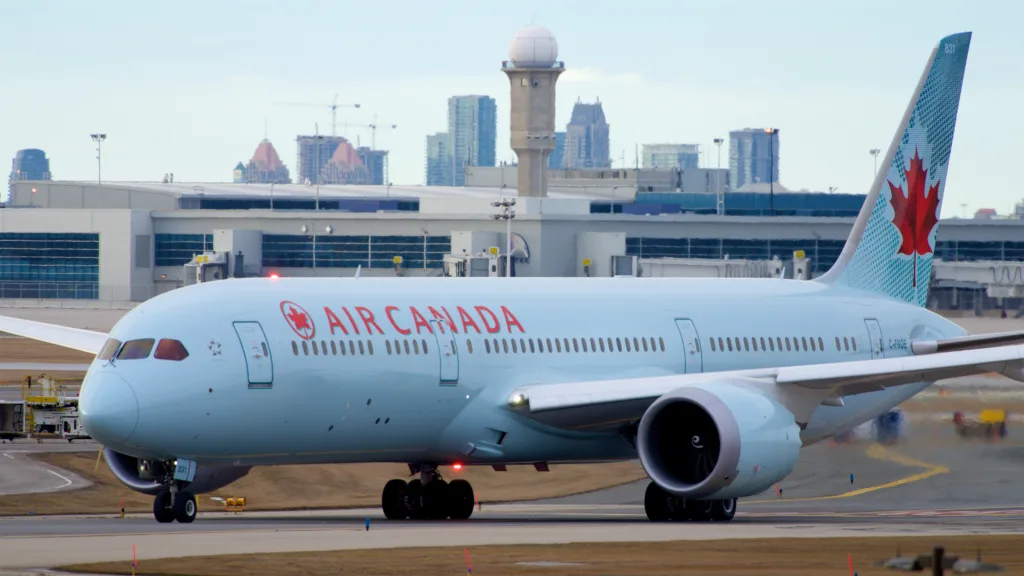
Air Canada cut its 2026 adjusted earnings outlook by C$500 million on October 29, even as third-quarter revenue reached a record C$6.984 billion. The Montreal-based airline expects higher jet fuel prices to weigh on profit through year-end. Its new adjusted EBITDA outlook is C$2.4 billion to C$2.7 billion, down from C$2.9 billion to C$3.2 billion.
The revision came with Air Canada’s third-quarter financial results. Revenue rose about 21% from a year earlier, but operating profit slipped to C$261 million. The difference shows how stronger ticket sales and fuller aircraft have struggled to offset rising expenses.
Air Canada lowers 2026 earnings and cash flow targets
Specifically, Air Canada reduced both ends of its adjusted EBITDA forecast by C$500 million. EBITDA is a measure of earnings before interest, taxes, depreciation and amortization, adjusted here using the company’s own accounting definitions. It is not the same as net profit or cash in the bank.
Air Canada also sharply reduced its free cash flow projection. Previously, it expected C$200 million to C$500 million for 2026. Now, it forecasts a result around break-even, within a C$150 million range either way. Therefore, the revised outlook leaves substantially less room for cash generation after investment and other spending.
Those forecasts reflect the company’s expectations, not final 2026 results. Air Canada says higher anticipated fuel prices are the main reason for both changes.
Record quarterly revenue masks tighter margins
Third-quarter revenue reached C$6.984 billion, compared with C$5.774 billion a year earlier. Still, operating expenses rose to C$6.723 billion. As a result, operating income fell to C$261 million from C$284 million.
The operating margin narrowed to 3.7%, from 4.9% in the same quarter of 2025. Adjusted EBITDA reached C$936 million, down from C$961 million. Net income attributable to shareholders also fell, to C$139 million from C$264 million.
Even so, passenger demand remained strong. The airline reported an 89% passenger load factor, up 2.6 percentage points, while total unit revenue increased 14%. Meanwhile, cargo revenue grew 33%. These gains helped absorb part of the cost increase but did not prevent the margin decline.
Fuel costs rise C$906 million in a single quarter
Air Canada said its third-quarter fuel expense rose C$906 million from a year earlier. Fuel prices were 10 Canadian cents per liter above the airline’s previous quarterly assumption. Even with pricing, capacity and cost controls, the airline offset only part of the fuel increase.
For the fourth quarter, Air Canada’s updated forecast assumes higher jet fuel prices than previously expected. However, Air Canada has not said that every fare will rise by a fixed amount. In practice, ticket prices depend on routes, demand and the number of seats available.
For travelers, the clearest implication is greater pricing and scheduling pressure rather than an immediate change to an existing ticket. A change to an earnings forecast does not automatically cancel a passenger’s flight. Separately, the Air Canada and United route expansion for summer 2027 remains an announced network plan.
Air Canada adjusts capacity expectations
For full-year 2026, Air Canada now expects capacity to grow about 2.75% compared with 2025. Its earlier guidance allowed an increase between 2.25% and 3.25%. The narrower forecast reflects greater visibility into the remaining flying schedule.
Adjusted costs excluding fuel, measured per available seat mile, are projected to rise 5.5% to 6%. The previous range was 5% to 6%. This metric compares airline operating costs against the amount of seating capacity offered, allowing investors to assess cost efficiency apart from fuel.
Air Canada also ended September with C$8.018 billion in total liquidity and C$4.219 billion of net debt. It reported using Aeroplan transaction proceeds to repay C$1.7 billion of debt and complete a C$800 million share buyback. Those balance-sheet moves are separate from the cut to its annual earnings forecast.
What the revised outlook means for passengers
The results do not announce a system-wide route cancellation or a new passenger surcharge. Nevertheless, the revised profit forecast signals that maintaining margins will remain difficult if fuel costs stay high. Travelers should judge any fare or schedule change against their actual booking, not against the earnings headline alone.
Air Canada’s figures also show why higher revenue is not the same as higher profit. The airline generated stronger unit revenues, yet its operating margin shrank. In turn, its next financial update will show whether winter demand and cost controls offset the fuel pressure.
Read next

JOIN THE CONVERSATION
Let’s discuss this story.
A question, a clarification or a different perspective? Share it with us.