Air cargo is moving back to the centre of airline strategy. Global cargo demand rose 4.4% year on year in August 2026, according to IATA, even as worldwide capacity edged down. At the same time, Airbus and Boeing are preparing a new generation of large dedicated freighters: the A350F and the 777-8F.
This is more than another Airbus-versus-Boeing contest. It reflects a structural change in global trade, driven by semiconductors, AI servers, pharmaceuticals, e-commerce and the need for faster alternatives when maritime supply chains become less predictable.
Demand is rising even as fuel costs surge
IATA says global cargo tonne-kilometres increased 4.4% in August, while capacity fell 0.1%. International demand grew even faster, by 5.3%.
The backdrop is not easy. Jet-fuel prices were 79.2% higher than a year earlier, yet cargo yields improved month on month for the first time since April. North American demand rose 6.6% while capacity fell 2.5%; Europe grew 4.1% with capacity down 3.5%; Asia-Pacific, which represents more than a third of the market, gained 4.3%.
Air freight is expensive, but it buys time. For chipmakers, pharmaceutical groups and technology companies, the cost of leaving high-value goods tied up for weeks can exceed the premium paid for air transport.
Reuters has highlighted the growing contribution of AI-related chips and servers to cargo demand. These products are high-value, time-sensitive and relatively compact: ideal air-freight commodities.
Shipping disruption adds another layer. Air cargo cannot replace container shipping at scale, but it can act as a pressure-release valve when sea routes become longer, less predictable or politically exposed. That is especially valuable for urgent industrial parts, pharmaceuticals and high-value electronics.
A350F: Airbus returns to a Boeing stronghold
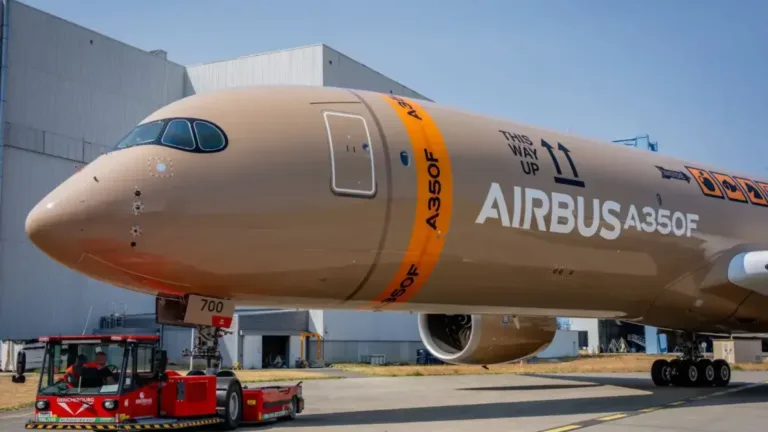
Boeing has dominated large freighters for decades through the 747, 767F and 777F. The A350F maiden flight on September 29 therefore represented a strategic return for Airbus to a market where its previous freighter efforts struggled.
MSN700 flew for 4 hours 10 minutes from Toulouse. Airbus is targeting entry into service in the second half of 2027 and says the programme has 115 orders from 14 disclosed customers.
The A350F offers up to 111 tonnes of payload and around 8,700 km of range. Airbus also highlights a 46-tonne lower maximum take-off weight than its direct competitor and claims up to 40% lower fuel burn and carbon emissions than current freighters with similar payload-range capability. Those efficiency figures are manufacturer claims rather than independent comparisons.
Its main cargo door is about 4.3 metres wide, a feature aimed at handling large pallets and outsize freight more efficiently. That detail matters because turnaround time and loading flexibility can affect freighter economics almost as much as headline range or payload.
777-8F: Boeing plays the capacity card
The 777-8F is built around a different proposition. Boeing lists a maximum structural payload of 118 tonnes, seven tonnes more than the A350F, and markets the aircraft as the highest-capacity twin-engine freighter.
It also benefits from the huge operating ecosystem created by the current 777F. Airlines already have crews, maintenance capability and ground infrastructure built around the type, which can reduce the cost and complexity of introducing a new-generation aircraft.
Ethiopian Airlines reinforced that advantage on September 30 by ordering eight 777-8Fs and two current-generation 777Fs. The carrier already links more than 70 cargo markets and becomes the first African customer for the 777-8F. MSC Air Cargo had already ordered five 777-8Fs in July, a symbolic move by a major maritime group into long-term air-freight capacity.
Airbus is betting on lighter structure, efficiency and A350 family commonality. Boeing is selling maximum payload, continuity with the 777F and a proven heavy-freighter operating model.
But aircraft economics depend on much more than headline payload. Route length, cargo density, fuel price, financing, utilisation and the ability to fill the aircraft in both directions can matter just as much.
A slightly smaller freighter can be more profitable if it flies full more consistently. A larger aircraft can be formidable on dense Asia-Europe, Gulf, North American and transpacific corridors where operators can reliably fill the extra capacity.
The replacement cycle may be as important as growth
A substantial part of the global freighter fleet is ageing. Older 747-400Fs, 767Fs and converted aircraft face higher maintenance bills, fuel consumption and environmental pressure.
Boeing forecasts demand for roughly 930 new dedicated freighters over the next 20 years, alongside about 2,000 passenger-to-freighter conversions. Boeing also says widebody freighters account for roughly 75% of global air-cargo capacity.
That replacement need helps explain why Airbus is willing to invest heavily in a market that is much smaller than passenger aviation: dedicated freighters are long-lived assets, major customers tend to operate fleets for decades and replacement decisions can lock in manufacturer relationships for years.
Modern air cargo is increasingly diverse: electronics, pharmaceuticals, fresh food, urgent industrial components, automotive parts, machinery and vast flows of e-commerce parcels.
Cross-border online retail has changed the economics of some long-haul cargo routes, while high-value technology products have increased the premium placed on speed and predictability. At the other end of the scale, dedicated freighters remain essential for heavy or oversized loads that cannot be accommodated in passenger aircraft lower decks.
Why passenger belly capacity is not enough
The recovery of passenger flying restored large amounts of lower-deck cargo space after the pandemic, but dedicated freighters remain essential.
They can operate at night, serve cargo-focused airports, carry dangerous goods and oversized freight, use main-deck pallets and follow logistics schedules rather than passenger timetables.
Roughly one third of world trade by value moves by air, and much of the heavy long-haul capacity is provided by dedicated freighters. That is why the return of passenger belly space did not remove the strategic case for aircraft such as the A350F and 777-8F.
Airbus has built a strong early backlog for the A350F, while Boeing retains a far deeper history in dedicated freighters and a broad installed customer base.
Delivery timing will matter. The A350F is aiming for service in 2027, while the 777-8F is due later. In cargo, availability can be as important as theoretical efficiency: a modern aircraft that arrives too late can lose business to a current 777F, a converted freighter or another available solution.
A wider shift in global logistics
The biggest change may be that cargo is no longer treated merely as a by-product of passenger flying. Dedicated cargo divisions, logistics groups and even maritime companies are building long-term air networks.
The A350F-versus-777-8F rivalry is therefore not just an aircraft contest. It is a fight over which manufacturers and operating models will underpin high-value global trade for the next two decades.
Airbus A350F completes maiden flight, testing begins
Ethiopian Cargo orders 10 Boeing 777 freighters to scale up
Sources
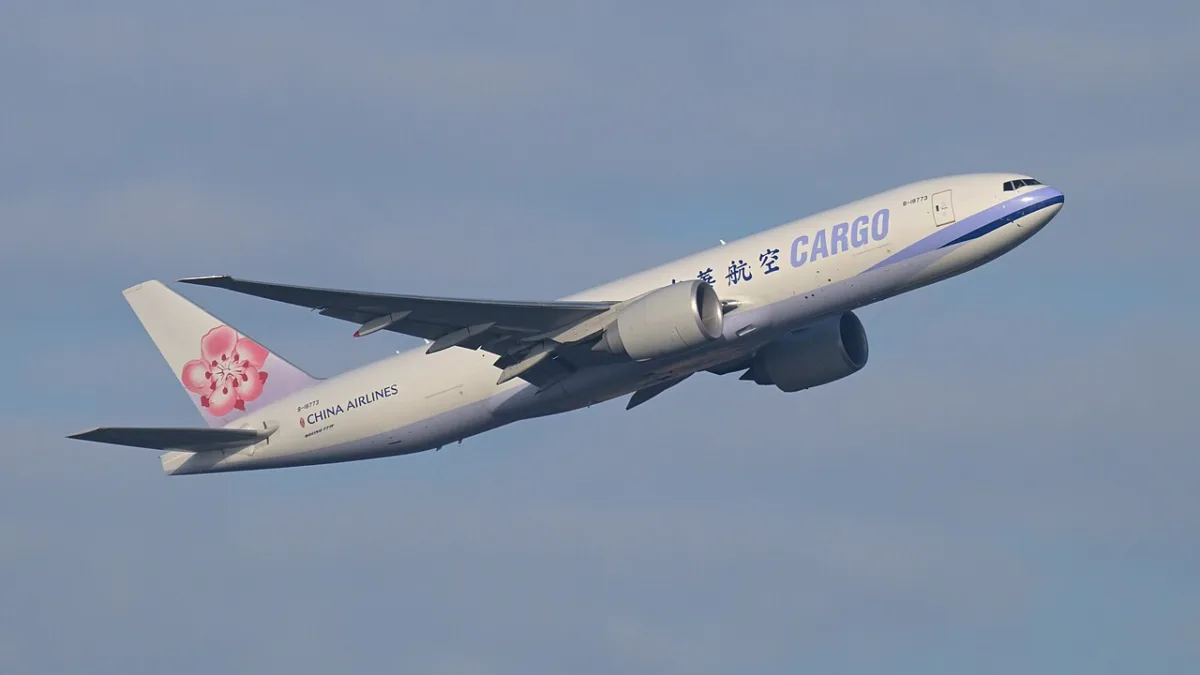
Photo: China Airlines Cargo Boeing 777F departing Taoyuan, February 2026. 4300streetcar / Wikimedia Commons, CC BY 4.0.